






What is Machi-Chuka?
Machi-chuka (町中華) are small old-fashioned neighborhood Chinese restaurants found in shopping streets and residential corners across Japan, often run by a single family, affordable, and full of nostalgia, with vinyl stools, faded menus, and the lingering smell of stir-fry. Chinese immigrants began opening modest eateries in Japan in the late 19th century, serving dishes that gradually adapted to local tastes. After World War II, these restaurants flourished by offering inexpensive, filling meals during lean times, and over time dishes such as gyoza, ramen, and fried rice became a staple of everyday cooking in Japan.

For decades, these restaurants had no formal name. The term machi-chuka only really caught on in the late 2010s. Driven by renewed nostalgia for Showa-era Chinese restaurants, two freelance writers, Toro Kitano and Maguro Shimoneki formed the Machi-Chuka Tankentai (町中華探検隊) and made it their mission to document as many places as possible before they were lost to time. “The group includes a diverse range of members, such as writers, photographers, manga artists, illustrators, editors, office workers, housewives, and cooking researchers”(source: Wikipedia). Their work helped bring machi-chuka into broader public awareness in books, travel guides, magazines, and television programs.
Machi-Chuka and Gachi-Chuka
The related term gachi-chuka(ガチ中華), used for restaurants that serve more authentic regional cuisine from mainland China, was nominated for Japan’s Annual Buzzword Award (Shingo Ryukogo Taisho) in 2022. The slang term gachi means “serious” or “the real deal” in casual Japanese. Chinese immigrants, particularly exchange students and more recent arrivals, drove the gachi-chūka trend by creating demand for unadapted flavors and opening restaurants catering to their communities. Japanese media has frequently used the terms machi-chūka and gachi-chūka to to depict two distinct styles of Chinese food found in Japan.

Machi Chuka in Osaka
Osaka has a fairly large number of machi-chūka restaurants, each with their own take on the classics. This is a guide to 10 of the “best” that I’ve visited over the years, though there is really no objective way to rank them, since most people’s favorite will be the one they grew up with closest to home. I’ve included an order of gyoza from each restaurant to show how different places tackle the same dish, but chose not to write about them (with one exception) in order to highlight other menu items.

Table of Contents
Heiwaro (Umeda)平和樓
[Map] 9-26 Kakudacho Kita Ward, Osaka 530-0017. Tel: 06-6311-4704. Open:11:30-14:30; 18:00-21:45. Closed: Mon. Lunch:¥1,000. Dinner: ¥1,000-¥2,000. Seating: 50. Credit Cards Accepted. Umeda (Osaka Metro Midosuji Line, 1 min. walk).

Heiwaro is a famous Chinese restaurant located in the Shin-Umeda Shokudogai, one of Osaka’s most famous post war dining alleys. The restaurant has been run by the same family for generations and dates back to around 1950, the same time the food alley was established after WWII.
The interior features hanging lanterns, walls lined with calligraphy, and posters advertising beer and chu-hai. Round tables with a lazy Susan seat individual diners during the lunch rush, creating a sense of community among strangers who share a table without ever speaking.

Tenshinhan at Heiwaro
Even though it is named after the city of Tianjin in China, tenshinhan was invented in Japan in the early 20th century at a Chinese restaurant in either Tokyo or Osaka (it is still unclear to this day). Tenshinhan is a soft, almost custardy omelet with small bits of crab mixed in, covered ankake, a glossy sauce thickened with potato starch that coats ingredients, giving machi-chuka dishes their rich, cohesive texture. At Heiwaro, the seasoning is light, with a balanced flavor that is typical of Osaka-style cooking, neither too sweet nor too sour. The sauce fully coats and blends with the eggs and rice, and at first glance it looks almost too perfect, as if they brought out the plastic food model from the display case by mistake.

Harumaki (春巻き) at Heiwaro
I was elated to see these thick, crunchy harumaki spring rolls on the menu at Heiwaro. Rather than the usual wheat wrapper, they are made with an egg based wrapper and filled with pork, harusame glass noodles, carrot, shiitake, and green pepper, giving them a crispy texture with a soft, melty interior. Outstanding, maybe the best harumaki I’ve ever had in Osaka.

Gyoza: Double order at Heiwaro

Kōbaiken (Hommachi) 中華料理 幸梅軒
[Map] Senba Center Building No. 10, B1F, Sembachuo 4-1, Chuo Ward, Osaka 541-0055. Tel: 06-6244-0597. Open: Mon-Fri 11:00-21:30; Sat 11:00-15:00. Closed: Sun. Lunch: ¥~999. Dinner: ¥1,000-¥1,999. Seating: 38. Credit Cards Not Accepted. Hommachi (Osaka Metro Chuo/Midosuji/Yotsubashi lines

Kōbaiken, founded in 1976, is located in the Senba Center Building, a massive multi-block commercial complex composed of 10 interconnected buildings between Hommachi and Umeda. Hommachi has a high concentration of office buildings and this restaurant is a popular destination for a quick, filling, inexpensive lunch. The portions served up here a much larger than most Chinese restaurants.
Sara Udon (皿うどん) at Kobaiken
Sara udon, which means “plate noodles,” originated at a Chinese restaurant in Nagasaki in 1899. Despite its name, this dish is not made with thick udon noodles but instead with crispy fried noodles called barimen. At Kōbaiken, the sara udon arrives in a generous portion, with cabbage, snow peas, onions, chives, moyashi bean sprouts, carrots, and wood ear mushrooms, along with pork, shrimp, squid, and slices of kamaboko fish cake, all coated with a thick ankake sauce. Over time, the sauce slowly softens the crisp noodles underneath.

Mapodofu (麻婆豆腐) at Kobaiken
Machi-chuka tends to tone down fermented pastes, Sichuan pepper, and the stronger aromatics common in many Chinese cuisines, so the seasoning is simpler overall. In Japanese machi-chuka-style mapodofu, the sauce is usually built around soy sauce and doubanjiang (fermented chili paste), with garlic, ginger, and scallion, plus a light dashi-style base often enhanced with shiitake for umami. These days most restaurants add miso for flavor. Regulars at Kobaiken often add Worcestershire sauce or vinegar and hot mustard (karashi) halfway through to change the flavor profile, which is common at many machi-chuka restaurants.

Chinese Style Katsudon 中華風カツ丼 at Kobaiken
The standout dish at Kobaiken is chūka-fū katsudon (中華風カツ丼), a Chinese-style katsudon that differs from the standard Japanese menu item. It contains deep-fried breaded pork cutlets on a bowl of rice covered with hot, thick ankake sauce swirled with beaten eggs (similar to tenshinhan). Rather than common loin cuts, they use bite-sized tenderloin cutlets. The lean tender meat pairs perfectly with the rich sauce. I recommend going to Kobaiken with a friend so you can share these humongous-sized dishes.

Gyoza: Double order at Kobaiken

Hong Kong (Shinsekai) 中華料理 香港
[Map] 1-19-12 Ebisuhigashi, Naniwa Ward, Osaka. Tel: 06-6631-6327. Open: Mon-Sat 17:00-23:45. Closed: Sun & 3rd Mon. Dinner: ¥1,000-¥1,999. Seating: 10. Credit Cards Not Accepted. Nearest Stations: Ebisucho (Osaka Metro Sakaisuji Line, 5 min. walk); Shin-Imamiya (JR, 7 min. walk).

Hong Kong is a narrow counter-only restaurant with about 10 seats in Shinsekai that is located only 60 meters away from Tsutenkaku Tower. From the name, you might assume the owners are from Hong Kong, but this is not the case. The restaurant was opened in 1969 by the father of the current owner who moved to Osaka from Kagawa Prefecture in Shikoku. The name “Hong Kong” (香港) was created by combing the first kanji in Kagawa (香) with the kanji for port (港). The restaurant is conveniently located next to The Pax, a guest house popular with tourists.
Stir-fried Liver and Nira Garlic Chives (レバニラ炒め) at Hong Kong
I decided to step out of my comfort zone and order a dish I’ve never had before: nira-reba, stir fried liver and nira (garlic chives). This dish became popular in Japan in the 1960s because it was high in iron and inexpensive. At old joints like this one it is common to order the dish as “reba-nira,” which is widely attributed tio the classic 1967 manga and anime Tensai Bakabon. The main character’s father loved the dish but repeatedly called it “reba-nira.” I was not expecting this dish to pack such a powerful punch. Consider me a convert.

Age-Nikudango Fried Meatballs (揚げ肉団子) at Hong Kong
Unlike the more common Nikudango no Subuta (sweat and sour meatballs), the age-nikudango here are served in a “dry” fried style that highlights the texture of the meat. The crunchy exterior and juicy interior is a major appeal with regular customers. They are typically served with a side of salt and pepper or karashi (spicy mustard). There is nothing like this dish and a cold beer.

Crab Omelet Fried Rice (かに玉炒飯) at Hong Kong
Kani tama chahan translates as “crab omelet fried rice.” The standard version features an omelet placed on fried rice and covered with ankake sauce. When my dish arrived, it looked like ordinary fried rice Where was the omelet? At Hong Kong the egg mxtured is stir-fried directly into the rice, giving them a fluffy moist texture. It’s seasoned with an old-school salt-based seasoning that allows the the flavor of crab, coarsely chopped onions, soft scrambled eggs to shine through. I was not expecting this simple dish to be this good.

Tonkara Pork Karaage (豚唐揚げ) at Hong Kong
I had to make a special return trip to Chinese Restaurant Hong Kong to try their most popular menu item: Ton-kara fried pork. When most people hear “karaage” they think of fried chicken. The name actually refers to a specific cooking technique, marinating meat or vegetables and then with potato starch before deep frying. It has a lighter, crunchier texture than tonkatsu, which uses a thick panko breadcrumb coating to create a heavier crust. Believe the hype, one bite of the crispy juicy pork here and you’re hooked for life.

Gyoza: Single Order at Hong Kong

Sakaichi (Tennoji / Abenobashi) さか市
[Map] 2-3-33 Matsuzakicho, Abeno Ward, Osaka. Tel: 06-6621-5262. Open: Tue-Sat 11:30-14:00; 17:00-20:00. Closed: Sun & Mon. Lunch: ¥~999. Dinner: ¥1,000-¥1,999. Seating: 20. Credit Cards: Not accepted. Osaka-Abenobashi (Kintetsu Minami-Osaka Line) / Abeno (Osaka Metro Midosuji Line), both approx. 3 min. walk.

Sakaichi, a 50-year-old restaurant located near Tennoji and Abenobashi Stations, is the type of place lovably referred to as a “dive,” “greasy spoon,” or “hole-in-the-wall.” It’s not going to win any awards for cleanliness or earn a Michelin star, but this small restaurant is packed with loyal regulars who understand that great food does not necessarily require a scrubbed and polished decor. When I entered the restaurant one evening, it was like sitting down at a casual dinner party, everyone inside seemed to know the owner, and they were engaged in animated conversations without giving the slightest thought to dining etiquette. I fell in love with this old joint immediately.
A Seat at the Counter
The only seat available was at the counter, directly in front of the owner, which proved to be both a blessing and a curse. I had the best seat in the house, a bird’s-eye view of all the dishes being prepared. The major downside was that several dishes were placed on the counter just inches away from me: two huge servings of yakisoba and a large mound of fried rice. I had already ordered two completely different dishes and it was too late to change my order. I kid you not, the aroma from those dishes stayed with me for the next two weeks, until I made a special trip back to Sakaichi just to try them.
Yakisoba (焼きそば ) at Sakaichi
The “regular” sized portion of yakisoba (seen in the photo below) is enough for two people, so regulars often order the “half-size,” which is also surprisingly large. The seasoning is often described as “junk style” (ジャンクな味 – janku-na aji), not a pejorative term but a positive slang expression for the kind of delicious comfort food with a bold flavor that is unashamedly greasy and filling.

Yakimeshi ( 焼き飯) at Sakaichi
The yakimeshi fried rice can also be ordered as a “half size.” The nice thing about this dish is that it is neither oily nor overly dry. The texture is often described as “moist-yet-fluffy” (shittori-parapara), and it is traditionally served with a clear, golden chicken broth soup that is highly praised for its depth and natural sweetness. The orders for this dish kept coming and coming in the short time I was there.

Subuta (酢豚) at Sakaichi
Subuta is a Japanese-style Chinese dish consisting of deep-fried pieces of pork and sautéed vegetables tossed in a thick, glossy sweet and sour sauce. The subuta at Sakaichi contains rather large chunks of onion, green bell pepper (piman), carrot, bamboo shoots (takenoko), and wood ear mushrooms (kikurage). As I watched the owner cut the fresh vegetables, I started to wonder whether there would be enough time to properly cook them, but I was wrong to doubt a professional, even for a moment. Another remarkable take on a classic dish.

Gyoza: Single Order at Sakaichi

Gyozaya (Nishinari) ぎょうざや
[Map] 3-7-21 Tsurumibashi, Nishinari Ward, Osaka. Tel: 06-6561-8576. Open: Wed–Sun 11:00–14:30; 16:00–20:00. Closed: Mon & Tue. Lunch: ¥1,000–¥1,999. Dinner: ¥1,000–¥1,999. Seating: 40.Credit Cards Not Accepted. Instagram. Nearest Station: Tsumori (Nankai Shiomibashi Line, 8 min. walk)

Have you ever been to a restaurant where a couple of items on the menu are so good you never order anything else? Gyozaya has been a staple in the same neighborhood for over 50 years. Situated in Nishinari Ward’s Tsurumibashi Shopping Arcade near Tsurumi Station, it has been featured on TV shows, in magazines, and consistently makes food critics and bloggers best-of lists. It’s best known for its exceptional gyoza. The small staff of four makes 800 hand-crafted pieces a day, and there are seven different types to choose from.
Meet the Owner of Gyozaya: Masaki Tanimura
Masaki Tanimura, the second-generation owner, is a warm, welcoming figure who greets his customers like old friends. His parents opened the shop in 1972, but Masaki had to take over the family business at just 15 after his father’s sudden passing. It took him some time to master the menu, which now boasts over 70 items. Following in his father’s footsteps, Masaki created five innovative gyoza flavors that helped elevate the restaurant’s reputation.

Standout Stars at Gyozaya
The Sudachi (citrus), Nira ( garlic chive), and Ninjin (carrot) gyoza are the standout stars among their famous “7 Varieties of Gyoza.”
Their signature gyoza is the sudachi. Each pan-fried gyoza is topped with a thin slice of fresh sudachi citrus. I thought you were supposed to squeeze the sudachi slices onto the gyoza for extra flavor, they are actually eaten with each piece of gyoza. This means you have to be pretty skillful with your chopsticks! Owner Masaki Tanimura recommends eating them with rock salt rather than traditional soy sauce. The refreshing acidity of the citrus cuts through the juicy meat filling, making them incredibly light and addictive.
The Ninjin Gyoza is so packed with carrots that the skin glows with a soft orange hue. The Ninjin Gyoza is known for its natural sweetness, and its often said that even children who hate carrots enjoy these because the “earthy” smell is gone. Locals often eat these with olive oil and salt to highlight the carrot’s sweetness.
The final member of the “Big Three” is the Nira Gyoza. These are perfect for gyoza fans who love punchy aromics. These green-tinted gyoza have a wonderful crunchy texture and a bold garlic-chive aroma that pairs perfectly with cold beer or white rice.
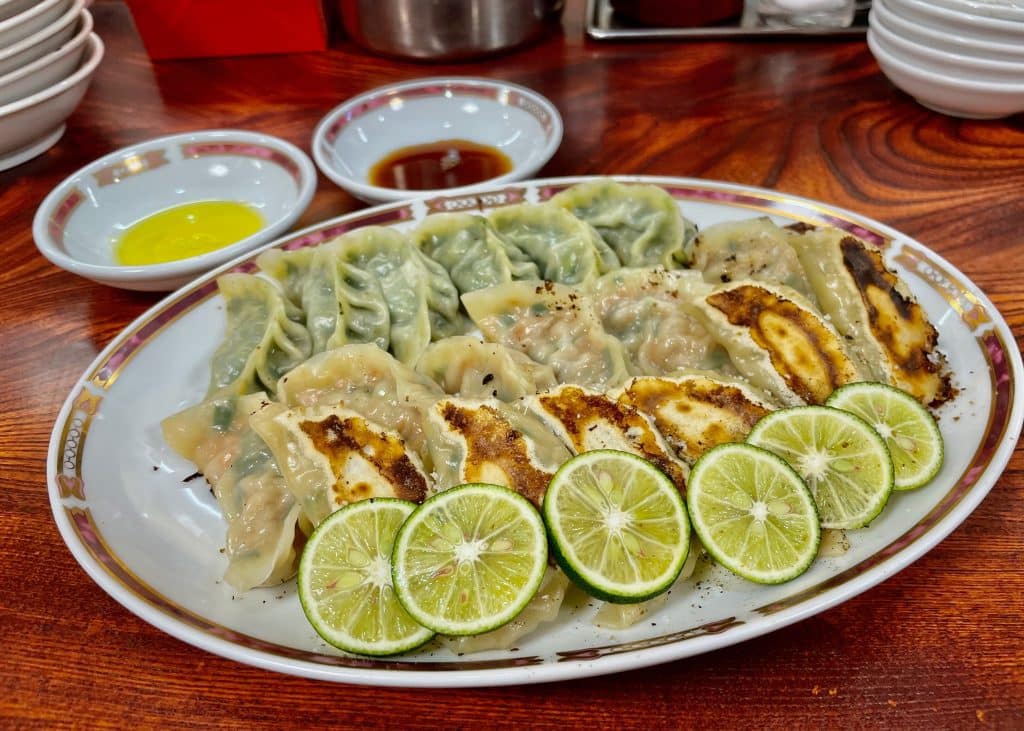
The four other types of gyoza are Aojiso Gyoza (青じそ餃子): Filled with green perilla (shiso), offering a refreshing herbal aroma, Yaki Gyoza (焼ぎょうざ), the classic pan-fried pork and cabbage gyoza, Sui Gyoza (水ぎょうざ), boiled dumplings served in broth or with a dipping sauce known for their chewy texture, and Age Gyoza (揚ぎょうざ), deep-fried until crispy and golden brown.
The Karaage Fried Chicken (唐揚げ) at Gyozaya
I’ve had karaage all over Osaka, but not like this. At Gyozaya the fried chicken is massive. They use large, bone-in chunks of chicken fried to a golden brown. It has a solid soy-sauce based marinade. The batter is crunchy and fragrant while the meat inside remains juicy. I enjoy bringing friends to Gyozaya just to see them react to the fried chicken.
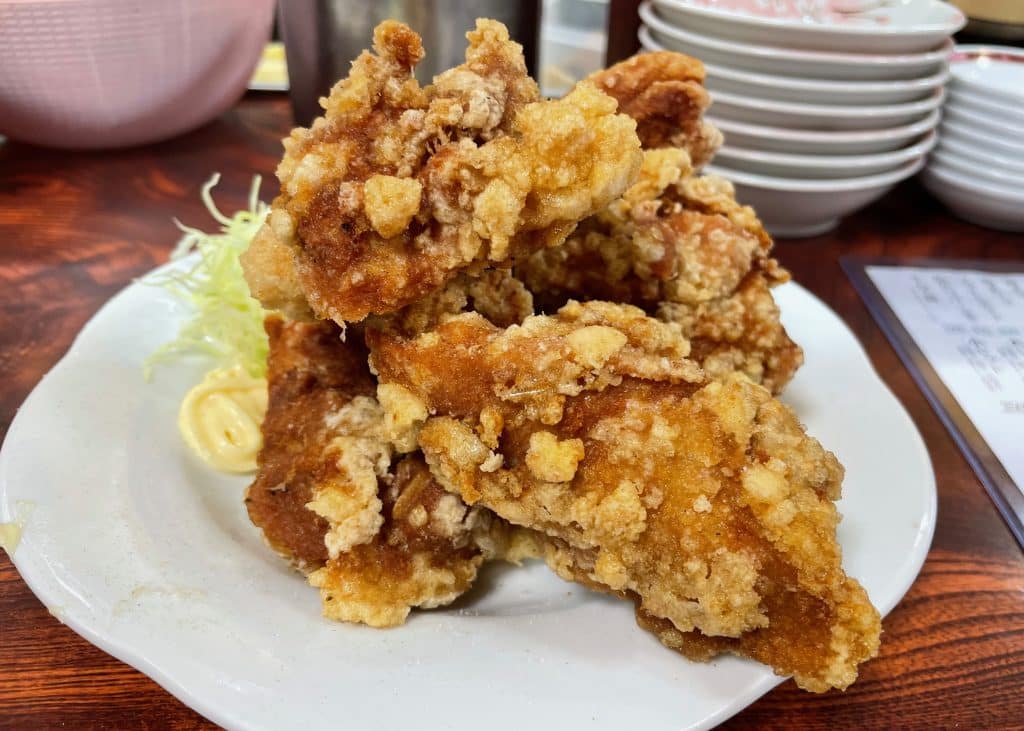
One of the best things about going to Gyozaya with a group is that you can order karaage by the piece (個数指定). Need 25, not a problem! Just be aware that the fried chicken is made from scratch, so a large order might take a bit of time, but totally worth it. Gyozaya is the one restaurant everyone always asks, “When are we going again?” One of these days, we’ll have to branch out and try some of the other items on the menu.

Horaitei (Imazato) 中華料理 宝来亭
[Map] 3-17-11 Oimazatonishi, Higashinari Ward, Osaka. Tel: 06-6972-7039. Open: Mon–Wed, Sat & Sun 11:00–14:00; 17:00–21:00. Closed: Thu & Fri. Lunch: ¥1,000–¥1,999. Dinner: ¥2,000–¥2,999. Seating: 15. Credit Cards Not Accepted. Nearest Station: Imazato (Osaka Metro Sennichimae Line, 5 min. walk).

Horaitei is a 5-minute walk from Osaka Metro Imazato Station in Higashinari Ward. One of the reasons I enjoy going to machi-chuka is that I get to explore neighborhoods that I would not normally visit. It’s nice to walk around after a big meal. You can often find a local shopping arcade nearby or duck into a classic kissaten coffee shop.
Imazato Soba (今里そば) at Horaitei
Horaitei is known for a famous local dish called Imazato yakisoba. The dish was born around 1949 in the Imazato Shinbashi shopping district. It was a popular, filling meal for many factory workers. Unlike typical yakisoba where the noodles are stir-fried with the sauce, Imazato yakisoba is often served plain or lightly seasoned after being steamed and pan-fried. Beef and onions are the only other ingredients, but somehow it all comes together to create a simple but extremely tasty meal.

Takaida Ramen (高井田ラーメン) at Horaitei
Takaida-kei ramen is widely considered to be the only local style of ramen native to Osaka. It was developed as “morning ramen” to serve workers on overnight or early shifts in post-war industrial areas spanning Higashinari Ward and Higashi Osaka City. The broth is an almost black soup made from chicken and kombu (kelp) seasoned with tamari or dark soy sauce. The signature feature is the chewy straight noodles, which are surprisingly filling. The toppings are minimal: lean pork, slices of menma bamboo shoots, and green onions.

Shumai (シュウマイ) at Horaite
Shumai in Osaka often features a higher percentage of onions in the pork filling, which creates a sweeter and juicier flavor profile compared to other regions. I originally planned to include Osaka’s most famous shumai restaurant, Ippotei, in this article, but the lines outside are too long these days. The shumai at Horaitei is just as good and no wait.

Gyoza: Single Order at Horaitei

Homuran (Oimazato) 中華料理 宝夢蘭
[Map]1-6-3 Oimazato, Higashinari Ward, Osaka. Tel: 06-6974-8089. Open: Mon-Wed, Fri-Sat & Hols 11:00-14:00; 17:00-21:30. Closed: Thu & Sun. Lunch: ¥~999. Dinner: ¥~999. Seating: 15. Credit Cards: N/A. Nearest Stations: Imazato (Osaka Metro Sennichimae Line, 9 min. walk); Midoribashi (Osaka Metro Chuo Line, 9 min. walk).

I’ve decided to include another restaurant from Higashinari Ward, an underappreciated area of Osaka that could use the love. The name “Homuran” (宝夢蘭), which comes from “homerun,” was chosen by the founder (the current owner’s father) who was a massive baseball fan. I have to admit that this clever play on words was a big reason I decided to visit. Homuran is known for their delicious fried rice, but I opted for other items.
Kata Yakisoba かた焼きそば at Homuran
At first glance, kata yakisoba seems almost identical to sara udon, but there are some key differences. The deep-fried noodles are notably thicker in kata yakisoba. The topping is essentially happosai (八宝菜), a classic Chinese stir-fry that literally translates to “eight-treasure vegetables” and usually features pork, shrimp, and quail eggs. While the version here skips the quail eggs, it makes up for it with a massive volume of pork and vegetables. The ankake sauce is made intentionally thick so that the noodles stay crunchier longer.

Reimen (冷麺) at Homuran
While most of Japan uses the term hiyashi chuka for this summer dish of chilled ramen noodles, ham, shrimp, julienned cucumbers, tomato wedges, moyashi bean sprouts and delicately sliced omelet called kinshi tamago, the Kansai region refers to it simply as reimen, meaning “cold noodles.” In Osaka, there is a strong affinity for the goma-dare sesame based sauce over the more common soy based sauce. This dish takes a bit more time to prepare because the noodles must be boiled and then immediately shocked in ice water to achieve the proper firm elastic bite.

Gyoza: Single order at Homuran

Pekin Ryori Koyotei (Suminoekoen) 北京料理 紅葉亭
[Map] 2-1-8 Midorigi, Suminoe Ward, Osaka. Tel: 06-6681-5970. Open: Daily 11:00-14:00; 17:00-20:30. Closed: Wed, Sun & public holidays (confirm). Lunch: ¥~999. Dinner: ¥1,000-¥1,999. Seating: 20. Credit Cards Not Accepted. Nearest Station: Suminoekoen (Osaka Metro Yotsubashi Line, 10 min. walk).

Peking Ryori Koyotei has been in the same neighborhood for over half a century. It’s a 10-minute walk from Osaka Metro Suminoekoen Station on the Yotsubashi Line. I didn’t list prices in this article, since they are constantly rising in this age of inflation, but it is safe to say that you can eat at most of the restaurants listed for ¥1,000-¥2,000. Koyotei, however, may be the cheapest of them all.
¥600 Chashu Ramen (チャーシューメン) at Koyotei
The chashu ramen at Pekin Ryori Koyotei has been described as a shocking value for the money. It contains 6 thick slices of meaty chashu pork (char siu in Chinese) that are melty and tender. The slightly wavy medium-thin noodles pair well with the simple shoyu broth. Some regulars here order a side of rice for ¥230 and add a bit of kimchi to create a DIY “chashu-don” rice bowl. It is unbelievable that you can still get quality like this in 2026 for only USD $3.77! For an extra ¥150 you can order the miso version, which is even more popular.

Curry Fried Rice (カレー焼きやきめし) at Koyotei
In Osaka, traditional Chinese restaurants often serve as neighborhood shokudo (cafeterias) that adapt to local tastes. Osaka also has a greater variety of curry dishes than any other region in Japan, so it’s only natural that small restaurants like this one have curry fried rice on the menu. In the high-heat environment of a Chinese wok, curry powder undergoes blooming, a process where fat-soluble flavor compounds in the spices are released into the oil. This creates a mouthwatering aroma that coats each individual grain of rice, making the dish more fragrant than standard versions.

Gyoza: Single order of Boiled Dumplings at Koyotei

Pekin Hanten (Noda) 北京飯店
[Map] 1-2-9 Ohiraki, Fukushima Ward, Osaka. Tel: 06-6461-3505. Open: Tue–Sun 11:30–23:40. Closed: Mon. Lunch: ¥~999. Dinner: ¥1,000–¥1,999. Seating: 52. Credit Cards Not Accepted. Nearest Stations: Nodahanshin (Osaka Metro Sennichimae Line, 2 min. walk); Noda (Hanshin Line, 3 min. walk).

Pekin Hanten is located in Noda-Hanshin Shinbashi-dori (野田阪神新橋通), a shopping area near Noda Station on the Hanshin Line. The area is known as the “Birthplace of Konosuke Matsushita’s Business.” This is because the founder of Panasonic started his first workshop very close to this location.
Chicken Rice (チキンライス) at Peking Hanten
Pekin Hanten is known locally for the huge size of certain menu items, such as their “Chicken Rice,” which has gone viral on social media. (The “large” is 660 grams!). This should not be confused with the Malaysian dish of the same name; the chicken rice here is basically the same thing as omurice. As mentioned earlier, machi-chuka restaurants often serve a dual purpose as shokudo (cafeterias) so a dish like this one is something that can be whipped up very quickly. When preparing omurice, Chinese restaurants tend to use a bit of lard or scallion oil instead of butter, giving it a heavier, more savory punch. Because it’s cooked in a wok over a high pressure burner, the rice gets a slight char and a smoky aroma. You might even catch a hint of the base seasoning they use for their regular fried rice.

Ebi Chili (エビチリ) at Pekin Hanten
Ebi Chili was invented by Chen Kenmin at his restaurant, Shisen Hanten, in Tokyo in 1957. It was a Japanese adaptation of the Sichuan dish gān shāo xiā rén. Unable to import doubanjiang at the time, he replicated its flavor using Japanese ingredients and added ketchup to provide sweetness and mellow the heat. His son, Chen Kenichi, later refined the recipe by reintroducing doubanjiang, which has since become standard in the dish. Pekin Hanten serves their ebi chili with a sprig of parsley and tomato wedges. Their version is hard to top.

Gyoza: Triple Order at Pekin Hanten

Ten Ten Saikan (Chidoribashi) 天天菜館
[Map] 3-28-11 Umeka, Konohana Ward, Osaka. Tel: 06-6463-9614. Open: Mon-Sat 11:00-15:00; 17:00-22:00. Sun & Hols 17:00-22:00. No fixed closing day. Lunch: ¥~999. Dinner: ¥1,000-¥1,999. Seating: 30. Credit Cards Accepted. Nearest Station: Chidoribashi (Hanshin Namba Line, 3 min. walk).

Ten Ten Saikan is the place to start if you would like to have the option of ordering most of the dishes featured in this article in one place. The restaurant, which opened in 1972, features over 100 items on the menu. Since the restaurant gets many foreign customers from nearby Universal Studios Japan, they employ several English-speaking staff. The owner’s son, who runs Kokuryu Tenjinro in Temma, uses his strong ties to Nepal to recruit and train staff in traditional machi-chuka techniques. These skilled workers then work at Ten Ten Saikan alongside the elderly owners to help preserve its 50-year-old legacy.
Yakisoba, Karaage, Subuta, Gyoza and Mapo Sundubu Jjigae at Ten Ten Saikan
The photo below shows what two friends and I ordered at Ten Ten Saikan. We started off with an order of yakisoba, which is topped with an egg and oyster sauce. The owner told me this dish contains elements of the kind of yakisoba you find in shitamachi (downtown) restaurants. The gyoza, karaage, and subuta (sweat and sour pork) were prepared at the highest level, without being oily or overly starchy. Don’t get me wrong, I love that “cheap” taste, but sometime you want something with more nuanced flavors and texture.
The standout item was a fusion dish called “Mapo Sundubu Jigae” (麻婆スンドゥブチゲ), an original creation that combines Chinese Mapo Tofu with Korean Soon-Jigae. It blends the numbing spice of the Sichuan peppercorns and chili oil from the Mapo Tofu with the deep, savory broth of the Korean stew. Having really enjoyed machi-chuka style mapodofu over the years, I was completely unprepared for the spice kick of this dish, although the owner did warn me to have a glass of water on hand.

Fluffy Ankake Crab Fried Rice at Ten Ten Sakan フワフワあんかけ カニチャーハン
One of the most popular dishes at Ten Ten Kaikan is the Fluffy Ankake Crab Fried Rice (Fuwafuwa ankake kani chahan). The rice is topped with a generous amount of pure-white, meringue-like gravy made from egg whites called awayuki-an (淡雪あん). I actually planned to order this dish at another restaurant, but it closed last year. It took me a while to find it on the menu again. The contrast between the fried rice and cloud like texture of the gravy is out-of-this world and keeps you hooked until the last bite.

I couldn’t help but notice that my server, a young man in his early 20s from Nepal, was writing everything down by hand in Japanese instead of using a tablet, which is the norm these days. It takes a lot of work to be able to explain the entire menu and its many variations, so I was really impressed. I asked him if he could write difficult kanji like 醤油 (soy sauce) and he modestly replied that he could. As I was paying I told the owner to give him a raise because the service was excellent. The owner told me the young man is currently studying to become a doctor at a local university. Before I left, I shook his hand and wished him the best of luck.