







The opening shot of the animated Jarinko Chie (Chie the Brat) clearly states that this is absolutely an Osaka movie: it features a nightly panorama of southern Osaka with Tsutenkaku Tower in the center.

The movie zooms into the streets of the city and to a character named Tetsu, just being in the process of making up a wild story to convince his elderly father to lend him some money. The old man gives in and hands Tetsu the cash. Tetsu goes straight to a gambling parlor and promptly loses the money to the parlor’s proprietor, a shady character named Shacho who runs a small outfit of tough guys.

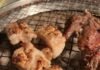
Meanwhile, Tetsu’s daughter Chie, about ten years old, runs the izakaya bar / horumon-yaki eatery belonging to her father all by her herself. Horumon-yaki translates to fried offal, served by Chie freshly fried on skewers, kushi-yaki style. Cheap food commonly found in the Shinsekai area of south Osaka.

That night, a hungry tomcat shows up in front of the bar / eatery and Chie throws him one of the meat skewers. Momets later, she invites the cat in, offering a place to stay and naming it Kotetsu.
So, there we are in south-central Osaka, in the larger vicinity of Shinsekai, in circa 1967. The area is dominated by small family-run businesses, many of them bars / eateries, there are a lot of crooks and toughs around but also lots of honest, hard-working people.
That same night, Chie crosses out the face of her father on the family picture on her bedside table, the next morning she erases Tetsu’s name from the bar’s exterior, adding her own. Now, she’s in charge!


She bravely takes care of the business, meticulously counting the proceeds before hiding them from her father.
What she really longs for, though, is that her parents get together again. Yoshie, her beautiful, gentle mother had recently fled the house and separated from Tetsu due to his impulsive, self-defeating behavior.
Tetsu proves his utter foolishness when visiting Chie’s school on Parents’ Day. On that day, parents are allowed to quietly observe their children taking classes. Tetsu however causes a big commotion, terribly embarrassing Chie and making himself the laughingstock of the neighborhood.

Chie meets up with her mother, still hoping that she and Tetsu can reconcile. They have a typical Osaka day out: a stroll in the park, a meal in a small eatery, they watch Son of Godzilla in a movie theater and eventually say sayonara to each other at Dotonbori.
Yoshie, Chie’s mother would love to return to the family but first Tetsu would have to change his ways.
Surprisingly, it’s Shacho, the gambling parlor proprietor who suddenly changes his ways. Shacho roughly translates to “boss”. The title usually denotes the owner of a business but is also frequently used by bar hostesses when addressing a male customer.

Basically overnight, Shacho changed his shady gambling house into a respectable okonomiyaki eatery – Japanese pancakes, a typical Osaka dish. He still has his goons around him but they too seem to be much less threatening now.
To top it off, Shacho hires Tetsu as his security guard, providing him with a stable job while Chie continues to run the horumon-yaki bar.
Will Tetsu use the chance and eventually be able to reunite with Yoshie?
Table of Contents
Jarinko Chie (Japan, 1981) じゃりン子チエ
Jarinko Chie, released in the English-language markets as Chie the Brat, is for the most part the story of a very resilient, tough and still loving young daughter but it is also a somewhat nostalgic social commentary.
It’s a great comedy at the same time. Not only are most characters presented in quite a humoristic way, there is also the parallel story of the cats playing out, giving the film quite an absurdist angle.
Chie had taken in Kotetsu, the tomcat with the crescent on its forehead. On the other hand, Shacho was in love with Antonio, his super-aggressive tomcat who he takes wherever he goes.
When confronting Tetsu early in the movie over money owed, it’s not Tetsu and Shacho who fight it out. It’s the cats taking are of the business.
Surprisingly, it’s the peaceful-looking Kotetsu who rips aggressive Antonio apart. Antonio loses a testicle in the fight… a fact which will spark many jokes and weird story developments down the line especially once Antonio’s equally aggressive son shows up and demands revenge.

There is a happy end after all but let’s just say that Osaka humor can be really weird at times and that that strange Osaka humor plays out here in full.
Pop Culture References
The films plumbs not only the depths of Osaka working class culture and the related Osaka humor, the film is also full of pop-cultural references.

The most obvious of them is Son of Godzilla (1967). Chie and her mother watch the film in a theater, Chie loves the movie. Short scenes of live action suitmation Son of Godzilla are edited into the animated Jarinko Chie as they are – they have not been turned into animated drawings.
Assuming that Chie and Yoshie watch the Godzilla movie on its first run would mark 1967 as the year the Jarinko Chie story takes place in.
Such assumptions can be misleading, of course. On Dotonbori, Chie can be seen running below a giant poster of Gone with the Wind (1939). That film was first released in Japan in 1952, a long time before the events unfolding in Jarinko Chie.

Another quite obvious though very brief reference is the salesman peddling his wares on a street corner, holding a lecturing speech to the onlookers. A salesman in checkered jacket wearing a Western style hat.
That’s of course meant to be Tora-san of the long-running and hugely popular Otoko wa Tsurai yo (It’s Tough being a Man) film series, consisting of 48 installments, released between 1969 and 1995.
These are just a few obvious examples. Keep your eyes open when watching Jarinko Chie and you will discover much more, depending of course on your knowledge of Japanese pop culture history.
The Manga
Jarinko Chie, the movie is based on the manga series of the same title, written and drawn by Etsumi Hariku and running from 1978 to 1997. In all 67 volumes of the manga were published.
Etsumi Hariku is the pen name of the artist, his real name is unknown to the public. What is known is that he was born in Osaka’s Nishinari Ward in 1947 and that he spent his childhood there – in exactly the area where also Jarinko Chie is taking place. From junior high school on, he lived in Sumiyoshi Ward, even further down south in Osaka.
Hariku describes himself as a slacker who was never interested in regular work. He did a variety of odd jobs in his youth to support himself while being a painter, creating large canvasses he had no place to store. Reportedly, after they were exhibited, he would not bother to pick them up again.
At about age 30, Hariku decided to scale down the size of his works, eventually opting for the manga format. Jarinko Chie was his breakthrough and it is still his most famous work.
Jarinko Chie is a work based on Hariku’s own youth in Nishinari Ward, on the characters and situations that surrounded him when growing up.
Hariku never entered the world of commercial manga studios. He preferred to draw his manga all by himself at home, occasionally helped by his wife. Only after she gave birth to their son at about the same time that his Jarinko Chie manga became a national sensation, he started to hire assistants to support him with the ever increasing workload.
Those assistants included Atsuji Yamamoto, later known for his Ultimate Teacher manga series and Takashi Iwashige, later known for his judo manga series Hanamaru Legend.
The Director: Isao Takahata
While Etsumi Hariku always worked outside the system, the director of the movie Jarinko Chie, Isao Takahata (1935 – 2018) was one of the great masters within the Japanese animation studio system.
Born in Mie Prefecture in western Japan, Takahata studied French literature at the University of Tokyo, graduating in 1959. Those studies left him with a taste for Western story-telling and a life-changing experience: once he had watched the early version of the French animation film Le Roi et l’Oiseau(The King and the Mockingbird), released without the consent of director Paul Grimault in 1952, Takahata knew that animation was the field he wanted to work in.
He joined Toei Animation and soon became friends with another aspiring animation director working there: Hayao Miyazaki.
Takahata worked his way up at Toei Animation, directed there his first animated feature in 1968 but along with Miyazaki, eventually left the studio.
Takahata and Miyazaki continued to closely work together, jointly creating the TV series Heidi – Girl of the Alps (1974) which became a smashing successs and their breakthough film.
Takahata had another great success with the TV series Anne of Green Gables (1979) on which Miyazaki also worked.

In 1981, Takahata’s movie version of Jarinko Chie premiered, immediately leading to a TV spin-off. Takahata himself directed that first Jarinko Chie TV series, 64 episodes (plus one bonus episode) running from 1981 to 1983.
In 1985, Miyazaki, Takahata and a number of other animation directors founded Studio Ghibli, the greatest of all Japanese animation studios.
At Studio Ghibli, Takahata directed his final film The Tale of the Princess Kaguya (2013), winning an Academy Award for Best Animated Feature in 2015.
Takahata passed away in 2018.
The Voice Actors
Chie’s voice was done by actress / politician Chinatsu Nakayama (born in 1948) who started out as child actress, then hosted a number of TV shows and eventually became known as voice actress for the adult animated films Cleopatra (1970) and Belladona of Sadness (1973).
During the 1970s, Nakayama went into politics. In 1980, she was elected to the National Diet, Japan’s parliament where she held a seat as an independent until 1986.
That means, at the time of the premiere of Jarinko Chie in 1981, she was a member of Japan’s National Diet. She must have done her voice acting for the film parallel to her election campaign.
All other voice actors come from the ranks of Osaka’s manzai comedy scene. Manzai is an Osaka style comedy, it’s always a duo performing together.
Manzai Connection
Tetsu, Chie’s father was voiced by one of Osaka’s most famous manzai comedians, Norio Nishikawa.
Many of Osaka’s manzai duos however joined the film intact as duo. Playing off against each other in the film as they did on stage.
Kotetsu, Chie’s cat has big fights with Antonio, Shacho’s cat as well as Antonio junior in the movie. All their interaction is voiced by one real-life manzai duo – Kiyoshi Nishikawa as Kotetsu, his stage partner Yasushi Yokoyama voicing both Antonio and Antonio junior.
Chie’s classmates Masaru and Shigeru are voiced by the manzai duo Shinsuke Shimada and Ryusuke Matsumoto.
Shinsuke Shimada became a larger-than-life TV character in the 2000s. He was present on all channels at once, as comedian, game show host, in all the variety shows. It was almost impossible to turn the TV on at the time whithout Shinsuke Shimada immediately appearing on screen.
In 2011, Shimada’s deep ties to the yakuza became public. From one day to the next, he totally disappered from TV. Reportly, he now leads a quiet life on a remote Okinawan island.
Osaka Locations

The working class districts of south Osaka are clearly the location of Jarinko Chie. Tsutenkaku Tower and its environs are frequently shown from various angles.

Dotonbori also features prominently in the film.

Some place names have however slightly been altered. For example, a nightly shot (presumably) showing an entrance gate sign to the Nishinari Shotengai (Nishinari Shopping Street) reads in the film “Nishiogi Shotengai”. Well, that’s common practice in Japanese animated movies. They are movies after all, not documentaries.