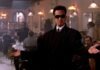







The film opens with aerial shots of Osaka while an off-screen narrator informs the viewer that Osaka had always been a city too big to be ruled by one yakuza gang. Therefore, since Meiji times (1868 – 1912), several criminal organizations co-existed in the city. They had their occasional scuffles but in general, they respected each other and would solve their differences through negotiations rather than fights.

The front titles run over black / white photo images of the Tsuruhashi Market in Koreatown, Ikuno Ward.

The pictures spring to life and focus on a boxing ring. The two fighters are supported and betted on by two different yakuza groups – the established Nambara-gumi and a rather new outfit, the Soryu-kai.
The latter consists mostly of ethnic Koreans, is much less hierarchic than traditional yakuza gangs and they have big plans to take over parts of the city. At the same time, the Soryu-kai are a hedonistic bunch. At their parties, the hired beauties quickly lose their dresses, the guys guzzle whisky gushing down from between the beauties’ legs.
Back to the boxing event. One fighter, Ichiro Sanada (Kan Mikami), in the ring for the Nambara-gumi, has clearly the stronger fists. This prompts the leader of opposing Soryu-kai, Toshiyuki Yasuda (Hiroki Matsukata) to enter the ring and kick him. A big brawl erupts.
Once things have cooled down, the owner of the venue announces that there will be no more boxing events in the future. The venue had just been bought and the new owner has other plans for the building.
That new owner is soon to be revealed as the Kawada-gumi from Kobe, a rapidly expanding yakuza outfit run more like a corporation rather than a local misfit group.
The Kawada-gumi have set their eyes on Osaka and they know, with their resources and corporate structure they can run the whole city all by themselves.

Just that first, they have to take care of the local Osaka gangs. They try to achieve that goal by simply buying them off, turning them into their subordinates through smooth talk and large envelopes filled with cash.
The leader of the Ishimura-gumi of Tennoji reluctantly takes on the offers, thus changing sides.
Neither the Nambara-gumi nor the Soryu-kai are ready to give in, however. They decide to join forces and to get rid of the invaders from Kobe by assassinating their leaders.
The assassination attempt fails and leads to a new strategy by the Kawada-gumi. If the Osaka gangs can’t be bought, they need to be destroyed.
At a large gathering in Kobe, photos of the Osaka leaders and their main enforcers are shown to the Kawada-gumi members, a merciless manhunt on all of them is declared. All of them need to be eliminated.

The remainder of the movie consists of exactly those assassinations. The Osaka gangs fight back ferociously against the murderous precision of the Kawada-gumi, they stand no chance.
Table of Contents
Authentic True Account: Osaka Shock Tactics (Japan 1976) 実録外伝 大阪電撃作戦
Jitsuroku gaiden: Osaka dengeki sakusen is the Japanese title of the film. Jitsuroku meaning True Account.
Following the huge success of the first installment of the Battles without Honor and Humanity series in 1973, based on real yakuza gang wars in post WWII Hiroshima, Toei Studio decided to put a strong focus on the jitsuroku genre.
They started to produce a large number of gritty, dirty, violent documentary-style yakuza movies, all based on real events. Those films did well at the box office but still, Toei Studio boss Shigeru Okada was not satisfied.
He wanted something with more atmosphere, with better actors. The result of his decisions was Authentic True Account: Osaka Shock Tactics.
The film features top-notch actors including Hiroki Matsukata, Akira Kobayashi, Tsunehiko Watase and Mikio Narita and it was produced on a rather large budget.
The story the film tells is based on a string of incidents that took place in Osaka in December 1960 when the Kobe-based Yamaguchi-gumi successfully took over Osaka. The Yamaguchi-gumi soon became Japan’s largest criminal conglomerate and in fact, one of the largest criminal organizations in the world.
For the movie, changes were made. The Yamaguchi-gumi as well as the other gangs all received invented names. The Yamaguchi-gumi for example becomes the Kawada-gumi in the film.
Throughout the film, documentary-style title cards show up, spelling out the name of the location and the exact date the incident depicted took originally place.
Though the first of those title cards clearly says that the year is Showa 35 (1960), the movie is no period piece. Fashion, haircuts, car designs and so on changed significantly between 1960 and 1975, the year the film was shot in. However, no attempt is made to recreate any design popular in 1960. All the suits, hairstyles, cars, etc. look contemporary to 1975, not 1960.
Another important decision was to depict the story of the take-over of Osaka from the Osaka perspective. From the perspective of the fierce yakuza warriors who eventually lost. The final scene of surrender by the survivors of the manhunt has to be seen to be believed: a large yakuza meeting, the Osaka survivors kneeling in humiliation, heads down, each of them with a tray in front of him presenting a severed pinkie.

Throughout the 1970s, drastic violence was a one of the main selling points for Toei movies. Authentic True Account: Osaka Shock Tactics took that approach to a new level. The film shows gritty, dirty, realistic violence throughout, the violence is only interrupted by scenes of guys plotting more violence. Plus, a few raunchy party scenes though those parties tend to end up in violent eruptions, too.
The Director: Sadao Nakajima
Sadao Nakajima (1934 – 2013) worked for Toei Studio all his life and was regarded there as one of the most prolific and dependable directors.
Nakajima started out at Toei Kyoto Studio as assistant director in 1959, he made his directorial debut in 1964 with the Osaka movie Kunoichi Ninpo. The film, an erotic period drama, takes place during the siege of Osaka Castle in 1614 – 1615 when Shogun Tokugawa Ieyasu destroyed the Toyotomi warrior clan. The movie tells the story of five female ninjas, all pregnant by Toyotomi Hideyori (son and successor of Toyotomi Hideyoshi) and their escape attempts from the besieged castle.
Nakajima shot mostly samurai-themed films during the 1960s, then, in the 1970s, he specialized in documentary-style yakuza movies.
Those yakuza movies often featured extreme violence – which had by then become a trademark of Nakajima. The depiction of extreme violence in some of his films caused nation-wide controversies.
From 1987 to 2008, Nakajima served as professor at the Osaka University of Arts.
The Script
The perhaps most famous film by Nakajima was Memoir of Japanese Assassinations (1969), a film depicting nine different political assassinations in the period between 1860 to 1936, assassinations that changed the course of Japanese history.
Upon the completion of the film, Nakajima wrote a screenplay for a movie based on the 1960 take-over of Osaka by the Yamaguchi-gumi. A script filled with extreme violence from start to finish.
Toei Studio film division boss Shigeru Okada dismissed the script with the words, “Can this even be made into a movie?”
By the mid-1970s however, the standards regarding violent images had considerably changed. Okada, by then president of Toei Studio, remembered Nakajima’s rejected script and revived the project. He brought in screen writer Koji Takada to pen a new screenplay based on the same topic. The job of director went to Nakajima.
The Cast
As it often goes with Yakuza movies, Authentic True Account: Osaka Shock Tactics has a very large cast. There are the bosses, there are the underbosses, there are the local enforcers. They all rarely show up alone on screen, they always have their men, usually in suits, with them.
Some of those subordinates might take on central roles, however, if only in certain scenes. If you are not familiar with any of the actors on screen, things can get confusing on who is who, who belongs to which faction.
Most of the actors seen on screen are Toei yakuza movie regulars, some are undisputed stars of the genre. Some actors however clearly stick out from the rest.

Actor Hiroki Matsukata
Hiroki Matsukata (1942 – 2017), playing Soryu-kai executive Toshiyuki Yasuda is the perhaps most central actor in the film.
Matsukata, born in Tokyo as the son of an actor and an actress was introduced to Toei Studio by his father in high school times. He made his feature film debut in 1960.
After acting in a number of samurai movies during the 1960s, Matsukata worked predominantly in yakuza films.
His most famous films include several parts of Kinji Fukasaku’s Battles without Honor and Humanity series as well as Fukasaku’s samurai drama Shogun’s Samurai (1978) and Takashi Miike’s yakuza picture Agitator (2001).
The Internet Movie Database (IMDb) lists 256 films in which Matsukata acted, plus a number of Television series and video games late in his career.
When Matsukata was not busy fighting it out in both samurai and yakuza films, he went out fishing. Not only fishing carp in ponds but also joining bluefin tuna angling contests.
He set some records in the latter field, hauling in some incredible catches. His personal best was a bluefin tuna he caught on a fishing trip to Ishigaki Island, Okinawa in 2015. It took him a fight lasting about 6 and half hours to defeat that fish more than 3 meters long and weighting 361 kilos. You can see a picture of Matsukata with his catch in this news report.
Some of his fishing adventures were broadcast on Japanese TV in the program Hiroki Matsukata: Fishing Around the World.

Actor Akira Kobayashi
Another larger-than-life personality acting in Authentic True Account: Osaka Shock Tactics was Akira Kobayashi, playing the role of Kobe Kawada-gumi underboss Takeo Yamaji.
Kobayashi was born in Tokyo in 1938. He dropped out of Meiji University and became an actor at Nikkatsu Studio, making his movie debut in 1956.
Kobayashi played a wide range of roles in various genres throughout the 1960s, in a time that is now often referred to as the Golden Age of Nikkatsu.
In 1972, Kobayashi changed to Toei where he was in the 1970s mostly cast in yakuza roles, including in the Battles without Honor and Humanity series.
At the same time, Kobayashi was a famous singer, mostly in the enka genre. With his first record released in 1958, Kobayashi put out more than 50 albums and over 150 singles. Between 1977 and 1996, Kobayashi appeared seven times on the prestigious NHK New Year’s Night music revue show Kohaku Gassen.
Actor Tsunehiko Watase
Tsunehiko Watase (1944 – 2017) studied judo and karate in his youth. After a few years working in a variety of jobs, he was introduced by an acquaintance to Toei president Shigeru Okada. Okada asked him to join the company right away. Though hesitant at first and warned that acting is precarious work by his brother (who was already an actor), Okada convinced him to give acting a try.
Watase made his debut in 1970 in Killer Hitman Betsucho, playing the lead in his very first picture.
Having no background in acting, Watase decided that the only way to compete with all the established actors around him was to be absolutely fearless in his action scenes.
Watase made a bus driver license for a movie in which he played a bus driver whose bus flips over, Watase would hang onto a flying helicopter with nothing but his own hands. He never used a stunt double.
In the 1976 gangster movie Violent Panic: The Big Crash, Watase was the only actor who did all the wild driving during the incredible car chase taking up the whole second half of the movie by himself.

In Authentic True Account: Osaka Shock Tactics can be seenhanging on to the door handle of a speeding car. Again, no stunt double.
The 1977 Kinji Fukasaku movie Hokuriku Proxy War ended his action career. A jeep he was driving flipped over and crushed one of his legs.
This accident forced Watase to leave the action genre. He became a serious and very successful character actor.
Osaka Locations
The film starts out with aerial shots of Osaka, including the Tsutenkaku Tower while a narrator talks about the yakuza state of things in the city. Then, a map of Osaka is shown onscreen, then the photo images of the Tsuruhashi Market in Koreatown, Ikuno Ward.
Throughout the film, the locations where the events depicted originally played out appear in writing on the screen, alongside the date of the original incident.

Most of those locations, usually yakuza bars and clubs are located in western Osaka, particularly in Taisho Ward but also in the area behind Fuse Station on the Kintetsu Line in Higashiosaka as well as the Tsuruhashi Market in Ikuno Ward.

Clearly in sight is also the Minami Osaka Police Station in Higashishinsaibashi, Chuo Ward.