






Every year in Osaka and Nishinomiya, the two largest festivals in honor of the deity Ebisu are held: the Tōka Ebisu. This festival takes place every year from January 9 to 11. To understand everything about this highly popular event in Kansai, follow the guide!
Table of Contents
But who is Ebisu?
Ebisu is one of Japan’s most famous deities and one of the seven lucky gods (Shichifukujin) in the Shinto tradition. He is often seen as a god who brings good luck, especially to businesses. But Ebisu is also the god of commerce, fishermen, and good harvests.
Ebisu-sama has been firmly regarded as a god of fishing since ancient times due to the appearance of bream and fishing rods.
Ebisu is particularly well known and revered in the Kansai region. He is affectionately called “Ebe-san” in the Kansai region, “Oibetsu-san” in the Tokai region, “Obes-sama” in the Hokuriku region, and “Oebisu-san” in the northern Kanto region.

Princess Oho-tsu-hime and the god Ebisu. Source: Miho Shrine Collection


The testimony of the chief priest of Nishinomiya
In 2023, I had the opportunity to meet Yoshii Yoshihide, the 56th generation of his family to be gon-guji, supreme priest, of the Nishinomiya Shrine, where one of the most important festivals dedicated to Ebisu is held every year. He told me his version of the deity’s appearance.
He was keen to point out that in Japan, the main deity is Amaterasu, the sun goddess. Since the beginnings of rice cultivation nearly 2,000 years ago, Amaterasu has been associated with the agricultural world and is particularly important to the inhabitants of the interior and the mountains, who hoped for good harvests. But even before the cult of Amaterasu, during the Jōmon period (13,000 to 400 BC), the cult of Ebisu took shape among the coastal populations who lived off the sea.
Y. Yoshihide explains that at the time, there was a belief that anything that came from the sea and elsewhere was a good omen and should be welcomed. Ebisu is mentioned in the Nihon Shoki and the Kojiki.
Dating from 712, the Kojiki is a collection of Japanese myths recounting the creation of the Japanese archipelago and the birth of the imperial family of divine lineage. The Nihon-shoki, dating from 720, focuses on the collection of historical facts that form the basis of the official history of Yamato, the ancestor of the current Japanese state.
It is written that Ebisu, unable to stand after three years of existence, was thrown into the waves. According to legend, the child was born deformed, with undeveloped arms and legs. His flaccid form earned him the nickname “the leech.” Ebisu, believed to be the first Japanese person or the ancestor of the Japanese people, was abandoned on Awaji Island, itself the first island of the Japanese archipelago to emerge. This island is located opposite Nishinomiya, in Osaka Bay, and Ebisu washed up on its beach.

Nishinomiya jinja main door
A deity from the Kojiki and Nihonshoki
In the Kojiki and Nihonshoki, the enshrined deity Ebisu-sama was born between Inoki no Mikoto and Ini no Mikoto, but because his body was tangled, he was described as being carried away on a reed boat or a heavenly camphor boat.
Although he is not mentioned after that, according to an old tradition passed down in Nishinomiya, it explains this: Once upon a time, a fisherman who lived in Naruo was fishing off the coast, and he felt that the net was very heavy, so when he pulled it up happily, it looked like a doll-shaped statue of another god. But it was not the fish he had expected, so he returned to the sea and headed west in search of a school of fish again. When he arrived in the area around Cape Wada in Kobe and set the net, he felt an excellent response again, and this time, I bravely pulled the net, and it looked like a statue of a god that should have been brought back to the sea earlier.
The fisherman was convinced that this was no simple matter, so he brought the statue of the god home and made offerings every day. One day, after some time had passed, a statue of the god enshrined in his dream appeared and said, “I am the god of eels. I have come here now after visiting various countries, but there is a good shrine to the west of here. I would like you to go there and build a palace and enshrine me there again. »

Contemporary Ebisu amulet. Available at buddhist-artwork.com. Source : Onmarkproductions.com
A god who isn’t so smiling after all
Thus, the cult of Ebisu first took shape in the prefectures of Hyōgo and Kansai, before spreading to the rest of Japan. Although today he is the god of happiness and fortune in the broadest sense, he was initially perceived as dangerous and wild.
In fact, the Chinese characters for the word Ebisu have a second reading and can be translated as ezo or yezo, a term referring to marginalized people, those who are not conventional or ordinary. The northern island of Japan, Hokkaido, was once called Ezo, meaning “wild lands.” Ebisu/Ezo is therefore above all the image of a radically different, ontologically different otherness, and a figure of marginality.
Behind his permanent broad smile lies a deity whose misfortunes must be appeased in order to avoid his wrath and potential calamities. This deity is therefore an example of a rite of inversion. The same is true of Tenjin, a deified politician who, during his lifetime, had been exiled to the island of Kyūshū. To take revenge, he cast a spell on the city of Kyoto. The image of this wrathful figure was reversed to become a sympathetic character and protector of education.

Ebisu, the kami of fishermen and merchants, dressed as a Japanese peasant with his attributes. Source: gods-goddess.wikia.com
Ebisu Over The Centuries
Over the centuries, the Japanese have associated Ebisu with everyday life. Through his cult, he encourages people to make an effort and never give up on finding happiness—happiness embodied by this upside-down Ebisu. This idea of “bringing together diversity” is reflected in his cult, in which people with abilities or strengths must put them at the service of the most disadvantaged and show compassion. “If we were to find an equivalent in contemporary society, we could talk about the pension or social security system,” compared priest Y. Yoshihide.
Ebisu represents danger that must be appeased by serving him. In both cases, the prevailing idea is that putting one’s energy at the service of others will come back to us, but in the opposite way: Ebisu is to be helped, while Shinnō works for the common good. Ebisu-sama has become a symbol of bringing together different or foreign elements that need to be reconciled. He is an example of the historical transformation of a marginal and frightening figure, a figure of reversal.
Why January 10?
The origins of the Toka Ebisu festival date back to the Heian period (794-1185), when it was originally deeply revered in regions where trade and fishing flourished.
Today, the Japanese refer to Ebisu as the god of commerce, without necessarily referring to the sea and fishermen. During the Edo period (1600-1868), Osaka became the central economic hub, as all the rice and fish in the kingdom were transported there and exchanged for gold in the markets.
January 10 is particularly celebrated in western Japan because, in the past, markets were held on the 1st, 10th, and 20th of the month. Since the market on January 1 could not be held due to New Year’s celebrations, the market on the 10th was the first of the year and was of particular importance. Even at that time, Ebisu was associated with commerce, and so January 10 became a date in his honor.
The festival takes place every year over three days, from January 9 to 11, with Yoi Ebisu on the 9th, Hon Ebisu on the 10th, and Nokori Fuku on the 11th.

Street vendors during the Tōka Ebisu
The Nishinomiya Shrine in Hyogo and Imamiya Shrine in Osaka
The Nishinomiya shrine was the first to bear this name to be built in Japan, and became the benchmark for all others venerating Ebisu, especially since the Muromachi period (1336-1573).
A second shrine of similar size was built 20 kilometers away: Imamiya Ebisu, in Osaka’s Naniwa Ward, which celebrates the same festival in January. The ceremonies there are larger in scale.
In its heyday, the Imamiya shrine attracted nearly a million visitors each year for Tōka Ebisu.
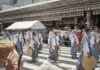
Whether in Osaka or Nishinomiya, the fukumusume, or “lucky girls,” are 50 women chosen to represent the festival. More than 3,000 women apply each year, and the acceptance rate is stricter than for most elite colleges and institutions in Japan. During the festivities, these women line up around the perimeter of the shrine, handing out lucky charms while remaining calm despite the chaos around them. You can spot them by their traditional eboshi hats, which look like giant tights worn inside out.

Imamiya Ebisu, more quiet than ever before the event
Events losing momentum
The Nishinomiya Jinja and Imamiya Ebisu festivals each attract 500 yatai street food stalls every year. Since the COVID-19 pandemic, this number has decreased: in 2021, only 40% of the yatai were set up in Nishinomiya; in 2022, there were 60%; this year, in 2023, the market had almost returned to normal and 80% of the vendors had regained their places.
In Imamiya, until 2023, only religious festivities were maintained, and entertainment activities were suspended.
However, Tōka Ebisu remains the most important event of the year for tekiya street vendors who run yatai stalls.
In 2024, according to the Nishinomiya Shrine, the number of tekiya present at the festival had returned to normal. This idea is disputed by the tekiya, who say that the event has never regained its former glory.

Street vendors during the Tōka Ebisu
Fewer local participants
Yoshii Yoshihide, the chief priest of Nishinomiya, says that this event follows the logic of caring for others. “Without that, the world couldn’t function. Being supportive and having a collectivist approach is essential in our liberal, capitalist society.”
Mr. Yoshii regrets that this way of thinking is being lost and that residents are less involved in preparing for the festival. Previously, ujiko, geographical groups attached to a shrine, would get together to make preparations, whereas today it is affinity groups. Anyone, even those from other prefectures, is allowed to get involved.
This change can be generalized to the whole of Japan. I have noticed the same phenomenon in other shrines I have visited. However, Yoshihide qualifies his remarks by pointing out that charitable works are held every year during Tōka Ebisu, in line with this idea of solidarity with the most vulnerable. One of the stalls sells lucky charms to raise money for the victims of the 1995 Kobe earthquake and the 2011 Fukushima earthquake.

At Imamiya Ebisu, someone is praying
The Lucky Fukuotoko Race
The three days of the festival are part of what Japanese society calls hare, the extraordinary, the “brilliant days” as opposed to ke, the things of everyday life. Residents are allowed to behave outside the usual norms.
At the Nishinomiya Shrine, this translates into a race from the gate to the entrance of the main temple building, even though running within the grounds is normally strictly forbidden.
At 6 a.m. on January 10, nearly 6,000 men and women (who, however, represent only 10 to 20% of the participants) wait for the gates to open so they can rush in en masse. The first three to arrive become the luckiest men of the year.
Like the mikoshi parades, palanquins shaped like miniature temples carried during certain festivals, the race is both spectacular and dangerous. Mikoshi are extremely heavy, weighing several tons, and require many people to carry or roll them. Tragic accidents sometimes occur during the parades.
The festival is a permissive space where residents can experience this danger, in contrast to their everyday lives, where they seek safety. The “race of the lucky ones” is seen as positive and liberating, allowing residents to release any desire to break the rules that they may have accumulated throughout the year.

The Lucky Fukuotoko Race. Source : https://ohmatsuri.com/en/articles/hyogo-nishinomiya-ebisu-and-kaimon-shinji
A Benevolent Deity
These activities are all the more unrestricted because Ebisu is known for being a particularly benevolent kami-sama (deity).
It is no coincidence that the shrine closes its doors on January 9 and welcomes runners in the early hours of the 10th. Many people commonly believe that it was traditional to stay at home on that night, without questioning why.
In reality, the shrine closes its doors to prevent Ebisu from entering and allow him to wander the streets of the city to visit families and bring them good luck.
Getting to the event
The most accessible shrine to enjoy the Toka Ebisu festival is usually Imamiya Ebisu in southern Osaka. The closest station is Imamiyaebisu Station on the Nankai Line, but since only local trains on the Koya Line stop there, Ebisucho and Daikokucho stations on the Osaka Metro may be more convenient. It is also within walking distance of major shopping districts such as Namba and Nipponbashi.
Since large crowds gather around the shrine every year, allow at least 2 to 3 hours for this visit. It may take you 20 to 30 minutes to enter the shrine, but the food stalls, souvenir shops, and lucky charm stands will keep you entertained as you slowly make your way through the crowd.

The view from the Imamiya Ebisu