





Table of Contents
Arthur Nersesian Comes to Japan
I was scrolling mindlessly through Facebook when I saw that one of my favorite authors, Arthur Nersesian, was planning his first trip to Japan. A New York–born novelist and playwright, Nersesian is best known for his portrayals of life on the city’s fringes, written with a sharply idiosyncratic wit. As The Village Voice once observed, “Nersesian captures the aimlessness and desperation of a generation with unflinching clarity.”

If you haven’t read his work, the best place to start is his most popular novel, The Fuck-Up, a snapshot of downtown New York City in the 1980s, before gentrification ruined everything. The New York Times called it “a darkly comic portrait of disaffection in downtown New York.” When The Fuck-Up was republished by MTV Books in 1997, it was compared to The Catcher in the Rye, and Trainspotting. Actor Bob Odenkirk (Breaking Bad, Better Call Saul), who later adapted the novel for a film that was never made, has said, “Nersesian is one of my favorite New York authors.” Dogrun, Suicide Casanova, Manhattan Loverboy, Chinese Takeout, and Mesopotamia are also well worth reading. Honestly, I’ve loved every single book by Nersesian that I’ve picked up.
Nersesian is one of my favorite New York authors.
Bob Odenkirk
From NYC to Osaka: An Unexpected Meetup
Anyway, I wrote a quick comment on the post suggesting that he visit Osaka. He replied that he was actually staying in Osaka, in.Yao, a city that is very close to mine. I suggested a few good restaurants in Osaka, including an all-you-can eat yakiniku (barbecued beef) restaurant in Ashiharabashi. About a week into his trip Nersesian messaged me that he was tired of eating fish and was up for meeting for dinner at the aforementioned yakiniku restaurant.

Meeting in Ashiharabashi on The Osaka Loop Line
I’d always assumed that I would meet Arthur Nersesian at a reading in New York City, not in Ashiharabashi, a local station on the JR Loopline located between Shin Imamiya and Taisho in Naniwa Ward, but there he was walking towards me dressed in white shorts, a flannel shirt and a black t-shirt with an illustration of a man in a gas mask playing the guitar by acclaimed Manhattan artist Eric Drooker.

Arthur was accompanied by his old friend Delphi from New York City, who is now living in Yao with his Japanese wife. They made the common mistake of taking the express train instead of the local, so they had to walk from Taisho Station, which takes about 20 minutes on foot. After introductions were made, we set off to the restaurant, which is located a few blocks from the station.


Yakiniku Gen: All-You-Can-Eat Barbecue on a Budget

What to Eat at Yakiniku Gen
Yakiniku-zanmai Gen (焼肉三昧 玄) offers a 70-minute all-you can eat yakiniku buffet for only 1,400 yen (At the time we visited it was 1,200). The buffet includes a variety of meats including beef belly (bara), beef tongue (gyutan), offal (horumon), Korean grilled short ribs (galbi/kalbi, chicken thighs (momo). You also get unlimited servings of rice, miso soup, kimchi, salad, moyashi sprouts, and curry. Plus sliced oranges and shiratama zenzai (red bean soup with mochi) for dessert. There is a one-drink minimum.

Insider Tips for Getting Your Money’s Worth at Yakiniku Gen
I first visited Yakiniku Gen almost a decade ago with two other friends. At that time we were a bit hesitant about loading up our plates with meat. For such a low price there had to be hidden charges, right? The owner, a friendly Korean woman, noticed our hesitation and said, “Be sure to eat your fill. I like a man who eats a big portion. Pile it on, boys! Pile it on! Her kind words made us lose our inhibitions and from that moment on we loaded our plates to capacity with the best cuts of meat.

As a semi-regular customer over the years, I laid out a strategy for my esteemed guests: Avoid the carbohydrates such as curry and rice that are meant to fill you up so you don’t get your money’s worth. Choose the beef belly, short ribs and chicken thighs over the lesser quality offal and beef tongue. We planned to drink across the street so we limited our alcohol consumption to two beers in order to complete our mission of getting the most bang for our buck, er yen.

Gen offers two kinds of sauce: tare, which is soy-based and miso. You can add condiments such as lemon, garlic and gochung. The kimchii and other pickled vegetables were of a very high quality. We stuffed ourselves with barbecue until we couldn’t eat another morsel, which led to the only faux pas of the evening: We left some burnt meat on the grill, which often warrants a fine in order to avoid waste, but I don’t think this is ever carried out in reality. Our server let us off with a warning and we promised we would be more careful next time.


Watabe Saketen: A Classic Osaka Kakuuchi Bar
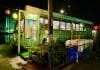
After our meal we headed across the street to Watabe Saketen, a liquor store with a bar on the premises (kakuuchi) that was founded in 1938. The 86 year-old shop is located under the tracks of JR Station has been located in the neighborhood before the Osaka Loop Line existed and the trains passing by overhead adds to its charm. In front of the shop you’ll find beat up old vending machines where you can buy beer, soft drinks and cigarettes.

The bar inside opens at 5 PM. We arrived at 6:30, and when we went inside it was already full of regulars, most of whom were salarymen stopping by after work for a few quick drinks and some light snacks and bar food such as potato salad, karaage fried chicken, and gyoza. They were sitting at a long table in the center of the bar, which is cluttered with dusty sake bottles, assorted boxes, and piles of newspapers. This is a place where fans of the Hanshin Tigers gather, and some of the regulars were watching a TV by the entrance. Unfortunately, the beloved Tigers were losing to the Yakault Swallows in the bottom of the fifth inning.

Arthur Nerseisan’s First Chu-Hai in Japan
Although Arthur Nersesian had been in Japan for about a week, I learned that he hadn’t tried a chu-hi yet. “Chu-hai” is short for shochu highball: shocho mixed with carbonated water and a fruit flavor like lemon or grapefruit. Arthur chose a lemon flavored one which he seemed to enjoy. I took a photo of him raising his glass and couldn’t help but notice that Watabe Saketen has a similar vibe to many of the dives bars on the Lower East Side of New York City. We were definitely in our element 7,000 miles away from home.

Making Friends with the Regulars
You don’t come to a place like this for the cheap drinks, and believe me, they are dirt cheap here. The real fun is drinking with the regulars, some of whom have been coming here for decades. We had a great time at Watabe Saketen, which I was able to capture in a series of photographs that I hope will help illustrate the process of ingraining yourself with the loyal customers at a very local, out of the way bar like this one.

Understanding Japan’s Bottle Keep System
Arthur was standing by the counter that had bottles of whisky and shochu with name tags attached to them. In Japan, the bottle keep system lets regular customers buy a full bottle of liquor and have it labeled and stored at the bar for future visits. Instead of paying for each drink, you order mixers and enjoy your own bottle whenever you come back.

I asked the owner if Arthur could pose with one of the bottles, Suntory Old Whisky, and he was happy to oblige. At that moment a friendly regular insisted that we drink from his bottle of top-shelf shochu so we could gain the full experience of the bottle keep system. The owner brought out three glasses of ice and we were initiated into the drinkers ritual of sharing alcohol with new friends.

Random Acts of Hospitality in Osaka
You can’t assume that random acts of hospitality like this will happen when you visit a drinking establishment in Japan. We could have easily spent the entire evening drinking by ourselves in the corner. But it’s nice when someone goes out of their way with a small gesture of kindness to make you feel welcome. I always make a mental note to pay it forward in the near future to restore balance to the universe. What comes around goes around.

Once the proverbial ice was broken, both literally and figuratively, several more of the friendly regulars came by to drink with us. Some offered to refill our glasses with shochu from their own bottles, but I for one had to decline politely because I can barely handle half a glass of this powerful elixir that can result in a very nasty hangover. One classy gentleman seemed to be in charge of dispensing ice. For all I knew it might have been from his personal stainless steel ice bucket he kept on the premises.

The Joy of Toasting Fictional Movie Characters
After participating in several toasts, we were able to have a nice chat with our new drinking buddies. They were curious about what we were doing in Osaka. I explained that Delphi and I live here and Arthur is a novelist who is visiting Osaka for the first time. Someone asked what he had written, so I googled his name in Japanese and a translation of his Wikipedia page popped up.

I pointed out that one of his novels, Dog Run, was made into a film (My Dead Boyfriend) which was released in 2016. Top Gun is very popular movie among Japanese middle aged men in their 50s and 60s, so they were very interested to learn that the director of the movie was none other than Anthony Edwards, who played doomed naval officer Goose. While explaining this I made a downward gesture with my arm to mimick a plane crashing into the ocean, which was immediately understood. The next thing we knew we were raising our glasses in tribute to the dearly departed Goose as if it happened yesterday.

Arthur Nersesian vs Tengu
Arthur noticed a Tengu mask on the wall above the bar. “A tengu is a supernatural being from Japanese folklore, often depicted as a long-nosed or bird-like mountain spirit associated with martial skill, mischief, and the protection of forests and temples.” The next think I knew the acclaimed author was doing a spirited imitation of the mythical beast using a small cylindrical puffed corn snack called Umaibo that he was gifted.

Heading Out into the Osaka Night
We were having so much but as the Irish say we were bluttered, scuttered and banjo’d after consuming so much booze. Delphi took a group photo of our new drinking companions and one of them covered his head in jest to hide his bald spot. I hope to see this fun group again the next time I stop by.

Once we said our goodbyes, I got Delphi and Arthur cans of Asahi Beer for their trip back to Yao. It was 7:30 P.M., which meant that we had been inside for exactly one hour. That’s all you really need in a place like Watabe Saketen. Usually I would take my guests to another spot, but we had eaten so much for dinner that it was time to call it a night, so we made our way down to the station.


Part II: An Interview with Arthur Nersesian in Japan
1.So, what first got you on the plane to Japan? Was it something you had always wanted to do, or did the trip just come together kind of suddenly?
AN: Going to Asia had always been on my bucket list. So when my friend Delphi invited me, I knew I had to go. I got hired at the old St. Mark’s Cinema as an usher in 1981 (I think) and Delphi was the manager, that’s how we met. I would’ve been ashamed to die without going there. Additionally I was always amazed by Japan, so it wasn’t just about touching base. I really did want to see Japan.
2.You stayed in Yao, Osaka. What was that like? I imagine it gave you a pretty local experience.
AN:After a lifetime in New York City, 3 weeks in Yao was like a soothing retreat.

3.What were your first impressions of Osaka when you arrived?
AN: I was impressed by how well behaved everyone was. In New York City, whenever I ride the train, I’m always on alert for who the most crazy person is. While in Osaka, I realized it was me!
4. Did anything about Osaka remind you of New York, or was it totally its own world?
AN: It was sort of an alternate, utopian universe. I didn’t know a society could exist without trash cans and significant homelessness. And was astounded by the level of cleanliness. The bathrooms in the subway stations are cleaner than my apartment!
5. Did you get to meet or spend time with local people while you were there? What were those interactions like?
AN: Everyone I met was very sweet and cordial. Of course the language barrier made it difficult to get a full sense of what people thought of me. And Japanese culture seems to be far more subtle and understated, whereas in New York, people hit you over the head with their message. Sometimes they even hit you over the head with their fists.
6. Was there anything about daily life that really surprised you, something small or funny that stuck with you?
It’s been about two and a half years since I left Japan and now I sort of measure things by my experience. And whenver I do, New York City usually comes up short. I greatly admired how one can dwell in one’s own thoughts in Japan, whereas here in New York one is always on guard. Beyond that, I really loved and appreciated, both the low cost and high quality of food. In the United States there is a constant sense that companies are trying to get the most from consumers while giving the least amount. I didn’t feel that way in Japan.
7. How did you manage communicating while you were in Japan? Was the language barrier ever a challenge, or did you find ways around it?
AN: It was a bit of a problem. Admittedly I was usually with my friend who helped me navigate through the language.
8. Did you visit any bars, cafés, restaurants, hotels or hot springs that made an impression?
AN: I did go to a really nice hotel that had a hot spring, as well as many restaurants. It was all quite wonderful. When I visited Japan I made a conscious decision to try to immerse myself in the native cuisine and not simply eat my usual dishes. So that was a real adventure. Some of the dishes, like the turbo snail, I wouldn’t eat again, but others were fine.
9.You also spent time in Hiroshima. That must have been a powerful experience. What was that visit like for you?
AN: Yes, I went to the museum. It was very sad and it made me reflect on my father who was a young man during World War 2. My father who had served in the military in the 1930s, decided to become a conscientious objector during the war. I was slightly ashamed of that. But as I get older, I’ve come to realize how hard it was for him. And realized if everyone put humanity above greed and patriotism, we’d have a much better world. With Trump we’re seeing the opposite of that now more than ever.
10. Did you have any preconceived notions about Japan that changed as a result of the trip?
AN: Not really.

11. Did you keep a journal or take notes while you were traveling, or were you just soaking it all in?
I tried taking some notes, but it’s amazing how every moment seemed to race by. I did get a lot of fiction writing done while I was there.
12. You’ve spent much of your life riding the subway in New York. How did the Osaka subway system compare?
AN:As I mentioned it was a study in contrast. The New York City subways system in many ways is New York at its worst. It’s filthy. The city has unofficially turned it into a sort of psychiatric ward, lately teenage kids climb up on top of it “surfing” and in the past year a dozen or so have fallen off and died. People jump over the turnstyle refusing to pay their fare. At the same time, the subway system holds the city together, so it’s really a shame.
13. Was there anything you wanted to see or do in Japan but didn’t have time for?
AN: I wanted to spend more time traveling, Kyoto, Tokyo, I wanted to see Mount Fuji, so many other places. If I ever win the lottery I’ll return.
14: How did you find the food in Japan? Any favorite dishes or memorable meals?
AN: As I mentioned, I loved it.
15: Could you ever see yourself setting a novel or a story in Japan, even partly?
AN: I’d love to write about Japan, but I don’t think I could do it justice.

Arthur Nersesian’s Most Recent Novel: Shit Show
I just finished his most recent novel Shit Show, which is a real tour de force set that jumps back and forth from Stalinist Russia, Woodstock and the 9-11 attacks on the World Trade Center. It’s full of fascinating characters who deliver poignant and comical dialog. It’s a real page turner and I’d like Paul Thomas Anderson make it into a film because it’s the perfect vehicle for him.

Links: Arthur Nersesian Facebook. Goodreads author page