





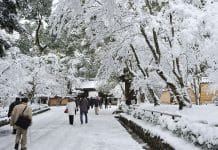


Karahori Shotengai is one of Osaka’s oldest and most atmospheric shopping streets. This walking guide highlights 16 essential stops, from coffee shops and record stores to bakeries, restaurants, and neighborhood bars in a part of the city best explored on foot.
Table of Contents
Introduction
Karahori Shotengai stretches approximately 800 meters along the edge of the Uemachi Plateau between Matsuyamachi-suji and Uemachi-suji in Chuo Ward. Its name means “dry moat,” a reference to the outer moat of Osaka Castle that once ran through the area during the era of Toyotomi Hideyoshi in the late 16th century. Because the shotengai sits on elevated ground above the flat city below, it largely escaped the 1945 air raids that devastated most of central Osaka, leaving behind a rare concentration of prewar machiya townhouses, narrow back alleys, and old commercial buildings that survive to this day.

Karahori Shotengai is split in two by Tanimachi-suji Avenue. The western side consists of the Haikarahori and Karahori sections, while the eastern side is known as the Karahori-dori Shotengai . Although they form a continuous marketplace, the three sections are managed separately by three different merchant associations. The closest subway exit to Karahori Shotengai is Exit 4 of Tanimachi 6-chome Station on the Osaka Metro Tanimachi Line. It can also be accessed from Exit 3 of Matsuyamachi Station on Nagahori Tsurumi-ryokuchi Line. It’s about a 2-minute walk to the arcade entrances on either side from both stations.
Part 1: Karahori Shotengai After Dark
Most guides to the area focus on the daytime experience of Karahori Shotengai, which is more lively in the morning and early afternoon. After dark, however, the Karahori Shotengai and its nearby side streets and back alleys become something else entirely as the crowds thin out. That is where our journey begins. I start at the entrance to Haikarahori, heading west down the upper slope of the shopping street defined by a sharp, triangular peaked roof. Its name is a clever pun on haikara (ハイカラ), a Meiji-era loanword for “high collar” shirts that came to mean trendy, Westernized, and modern-chic.

Moving down the incline, this section ends at a small crossroads where the historic Japanese tea merchant Koshunen stands. Knowing the official boundaries of the arcade sections isn’t important; it is simply interesting to observe the subtle changes as you walk. At this exact intersection the triangular peaks change into the rounded dome roof of the main Karahori Shotengai section. If you look carefully at the ground, you’ll notice that the paving changes as well. The Haikarahori section is paved with interlocking octagonal bricks featuring a floral pattern, while the main Karahori Shotengai section uses wavy, zigzag-shaped interlocking bricks.
Fusaya Honten
[Map] 6-14-19 Tanimachi, Chuo Ward, Osaka 542-0012. Tel: 06-6762-3220. Open: Tue-Fri 17:00-24:00 (L.O. 23:00); Sat, Sun & Hols 12:00-15:00; 17:00-24:00 (L.O. 23:00). Closed: Mon. Dinner: ¥2,000-¥3,999. Seating: 103 (tatami 14, table 24, VIP room 8, 2F up to 24). Credit Cards: VISA, Mastercard, Amex, Diners, JCB. https://fusaya.gorp.jp/ Instagram: sousaku.okonomiyaki_fusaya
Fusaya Honten has been around for 47 years and is one of the most famous okonomiyaki restaurants in all of Osaka, attracting both neighborhood regulars and celebrities from all over Japan. Located on a gentle slope in the heart of the Karahori Shotengai, the exterior is impressive: a broad green wooden sign with gold lettering spans the width of two shopfronts. The three shapes (○△□) represent a circle, triangle and square, a reference to the Buddhist mandala. Stone-clad walls, potted plants and warm globe lights add to the overall charm.

The restaurant is spacious and divided into two distinct sections. The main floor has tables seating 4 to 6 people, separated by partitions and walls. The second section is more open and flexible, able to accommodate larger groups. There is also a tatami zashiki room seating up to 14 people and a 2F floor with large tables for up to 24. A portrait of the bearded founder, painted by actor Naoto Takenaka (Shall We Dance), hangs on the wall above the entrance.

Rock and Roll Okonomiyaki
Fusaya Honten has long been associated with punk and rock and roll. One of the founder’s sons played saxophone for punk band Off Mask OO, and a former member of The Boredoms works here on weekends. The walls are decorated with faded posters of James Brown, The Ramones, Joe Strummer of The Clash and Iggy & The Stooges. More recent fliers promoting upcoming gigs and i films such as Street Kingdom and a restored version of Le Samouraï starring Alain Delon. I was moved by a makeshift tribute to David Bowie with a quote from Iggy Pop, jotted down on a now-tattered piece of paper by a staff member shortly after Bowie passed away in 2016.


Celebrity Autographs on Parade
Fusaya Honten has a reputation in the Japanese entertainment industry as a safe haven for celebrities to eat privately. There are hundreds of autographs on the walls from Arashi, Snowman, Bump of Chicken, Radwimps, actor Issey Ogata and scores of Yoshimoto comedians like Downtown. I even spotted some foreign bands like Pavement and Sum 41, who stopped by during tours of Japan.

The Namie Amuro Seat
One of the rarest autographs is from Japanese pop icon Namie Amuro, a notoriously reclusive figure who has sold over 40 million total records from 1992 until she retired in 2018. There is a specific seat where she sat that fans, often called Amurer, frequently request when making a reservation.

BTS ate here in 2014
Korean superstars have also made the pilgrimage, including actors Seo Kang-joon and Park Bo-gum, K-pop groups Girls’ Generation, Kara, and (drum roll, please) BTS, before they became global icons. For this reason, Fusaya Honten is considered a “holy spot” for members of the BTS army when they visit Osaka, and it is not unusual to see fans taking photos in front of the restaurant.

Despite all of this, celebrities are treated no differently than regulars who have been coming for years, and there are no velvet ropes or VIP lounges.
I visited Karahori Shotengai with my wife, so I decided to take her to Fusaya Honten. Since we arrived before the dinner rush, I managed to get a table without a reservation. For people like me who tend to become indecisive in the face of too many choices, Fusaya Honten makes ordering for two remarkably easy. Their four most popular dishes are available as a set, and it even comes with dessert. They also offer an English menu for their many overseas customers.
Tonton-yaki
Without question, the most popular dish on the menu, Tonton-yaki is made with just three ingredients: yamaimo, pork belly, and cabbage. No flour is used, which sets it apart from standard Okonomiyaki. The name tonton is onomatopoeia for the sound of pork being chopped. The yamaimo gives it a fluffy, almost soufflé-like texture.

Kimchi Yakisoba
The acoustic guitar duo Gontiti described the kimchi yakisoba with a blunt quote that now appears on the menu: “Do not die without eating this.”
It’s made with lightly fermented, crisp kimchi that adds a welcome crunch against the soft noodles. Instead of the usual sweet brown yakisoba sauce, Fusaya Honten uses a soy-based tare, a secret recipe developed by the restaurant’s founder.

Pork and Beansprout Steamer Pot 豚せいろもやし鍋
Also known as Yusaku Nabe, this was reportedly a favorite of the late actor Yusaku Matsuda, who was a devoted regular at Fusaya Honten. A bamboo steamer is placed over a hot pot of broth, with thinly sliced pork belly and fresh bean sprouts layered inside. The steam from the broth below gently cooks the ingredients, keeping the pork tender and the bean sprouts crisp.

It’s hard to explain just how popular Matsuda was during his short career. Imagine an actor with the rebellious mystique of James Dean, the intensity of Al Pacino, and the cool of Steve McQueen. He came across as dangerous, stylish, emotionally raw, and impossible to ignore. Matsuda stole every scene opposite Michael Douglas in the 1989 film Black Rain, directed by Ridley Scott, shot on location in Osaka.

Grilled Salt and Spring Onion Pancake
After devouring three dishes, I turned to my wife and said, “Man, that was incredible.”
Then our server brought out the fourth dish: negi-yaki, a grilled salt and spring onion pancake that looked almost too good to eat. Thin, crispy, and deeply satisfying, it’s made with hand-harvested salt from the Ako Salt Fields and finished with a squeeze of lemon.

Imokko Ice Cream
Just when I thought we were finished, dessert arrived.
Imokko Ice Cream, reportedly a favorite of Namie Amuro, serves as the set’s signature finale. The name imokko means “little potato child” in Kyushu dialect. The contrast of hot sweet potato and cold ice cream makes for a surprisingly memorable finish. Can you celebrate?

Squid Ink Modanyaki
Modanyaki is an Osaka classic that layers yakisoba noodles inside an okonomiyaki batter. Fusaya Honten takes it a step further. Instead of Worcestershire sauce, they use a squid ink and garlic sauce. First-time customers are often shocked by its jet-black appearance, but somehow it works beautifully. The garlic amplifies the deep, briny flavor of the squid ink, creating a combination that’s hard to find anywhere else in Osaka. I ordered it on my first visit and was completely won over.

Record Kissa and Bar Harmony レコード喫茶&バー ハーモニー
[Map] 6-14-31 Tanimachi, Chuo Ward, Osaka. Tel: 06-6795-4882 Open: Cafe : 11:30-16:30. Closed: Mon and Tues. Bar: 18:00-23:00. Closed: Tues. (Confirm via Instagram). Drinks/Food: ¥1,000-¥1,999. Credit Cards Accepted.
I would have visited Record Kissa and Bar Harmony while writing my article on Osaka record bars, but I confused it with a place in Tamatsukuri with a similar name called Harmony Dining Bar. After sorting out the mix-up, I decided to drop in on a Thursday evening, which turned out to be fortunate because it just happens to be the one of the two days (Wednesday, Thursday) the owner, Takashi Inoue, works there. Inoue-san also owns a log cabin café called Cafe Kiyu. The café, which celebrated its 35th anniversary last year, is located in Nose, a town on the northernmost edge of Osaka Prefecture.

Harmony is a coffee shop by day and a record bar by night. It is also home to a record shop called Po’Boy, which is located upstairs. When I arrived, Inoue-san was sitting at the bar, and I assumed he was a customer. My order was taken by Kira, who is Japanese and American and fluent in English. An artist who has worked with Shonen Knife and other bands, Kira told me she was born in Brooklyn, where I’m from. After ordering a beer, Kira asked me what I wanted to listen to. I let her pick the selection, and she chose Armchair Boogie by Michael Hurley and Pals, which I had never heard before.

Music as an Icebreaker
The music served as a natural icebreaker, and I struck up a conversation with the customer next to me. I mentioned that I had recently seen Ko Machida of INU perform at a tribute concert for the late writer Ramo Nakajima, and he surprised me by saying that he had helped organize the event. When I mentioned that I had been listening to Maki Asakawa, Kira recommended Hako Yamasaki, and I have been a huge fan of her music ever since. Two young Korean tourists wandered in, and after chatting with them I learned they had never heard David Bowie, so I requested Ziggy Stardust and The Spiders from Mars, which they seemed to enjoy.

The Open Sandwich at Harmony
I wasn’t planning on ordering food, so I settled for a coffee. After seeing the customer next to me order a scrumptious-looking quiche plate, however, I became more interested in perusing the menu. The hayashi rice and desserts, such as the Basque cheesecake, certainly looked tempting, but I had to refrain. I do have my eye on their “open sandwich,” a rustic brunch plate built around slices of naturally leavened bread and served with an omelet, prosciutto, cheese, salad, and seasonal vegetables.

Po’Boy Records
[Map] 2F, 6-14-31 Tanimachi, Chuo Ward, Osaka (above Harmony). Tel: 0723-500-900. Open: Wed-Sun 13:00-18:00. Closed: Mon & Tue. http://poreco.blog28.fc2.com/ Instagram: @poboy_records
Having been shown Po’Boy Records after hours by Inoue-san during my visit to Harmony, I was eager to return and explore the second-floor shop specializing in American roots music. I did not want to simply stop by and take photos, so I made up my mind to buy something and further my musical education.

Po’Boy Records was founded in 2010 by Takashi Miyazawa, a former buyer for Tower Records who helped introduce deep American roots music to Japanese listeners. The shop was originally located in Toyosaki but closed during the pandemic. In 2024, Miyazawa resurrected the physical store on the second floor of Harmony. Visitors can enjoy music and drinks downstairs before heading upstairs to browse a carefully curated selection of vinyl records and CDs handpicked by a true expert and music lover.
Buying music at Po’Boy Records
At first, I was overwhelmed by the selection: Willie Willis and the Wildcatters, Mel Brown, John Fahey, Lena Hughes, Wade Walton. There was so much incredible music packed into such a small space. Then a CD by Pink Anderson titled Carolina Medicine Show Hokum & Blues caught my eye. Just the day before, I had read that Pink Floyd took their name from two American blues musicians, Pink Anderson and Floyd Council. Miyazawa-san let me sample the album on his computer, and I was hooked before the first song had even finished. It was probably the quickest music purchase I have ever made.

Afterward, Miyazawa-san and I had a pleasant chat and discovered that we had several mutual friends. I also found myself admiring a painting of Chicago blues legends by Tetsuro Sakanashi, the owner of Playoff, a jazz kissa in Temmabashi. I often come across his colorful artwork in music-related shops and bars around Osaka, and I have become a huge fan of his work.
Yuion Chaho Japanese Tea Bar & Restaurant 結音茶舗
[Map] 6-14-2 Tanimachi, Chuo Ward, Osaka. Tel: 06-4305-4926. Open: Lunch 12:00-15:00; Cafe 15:00-17:00; Bar 19:00-last order. Closed: Mon & 3rd Tue (subject to change for events – check Instagram or yui-on.jp). Lunch: ¥~999. Drinks: ¥1,000-¥1,999. Seating: approx. 12-15. Credit Cards: Not accepted. Instagram: @yuion.tea
Yuion Chaho is a Japanese tea house and bar that serves lunch by day and original tea cocktails by night, hidden behind the Karahori Shotengai. Yuion can be hard to find, even with GPS. You have to walk down a narrow alley next to Life Supermarket, then wind your way through a maze of backstreets until you arrive at one of the oldest surviving buildings in the Karahori area: a nagaya row house built in Meiji 40 (1907) that the owners dismantled and refurbished themselves.

I was a bit hesitant about opening the door because it felt like stepping into someone’s private home around dinnertime, but once inside we settled onto zabuton cushions around a chabudai, a low wooden dining table, and I needed a few minutes to take it all in. The interior features exposed ceiling beams, antique furniture, a green stained-glass pendant lamp, and a large ceramic mizugame traditionally used in Japanese homes and tea houses to store fresh water. A reel-to-reel tape recorder sits on a shelf alongside vinyl records and vintage manga. The bookshelves are lined with old Japanese paperbacks, magazines and art books by outsider artists such as Yamataka Eye of the Boredoms. In the corner, an old television played blurry episodes of 1970s anime Dame Oyaji, while the haunting polyphonic folk of Zaraita Bushi by Suzumeno Tears drifted through the room, blending Japanese minyo with eerie Balkan harmonies.

Yuion Chaho is owned by a married couple, the Yamaokas. Yusuke Yamaoka is originally from Uwajima in Shikoku. According to a recent article in Osaka Metro Nine, he conceived the idea of Japanese tea cocktails while working as a bartender in Osaka. Yamaoka also works as a sound installation artist and organizes live events on the second floor, hosting artists such as Yoshimi of OOIOO. His wife, whose name does not appear online, works in the shop and is responsible for the obanzai and wagashi.

The shop serves four grades of Uji tea: sencha, kabusecha, gyokuro, and kariganecha, but I opted for something that I was more familiar with: genmaicha. The tea arrived on a rough-cut wooden board. On the left sat a blue and white kyusu teapot with a woven rattan handle. In the center was a matching floral yunomi already filled with a vivid green pour of genmaicha. On the right was a small white yuzamashi, a cooling vessel used to lower the water temperature. The first cup was prepared by the staff so I could taste the tea exactly as they intended. After that, I took over, pouring hot water into the yuzamashi to cool it before transferring it to the kyusu for a second brew. I only had two infusions, but the second cup was noticeably different, lighter, softer and a little sweeter than the first.

My wife, being something of a tea connoisseur, ordered three infusions of kabusecha, with the flavor changing from deep and full-bodied in the first pour to light and delicate by the third. After the final infusion, the used tea leaves are drizzled with soy sauce and eaten as a snack.

I do regret that I did not get to try one of their famous tea cocktails. The concept is fascinating: the staff serves the first infusion as a traditional hot tea, and then uses the second infusion to craft a cocktail with your choice of gin, shochu, or umeshu (plum liqueur). It gives you a chance to taste the tea on its own first, then see how its character changes when it’s mixed with alcohol. I have to admit that before entering this shop I had absolutely no idea what “infusion” even meant, but now I’ll be able to order a tea cocktail like a seasoned pro.

Obanzai at Yuion Chaho
It was time to order some food, so we got three obanzai dishes. Zucchini Steak (ズッキーニのステーキ) Thick rounds of zucchini are grilled until caramelized on both sides and served on a white ceramic dish with shiso leaves. My wife ordered this dish, and I was initially reluctant to try it because I have never been much of a zucchini fan. However, its rich, savory flavor completely won me over.

Next up was Chicken and Daikon Simmered in Dashi (大根と鶏の煮物). The chicken was so tender it fell apart with a pair of chopsticks, while the daikon had absorbed the full depth of the broth. Garnished with sakura-cut carrot and mitsuba, it is one of the shop’s most popular menu items. I could seriously eat this all day.

Our final dish was Kikurage no Satsuma-age (きくらげのさつまあげ), a fried fish cake containing wood ear mushrooms (kikurage). Satsuma-age is a specialty of Kyushu, and the mushrooms provide a pleasant chewy contrast to the soft fish cake. I found that it paired especially well with the tea. I’d happily return to sample more of Yuion Chaho’s obanzai dishes.

Rally’s Craft Coffee Beer
[Map] 6-14-22 Tanimachi, Chuo Ward, Osaka 542-0012. Tel: N/A. Open: Mon–Sat 17:00–23:00. Drinks: ¥1,000–¥1,999. Seating: 15 Instagram: @rallys_osaka

Rally’s is a café and bar with a guest house upstairs, run by Kazuna from Japan and Patrick from the United States. We didn’t get to meet Patrick, but I was happy to find out he’s from Madison because of the Bucky Badger sign on the wall. I lived in Madison for three years in the early ’90s before moving to Osaka.
I told my wife we would stop in for “one drink,” but we ended up staying for three hours.
A Neighborhood Bar
Kazuna, a fluent English speaker, held down the fort admirably on her own. Rally’s has a true neighborhood bar feel, and I especially liked the way the staff and regulars switched effortlessly between English and Japanese in a completely natural way, drawing first-time visitors like us into the conversation within minutes of sitting down.
I was pleasantly surprised by the selection of craft beers, all very reasonably priced. It was especially nice to see three beers from Baird Brewing on tap: Four Sisters’ Spring Bock, Saison Sayuri, and Carpenter’s Mikan Ale. It was always fun visiting their taproom in Temma, so I was disappointed when it closed, but this place helped make up for it.

I also tried Atsuma Peninsula Wakana Modern Grui and a can of Nomcraft Neon Lager. Unfortunately, I didn’t get to try Johanna Earl Grey Tea Ale or Dieu du Ciel! Petite Morale IPA, but my friend Jean-Yves told me the latter is from his hometown in Quebec. We’ll have to meet at Rally’s one day and drink it together. Now I have an excuse to come back.
Mac and Cheese Quesadilla
I had dropped into Rally’s primarily for a few beers. Three regulars, a local Japanese couple and a longtime Osaka resident from Massachusetts, were sharing an order of the Mac and Cheese Quesadilla. When I first spotted it on the menu, it didn’t particularly stand out. But after hearing my barstool companions rave about it, I decided to give it a try. Compliments to the chef, in this case Kazuna, because this rich, cheesy dish was just what I needed.

Original Hot Sauces: Spiciness Levels 1-14
The bar keeps a selection of original hot sauces on hand, numbered from 1 to 14 to indicate the spice level. You could come here with friends and play 14 rounds of Hot Ones. I had to stop after number nine. The heat was overpowering, and I wanted to shout, “No más! No más!” like Roberto Durán when he lost to Sugar Ray Leonard. Fortunately, Kazuna handed me a glass of water before my mouth melted.

A Secret Room Behind a Vintage Cigarette Machine
Before leaving, I asked Kazuna about the vintage cigarette machine in the corner. She told me it’s actually a secret door that leads to the basement. I really should have gone down and taken photos, but a certain song by the Ramones popped into my head. Besides, I’ve seen enough horror movies to know better than to enter the basement of any establishment on my first visit.

All joking aside, I later found out online that the basement can be rented out for private functions. Apparently there’s even a moat down there, which sounds both mysterious and intriguing.
Part 2: Karahori Shotengai Daytripping
We entered Karahori Shotengai from the Matsuyamachi-suji side. The entrance sits in the heart of “Matchamachi,” Japan’s premier wholesale district for traditional dolls and retro toys, a shopping area with a history stretching back hundreds of years. Although it runs perpendicular to Karahori Shotengai, the two districts are quite distinct and do not overlap.
My wife told me it was her first visit to Matchamachi since her grandparents brought her there as a child to buy dolls for Hinamatsuri, also known as Girls’ Day or Doll’s Day, the traditional festival celebrated each year on March 3rd.

Having visited only in the evenings before, I was not used to seeing the arcade so crowded, although there was still plenty of room to walk around. There seemed to be a healthy mix of tourists sightseeing and locals doing their daily shopping. I also noticed several guesthouses in the area and thought it must be a wonderful neighborhood to wake up in as a traveler. This is the only shotengai I can recall having to walk uphill, and you definitely get a light workout going from one end to the other several times. On my previous visits, I had entered from the Tanimachi-suji side, making the walk a much easier downhill stroll. This time, however, I planned to do a lot of eating, so I could use the exercise.

Tea Room Mac 喫茶マック
[Map] 6-14-15 Tanimachi, Chuo Ward, Osaka 542-0012. Tel: 06-6762-0620. Open: Mon–Sat 7:00–18:00. Closed: Sun. Breakfast/Lunch: ¥~999. Credit Cards: Not Accepted. Allows Smoking.
Tea Room Mac was founded more than 35 years ago. I decided to stop in for breakfast simply because I liked the sign. Later, I read that the small café had long served as a place for film crews working in the area to rest and unwind, which explains the autographs covering the walls.

Morning Set
The café offers a breakfast set known as a Nagoya-style morning service, where you pay only for the coffee and receive the food free alongside it. The tradition originated in Nagoya during the 1950s and spread throughout the Tokai region before becoming popular in parts of Kansai as well. At Tea Room Mac, the coffee costs ¥550 and comes with toast and a hard-boiled egg, which is a great deal. I like my coffee strong, and this cup had just the right amount of bitterness. It gave me enough of a caffeine kick to last the entire day.

Popular Egg Sandwich
Tea Room Mac has also gone somewhat viral on social media for its tamago sando (¥900), made with four large eggs. This is not the typical egg salad sandwich found at convenience stores or shops like Dekasan. Instead, the sandwich is filled with a generous portion of dashimaki tamago, the kind commonly served at a classic Osaka izakaya. I ordered coffee with mine and received a ¥50 discount, bringing the total to ¥1,400. At first, I thought that was a little steep, but then I realized that a single serving of dashimaki tamago alone can easily cost between ¥600 and ¥900. Add the tamago sando to the morning set and you end up with a full breakfast for only ¥1,450, even if the items still have to be ordered separately at ¥900 and ¥550 respectively.

Jyugoban Dango 十五番だんご
[Map] 6-16-23 Tanimachi, Chuo Ward, Osaka 542-0012. Tel: 06-6777-5148 (café). Open: Daily 10:30–17:00 (Sun from 11:00). Café closed Wed. Takeout/Café: ¥~999. Credit Cards + PayPay: Accepted. Instagram: @15bandango
Walking through Karahori Shotengai felt vaguely familiar. Then it hit me. This shopping arcade has a distinctly Kyoto feel. Why squeeze shoulder to shoulder through Nishiki Market when you can enjoy many of the same experiences here?

Mitarashi Dango
For just 120 yen, you can pick up a skewer of mitarashi dango from Jyugoban Dango and enjoy it on a bench outside this highly photogenic shop. This is where the Kyoto connection really starts to make sense. This classic Kyoto street snack is said to have originated in the 14th century near Shimogamo Shrine, a UNESCO World Heritage Site. The dumplings were inspired by the bubbles rising from the shrine’s Mitarashi Pond.

Despite its old-world charm, Jyugoban Dango is a relatively new addition to Karahori Shotengai, having opened in 2020. The shop uses uruchi rice, which gives this 600-year-old Kyoto specialty its signature chewy texture. If you feel like grilling your own mitarashi dango, head up to the second or third floor, where café seating is available.
Jyugoban Parfait
Another customer favorite is the Jyugoban Parfait, which features matcha ice cream, vanilla ice cream, chewy dango, crispy fu rusk, chunky tsubu-an, and whipped cream layered into one impressive dessert. Perfect on a hot day after walking up and down the shopping arcade.

Tani-roku Saka 谷六茶菓
[Map] 6-15-16 Tanimachi 1F, Chuo Ward, Osaka 542-0012. Tel: 06-6777-7713. Open: Tue-Sun 11:00-18:00. Closed: Mon. Takeout: ¥~999-¥1,999. Instagram: @tanirokusaka

As I sat in front of Jyugoban Dango, I kept staring at the shop at the top of the hill because it had an unusual design unlike anything I had seen before.
Tani-Roku Saka opened in 2024 by pâtissier chef Teru Taniguchi. The shop sells baked goods, refrigerated desserts, and meringue cookies. Its cookie tins, wrapped in an obi-style sash design, have become a popular souvenir and make the perfect omiyage gift.

My hunch about the shop’s design turned out to be right. It was designed by Supermaniac founder Nobuaki Suzuki and was shortlisted for the 2025 Sky Design Awards in the retail interior design category. The ceiling is upholstered in white tent fabric that resembles a cloud. The ceiling height gradually lowers toward the back, making the tiny shop feel much larger than it actually is. The lighting was inspired by stage lighting, with only reflected light from the ceiling illuminating the small space. The staff serve customers from outside the shop, an idea inspired by the greengrocer across the street and a fish shop three doors down.


I have to admit, if it weren’t for the stunning design, I probably would have walked right past without a second thought. Instead, I was drawn in like a hapless pedestrian abducted by a UFO beam against his will. I ended up buying a tin of cookies to take home, which shows exactly why retail design matters. In this case the contents lived up to the design. The cookies exceeded all of my expectations.
Shanghai Rontan 上海ロンタン(弄堂)喫茶店
[Map] Minami Nagaya 2F, 7-14-2 Tanimachi, Chuo Ward, Osaka. Tel: N/A. Open: Mon, Tue, Thu, Fri, Sat 11:30-22:00; Sun & Hols 11:30-21:00. Closed: Wed. Lunch/Dinner: ¥~999-¥1,999. Seating: 10. PayPay Accepted Website: rontan.jp Instagram: @shanghai_rontan
Karahori Sou: A Restored Row House
Before continuing on, we took a short detour down a side street on the right to visit one of the most important architectural landmarks in the area: Karahori SOU (惣).
The building is a nagaya, a traditional Japanese row house made up of narrow side-by-side units that share walls under one roof, similar to a terraced house. Built in 1913 during the Taisho era, it was restored and reopened in 2002 after a period when it was in danger of being torn down to make way for a parking lot.
Karahori SOU, now home to 10 tenants, is divided into two connected sections with separate entrances: North Nagaya and South Nagaya. The name comes from sou-mura (惣村), self-governing village communities that existed across what are now Osaka, Kyoto, Nara, and Shiga during the Muromachi (1336-1573) and Sengoku (1467-1573) periods.

A Picturesque View at Shanghai Rontan
Shanghai Rontan is a small restaurant on the second floor. As we climbed the wooden steps of the old nagaya, I had the feeling we were heading somewhere special. The first thing I noticed when I entered was the picturesque view from the large window, which allowed natural light to flood the restaurant on this beautiful spring day.

The name longtang (弄堂) has special significance. In Shanghai, a longtang is a narrow alleyway neighborhood made up of interconnected lanes lined with two- or three-story houses. Owner Eric grew up in a longtang, where families lived side by side and children ate in each other’s homes. The menu consists of the Shanghai home cooking Eric grew up eating in his neighbors’ kitchens, not restaurant food. He was drawn to Karahori specifically because its backstreet atmosphere reminded him of the longtang of his youth.

Handmade Shanghai Wonton
The one dish you absolutely have to order here is the Handmade Shanghai Wonton. The wrappers are boiled rather than fried. For ¥1,200, you get 10 pieces, and each one is packed with juicy pork and fresh vegetables. It also comes with a bowl of soup and three different dipping sauces. Since we were planning to eat again shortly after this, my wife and I decided to share the wontons so we could sample another item on the menu.

Shanghai Desserts and Tea
My wife chose a classic Shanghai home dessert called zhīma hú (芝麻糊) a warm black sesame soup with a deep charcoal-gray color containing glutinous rice balls called yuan. I was in the mood for something crunchy, so I ordered the guoba (鍋巴). In Shanghai cuisine, guoba traditionally comes from the scorched layer of rice left at the bottom of the pot. The rice is dried, then fried until it puffs up into an airy, honeycomb-like structure. The sweet snack version is held together with glutinous rice starch and dusted with sugar or milk powder.


We ended our light meal with a pot of Shanghai tea, a refreshing blend of osmanthus and oolong leaves. I tend to gulp down tea, but my wife gave me a sideways look that said, “Don’t rush. Take your time and enjoy each sip.”

Bookcafe Mori 書肆喫茶mori
[Map] 6-14-2 Tanimachi, Chuo Ward, Osaka. Tel: 06-7501-6763. Open: 12:00-21:00 (Wed until 20:00). Irregular closing days – check Instagram. Drinks/Food: ¥~999. Seating: 1F wooden interior + 2F tatami seating. Credit Cards: Not accepted. Instagram: @bookcafe_mori

Bookcafe Mori is a café and bookstore specializing in independent comics and graphic novels. The shop carries more than 1,000 titles from over 30 countries. It is housed in a renovated building originally constructed in 1907 (Meiji 40), making it, at 118 years old, one of the oldest surviving buildings in Karahori.

Owner Masayo Morisaki opened the café in 2019 after discovering bande dessinée (French and Belgian graphic novels) at the Louvre No. 9 Exhibition in Japan in 2016. Originally a fan of Japanese manga, Morisaki soon became an important figure in Japan’s foreign comics scene. She hosts podcasts, publishes newsletters, and raises money to support Japanese translations of bandes dessinées.


Read on the Premises
The best thing about Bookcafe Mori is that customers can read most of the books, except for those currently for sale, for a minimal fee. The system works like this: you pay ¥700, which includes a ¥500 drink. Essentially, you are paying ¥200 for the privilege of reading. My biggest concern when I visited with my wife was whether there would be enough titles available in English. I was overjoyed to discover a complete collection of works by Adrian Tomine on display, both in Japanese translation and in the original English editions. I have been a fan of Tomine ever since discovering his work in Pulse, the official magazine of Tower Records, back in the 1990s.

It was also nice to find Japanese editions by legendary Yoshihiro Tatsumi, one of the defining artists of gekiga. I own many of his graphic novels in English, but I had never seen copies in Japanese before, so it was a pleasure to browse them in their original language.
The Second Floor Tatami Room
The second floor is a tatami-style room used for events and contains even more foreign manga along with a small collection of zines. To access it, visitors must register their name and address through a QR code that links to the shop’s website. I guess this is where they keep the rarer titles. I’m not sure if it’s worth it to register unless you plan on returning, but it’s quiet and the view from the window is nice.

We spent a nice hour Bookcafe Mori reading and drinking coffee. I began reading a graphic novel called Hello Sunshine by Keezy Young, which immediately caught my interest. While we were there, a French couple wandered in off the street looking for coffee. I do not think they expected to find so much reading material available in their native language. Even our brief visit left me wanting to learn more about bande dessinée.
Kyu Yamutei Karahori 旧ヤム邸 空堀店
[Map] Karahori Shopping Street, 6-4-23 Tanimachi, Chuo Ward, Osaka 542-0012. Tel: 06-6762-8619. Open: Tue–Sat 11:30–14:00 (L.O.); 18:00–21:30 (L.O. 21:00). Sun 11:20–14:00; 18:00–21:00 (L.O. 20:00). Closed: Mon. Closes early when curry sells out. Lunch/Dinner: ¥1,000–¥1,999. Seating: 15 (1F); 4 (2F). Credit Cards Not Accepted. Instagram:kyu_yam
Kyu Yamutei is not only one of the most popular restaurants in Karahori, but also one of the best-known spice curry shops in all of Osaka, and this is the flagship branch. Nearly every article about Karahori mentions the restaurant, so I’ll keep my comments brief. My wife and I happened to stop by on a day when Google Maps claimed the restaurant was closed, but we jumped at the chance to grab a table when we realized it was actually open.

A Spice Curry Restaurant in a 130-Year-Old Kominka House
The restaurant occupies a 130-year-old kominka, and the interior is filled with antiques collected by owner Daisuke Uetake, along with various items contributed by neighbors. The second floor is also home to a local celebrity: the shop’s resident cat, Taro, who is frequently photographed by passersby whenever he appears at the upstairs window.

Trying the spice curry
We were especially lucky because the day we visited happened to be Children’s Day on May 5, so the restaurant was offering a special selection of four curries. I chose the fragrant roasted chicken with spinach and the São Paulo-style gizzard curry, which carried a ¥100 surcharge but was well worth it because the portion was far larger than I expected.

My wife ordered the two remaining options. The first was Sri Lankan chicken keema with daikon, spinach, lightly grilled celery, and mozuku seaweed. The second was a fennel-scented squid curry paired with spiced beef and pork keema, topped with black olive tapenade. Halfway through the meal we exchanged trays so we could sample everything. Believe the rave reviews. The curry here is outstanding. Enough said.
European Bread GREEN
[Map] 7-2-28 Tanimachi, Chuo Ward, Osaka. Tel: 06-6761-1468. Open: Mon-Sat 7:00-20:00. Closed: Sun & public holidays. Takeout: ¥~999.

Seeing “Since 1952” displayed prominently on the sign at European Bread Green was enough to draw me in.If a business manages to stick around for 74 years, they must be doing something right. The baked cheese curry flatbread, condensed milk sweet potato buns, deep-fried curry pan, mentai egg baguette rolls, baked cheese potato flatbread, and chorizo French bread rolls in the photo below all looked incredibly tempting, and I could not decide what to order.

Then I noticed two certificates signed by the then governor of Osaka awarding the shop the grand prize in the 2013 Osaka Pan Grand Prix in both the cream pan and baguette categories. I figured I might as well order one of the prize winners. After reading the description, I went with the cream pan: “Our homemade custard is made with milk sourced directly from Hida and pasteurized at low temperatures, then blended with fresh cream from Hokkaido. It is wrapped and sandwiched inside Danish pastry dough made with almond powder.”
Say less. You had me at “homemade custard.” I knew from the first bite that I made the right choice.

Delica Izumi デリカ いずみ
[Map]6-14-15 Tanimachi, Chuo Ward, Osaka 542-0012. Tel: 06-6762-2229. Open: Mon–Sat 10:00–19:00. Closed: Sun & public holidays. Takeout: ¥~999. Seating: None (takeout only). Credit Cards: Not accepted
Delica Izumi is a popular sōzai-ya (side-dish shop) in the heart of the Karahori Shopping Street, famous among locals for its build-your-own bento system. Customers can choose between a small (shō) bento for ¥400 or a large (dai) bento for ¥500. They then select four or five daily side dishes from a glass showcase stocked with around 30 different varieties.

I was too full to order a bento, but I could not resist trying one of the fried items from a separate metal cart positioned at the front of the shop. I was torn between the korokke potato croquettes and the rosu tonkatsu pork cutlet, but ultimately chose the latter. At only ¥160, it was an incredible bargain. It was delicious, and I ate it while standing in front of a nearby shop that happened to be closed for the day.

When you’re finished, simply hand the paper wrapper or bag back to the shop staff, and they will happily throw it away for you.
Part 3: Karahori-dori Shotengai 空堀ど~り商店街
Karahori-dori Shotengai, also known as Karahori Roman Kaido (空堀ろまん街道), is the official name of the eastern section of the Karahori shopping street, stretching from Tanimachi-suji to Uemachi-suji. Located in a quiet residential area, it has fewer shops than the main arcade, but there are still enough cafés, bakeries, and neighborhood favorites to make it worth exploring. The covered arcade ends shortly after crossing east over Tanimachi-suji. Beyond that point, the Roman Kaido continues as an open-air shopping street, giving the area a more relaxed, local feel than the bustling covered arcade to the west.

Taishu Shokudo Stand Sonoda 大衆食堂スタンド そのだ
[Map] 6-3-7 Tanimachi, Chuo Ward, Osaka 542-0012. Tel: N/A (no reservations accepted). Open: Daily 11:00-23:00 (L.O. 22:30). No closing day. Lunch/Dinner: ¥~999-¥1,999. Seating: counter only (standing style). Credit Cards: Not Accepted. Instagram: @sonoda.honten
Sonoda is a neighborhood izakaya that helped jumpstart the “Neo-Taishu Izakaya” (modern-retro public izakaya) trend by introducing traditional Showa-era culture to the Instagram generation. It models itself after a classic blue-collar diner (taishu shokudo), complete with a U-shaped counter, but the menu features creative twists on standard izakaya fare, blending it with flavors from across Asia. Stand Sonoda was originally conceived and built by Takamasa Sonoda right here in the Karahori-dori Shotengai. It now has four locations in Osaka and one branch each in Tokyo and Fukuoka.

While all of this may seem like a marketing gimmick on paper, I can assure you that Stand Sonoda is not some corny “retro restaurant” akin to a fake 1950s American diner. Rather, it is a fully functioning neighborhood izakaya with a hardworking staff that attracts customers of all ages. We were genuinely impressed by the quality of the menu at such affordable prices.
Drinks and Mexican Cucumber Appetizer
We started off with drinks. Since my wife was driving, she ordered a jasmine tea. I went for the Omoide no Pattaya Sour (Pattaya Memories Sour), the restaurant’s signature drink. It’s a sweet-and-sour fusion of green apple and Baisu, a nostalgic plum-vinegar-flavored mixer popular in older Tokyo drinking establishments. The strong shochu base is frozen into a slushie-like state, so customers are limited to three orders. It arrived in a glass decorated with a girl, a panda, and a tiger-a homage to the postwar Chinese and Japanese industrial branding often seen on household product labels. We enjoyed our drinks while munching on Mexican-flavored cucumber slices with sesame oil.


Ordering The Four Most Popular “Meibutsu” (House Specialty) Dishes
The first dish to arrive was the Meibutsu Menchi Katsu (House Specialty Minced Meat Cutlet 名物 メンチカツ). Sonoda’s version is famous for arriving piping hot with an exceptionally crispy panko crust. Next up was another crowd-pleaser: Chashu Egg (チャーシューエッグ). Originally a breakfast staple at old-school fish market diners, it features thick, melt-in-your-mouth slices of braised pork, pan-seared and served beneath a fried egg.


My wife chose the next two dishes: Anchovy & Soft-Boiled Egg Potato Salad (アンチョビ煮卵ポテトサラダ) and Simmered Beef and Tofu (Meibutsu Niku Tofu 名物 肉豆腐). Instead of a standard potato salad, Sonoda ups the ante by infusing the creamy potato base with the salty punch of anchovies. It’s topped with a gooey, soy-marinated soft-boiled egg. The Simmered Beef and Tofu, perhaps the restaurant’s most popular menu item, features a large block of tofu slow-simmered alongside soy-braised beef. Both dishes were outstanding.
Gyu-suji Stew and Youlinji Chinese Fried Chicken
We were almost stuffed, but we just had to order two more dishes. Gyu-suji Stew (牛すじシチュー) is a slow-simmered beef tendon stew, their own original recipe of this Osaka favorite. Stand Sonoda serves it in a Western-style earthenware dish accompanied by slices of toast. This seems to be a special item that is not listed on the printed menu. I was in the mood for chicken, so I ordered three pieces of Youlinji Karaage (ユーリンチー唐揚げ), a traditional Chinese dish of crispy fried chicken. It was the perfect way to end our delicious meal.
With drinks included, the total came to ¥5,230, or about $32.80. A great deal!


Mumo Life
[Map] 6-3-12 Tanimachi, Chuo Ward, Osaka 542-0012. Tel: 090-8180-6868. Open: 10:30-17:30. Closed: Thur. @mumolife.osaka
I hadn’t planned on including this shop, but curiosity got the better of me and I had to step inside to investigate. I noticed a bouquet of flowers outside Mumo Life and assumed the shop had recently opened, since flowers are often sent to new business owners by family, friends, and neighboring shops.

Once inside, the staff, who were from China, told me the shop had opened only two weeks earlier. Mumo Life is a small independent home design company based in Rui’an in Wenzhou that specializes in environmentally friendly furniture and wooden goods. This is the company’s first shop in Japan, and they sell items such as cutting boards and rocking horses, which I learned are called mokuba in Japanese.

I was not in the market for household items, but I was desperate for a cup of coffee, so I ordered a latte along with a rocking horse-shaped cookie. It was a short but pleasant visit, and anyone interested in crafts, woodworking, and handmade design would likely enjoy this café hidden inside a furniture store.

Panya Yoshi パン屋・吉
[Map] Room 102, 6-3-12 Tanimachi, Chuo Ward, Osaka 542-0012. Tel: N/A. Open: Mon-Fri 9:30-19:00. Sat and Hols: 10:30-19:00. Seating: 4 Takeout: ¥~999. Instagram: @panyayoshi

Just as I’m about to leave Karahori Shopping Street, someone pulls me back in. In this case, it was my wife, who wandered into this Chinese-owned bakery. I told her that normally this is exactly the kind of place I would include in an article, but we had already visited European Bread Green. “Let’s just grab a few things to eat in the park nearby,” I said.

So we picked up a salted bun and a smaller pastry labeled with the Chinese characters xiān ròu (鲜肉), which translates roughly as “fresh meat.” Apparently, the phrase xiǎo xiān ròu (小鲜肉), meaning “little fresh meat,” has become popular slang for young, handsome men, but let’s not go there.

As we were leaving, I noticed a chicken sandwich in the cooler labeled geki kara (激辛), meaning “extremely spicy,” but I passed on it at the time. We enjoyed the pastries, but while putting the finishing touches on the layout for this article, sorry to get meta, I kept thinking, “Man, I really should have ended this piece with that spicy chicken sandwich.”

I could not let it go. So the following week, I took the train all the way back to Tanimachi 6-chome Station just to try the sandwich. It was delicious, though honestly not all that spicy. I asked the very friendly owner about the thin strips inside, assuming they were some sort of pâté, but she told me they were potato.
And there you have it, folks: Karahori Shopping Street by night and day. I hope you visit soon.





Thank you for this wholesome blog. I have visited in april of 2026 by a guided tour through Osaka. It quickly became our favourite area. Therefore I will visit again next year and I am planning to do some drawing/photography to draw more attention to this lovely neighbourhood. Your blog helped me pick out the next places to visit. Especially the interactions with the owners draw me in. I also love kissaten and tea. Which Karahori features perfectly. Did you also see the old hospital? That is my favourite place to visit. It has a garden, kanji shop and also an amazing belgian chocolate café. The latter is as good as it is in Belgium.
Thank you for your nice comment. I do not know the old hospital but I want to try the Belgian chocolate cafe. Enjoy your trip to Osaka.