I first met artist and photographer Kim Dunstan on the Mixi social network site about 20 years ago. He went by the name Kim Osaka and only posted photos of his art, so I wrongly assumed he was Korean (which is often the case). I finally discovered he was an Australian with a French first name when I met him in person a year or so later. A mutual artist friend, Eri Moon, was doing printmaking in the same studio as he was, so she put us in touch in the real world. We became fast friends due to our mutual interests in art, photography, and the Showa Era in Japan.
I met up with him in November last year at 10w Gallery, a small gallery in Hiranomachi that specializes in erotic art, and is owned by a former Playboy Club waitress. We have both participated in several group shows at the gallery over the years, so it was a good place to catch up.
Why and when did you come to Japan? I came to Japan in 1992 with a backpack and a working holiday visa and a year open air ticket to Paris. I came because I was interested in Japanese art, in particular wood block printing. I chose Osaka because friends who had lived in Japan said it had the best food and Kansai was more interesting than Kanto. I never used the ticket to Paris.
Was your art influenced by Japan before you arrived here? Yes, I was always a printmaker, etching, screen printing, lino printing and wood block printing, so it was very natural to be influenced by the Ukiyoe of Japan. Also as well as the more well known woodblock prints of Japan as an artist who almost exclusively works with nudes I was particularly attracted to “Shunga” the traditional erotic artworks of Japan featuring woodblocks by all the well known classical artists of Japan, from Utamaro to Hokusai.
How did you begin making art in Japan? I remember a while ago you told me you studied under a famous wood block artist. What was his name? I started at a print studio featuring woodblock and etching in Hyogo, helped by the artist and owner Fumi Gyobu.
Has Japan influenced your style? What brands are you wearing today? Maybe. I have always been attracted by some Japanese brands and designers, Comme Des Garçons and Yoji Yamamoto. Today I am wearing a hat by Dry Bones Japan, a Schott NYC jacket, Japanese indigo dyed denim jeans by Edwin, and Dr. Martens boots. The t-shirt is my own brand, Nama-Tease.
What is the difference between how you approach printmaking and photography? Actually the approach to the subject matter is pretty similar and all of printmaking starts from my photography. Once I have captured the images I want in the setting I have chosen then the two areas divert. Whereas in photography I am concerned with light and dark, and colour tones created by using up to ten strobes with coloured gels, in printmaking I focus totally on line. I am obsessed with the line of the body for example and for that reason I work primarily using the “Drypoint” technique in etching. Of course woodblock is all about the carved line too.
When did you first start showing your work at 10w? How did you discover the gallery? I think it was in 2012 that I first exhibited. I discovered the gallery as a rare Osaka gallery that focused on erotica and interesting themed exhibitions and events with a great sense of humour and enthusiasm. This is totally because of the wonderful owner Akiko Sakai. I believe she saw my erotic etchings somewhere and invited me to join an exhibition.
So you decided to start putting your art and photography on t-shirts to establish Nama Tease? When did you begin the company? We began in 2016. Did you look to any particular advertising to give your shirts the Showa style? Not consciously, but I am a collector of old Japanese magazines, so I am familiar with Taisho and Showa advertising. What was your first shirt design? It was the “Nama Beer” T-shirt. Followed very quickly by the “Nama Beer Amasan Diving Girls” T-shirt
Anyone who has seen your prints or art knows you love Amasan (pearl divers). What fascinates you about Amasan? Firstly I grew up free diving in Australia and I became interested in Amasan after seeing the amazing photographs of Italian photographer Fosco Maraini and other even earlier photographs. These women free diving wearing nothing more than a simple loin cloth seemed so unlike anything in modern Japan. And when I read about them and discovered that they were a totally matrilineal society within the traditional totally patriarchal society of Japan, I was instantly fascinated. The more I researched I realised that most Japanese people know nothing about them or simply know a rewritten history of them produced by prudish Mikimoto or an enforced pandering to foreign prudishness at the beginning of the tourist industry. This curtailing to foreigner prudishness is also what led to “Shunga” Japanese classical erotic art being hidden and even outlawed for so many years, which in turn has led to a total ignorance by many average Japanese people of their own history.
What is the best way to purchase art from you, or get info for upcoming exhibitions? I guess direct contact through my Instagram site is the easiest for inquiring about art. But you can get a better feel for the art at exhibitions. My upcoming exhibition info is always posted to Instagram.
What are your plans for Nama-Tease’s future? Sales are mostly online now, but it would be nice to have them in some shops in Japan. Though online on-demand sales are the most eco friendly. We have a wide variety of designs now and will always be adding new ones. Please have a look! https://namatease.com
Expo 2025 is in full swing and it seems like there are more visitors to Osaka than ever this month. Here is our curated list of the best restaurants, bars, live shows and exhibitions to check out this month. What a great honor that Osaka will be graced by none other than Nicholas Cage this month, one of the finest actors of his generation, known for his over the top performances. I think he’ll feel right at home in Osaka.
Mittera Kaikan is a four-story building in Ame-Mura, built over 50 years ago, and home to around 60 bars, each with a unique theme reflecting the interests of its owner. Many of these bars are small, seating only 6 to 8 people at the counter, creating an intimate atmosphere. It’s the perfect spot if you happen to miss the last train, as most of the bars stay open until around 5 A.M. Balabushka, a darts and pool bar on the fourth floor has been a popular hang out for foreigners for years.
Ehon Bar Gabu is a bar located on the first floor that is devoted to picture books. I don’t mean graphic novels or art books aimed at adults, but children’s books such a The Very Hungry Caterpillar and Where The Wild Things Are. The tiny bar has a collection of around 1,000 books on its shelves and the complete list can be seen here. There are also toys and stuffed animals of popular characters from children’s books.
Tsuyoshi Adachi
I brought my wife M. to this bar because she doesn’t drink alcohol and wanted to find a place where she could feel at home as she has always been a big fan of picture books. The bar is owned by a gentleman with an impressive haircut named Tsuyoshi Adachi, who looks like character in a children’s book. The reason he started the bar is an impressive tale in itself, one that fortunately has a happy ending.
Dreams and Reality
According to an article in the Asahi Shinbun, Adachi dreamed of opening a bar in the Mittera Kaikan as a young man. There was only one problem: His parents suffered from crippling debt that they could not repay. In order to help them, he took a job doing sales for a disreputable firm that was involved with scams. He was arrested and given a suspended sentence at the age of 25. Even after getting a second chance, Adachi was not able to change his ways due to his own mountain of debt.
A Chance Encounter with a Book
One day on a sales trip to Nagasaki, Adachi found a childrens book in a business hotel called Undekureta, Arigato (The Gift of Life) by Yoh Shomei that changed his life. After reading the book, Adachi was able to turn his life around for good. He decided to open a bar for people who love picture books, because unlike a cafe, people sitting at a bar could discuss them more easily. Customers are encouraged to bring their favorite books to share with others.
The Drunken Wolf
Since Ehon Bar Gabu opened in 2010, Adachi has organized events and been involved in bringing picture books to a larger audience. To mark the bar’s 10th anniversary, Adachi published his first book called Yopparaidore Okame (The Drunken Wolf) which you can read at the bar, along with the second book in the series. I really enjoyed the fact that the bar menu is a picture book! You can order cocktails or Heartland Beer. Like most places in the building there is a small charge.
The Drunken Wolf 2
The menu
The menu
I have spent countless hours in bars discussing music, films and literature, but I can state for the record that this was the very first time I had a nice conversation about some of my favorite authors from childhood such as Maurice Sendak and Arnold Lobel. I started to recall books I hadn’t thought about in years like Harry The Dirty Dog and The Small Pig. My wife also had fun picking out nostalgic books and discovering a few new ones. This is really a special bar, well worth a visit.
As we were leaving Mittera Kaikan, my wife pointed out a bar called Nikorasu Keiji, which translates as “Police Detective Nicholas” that happens to sound like the famous actor when you say it out loud. Wow, I just stumbled on what has to be the only Nicholas Cage-themed bar in all of Japan! We didn’t have enough time to go inside for a quick drink, but from the scant info I found on social media, the owner is a native of Okinawa and serves Okinawan food and oden. At one point, there was a photo of Nicholas Cage on the sign, but it seems to have been painted over.
I noticed a sign on the door that said something like, “I can’t speak any foreign languages, but won’t you come inside and try to speak a little Japanese with me?” I thought this was a thoughtful way to welcome foreigners while making it clear that the owner can only speak Japanese. If you’d like to meet other Nicolas Cage fans and practice your Japanese, this is the perfect bar for you. I wonder what the owner’s top five Nicolas Cage films are—something to discuss when I decide to drop in.
Nicholas Cage is Coming to Osaka this Month!
Coincidentally, the actor himself will be attending Osaka Comic Con at Intex Osaka on May 3rd and May 4th. If you meet Nicholas Cage, which costs ¥31,000 please let him know there is a bar in Osaka named after him. Nicholas Cage drinking at Nikorasu Keiji, would be the most Nicholas Cage thing ever. Since his wife Riko is Japanese, he can bring her along to translate his colorful way of speaking English.
I don’t usually go out for sukiyaki because I have never found a restaurant that makes it better than my mother-in-law. That being said, I have wanted to visit Nabeya in Nishinari for over a decade, back when the price of a sukiyaki meal was only ¥600! The price has gone up to a little over a thousand yen, but still an incredible deal considering inflation. Nabeya is located on a side street that runs parallel to Sankaku Koen (Triangle Park), not to be confused with the one in Ame-Mura. This one is quite different. Although the area has improved considerably in recent years, travelers unfamiliar with this part of Nishinari should exercise caution and refrain from filming anyone without permission.
Reservations Recommended
One of the reasons I have never visited Nabeya is because you need to make a reservation by phone. You do have the option of waiting in line if a spot opens up, but there is no guarantee you will get in. Unfortunately, due to the language barrier, this has caused many misunderstandings, and several one star reviews with comments like “Gave us the no foreigners x fingers…Extremely disappointed with Osaka people. I thought they were friendly.” The restaurant could easily solve this problem with “Reservations Required” written in English, but who am I to tell them how to run their business?
Group vs Solo Dining
Even though I didn’t have a reservation, I was let in immediately because there were a couple of seats still available. I was seated at a table with four students from China, Germany, The UK and Russia studying at a Japanese Language School. I found this out when one of the students decided to try out his language skills by asking a question in very polite Japanese about the food to a middle aged man sitting at the next table. The man turned out to be a fluent English speaker and peppered the entire group with questions of his own for the duration of their meal, but they didn’t seem to mind at all. They were in the moment, taking in their surroundings and enjoying their meal.
Cooked to Perfection
I ordered the sukiyaki (¥1,000) plus a large bowl of rice (¥250) and a bottle of Asahi Beer (¥600). The sukiyaki was very good, although not as sweet as I am used to, but it was full of sprouts, leeks and other fresh vegetables. I read some reviews online that the servers were “gruff” but I thought they were very helpful in preparing the meal. The place was packed and they had many other customers to attend to; it’s not the type of place where you exchange pleasantries with the staff. I was asked if I wanted a raw egg with my meal and I don’t believe there was any extra charge. Not everyone orders it, but I think dipping the meat into the yolk is the best part of eating sukiyaki.
Although I enjoyed my meal, I realized that I blew it by coming here alone. It seemed like every other person in the place had a dining companion, chatting and laughing and sharing the meal, and here I was sitting at another party’s table eating sukiyaki for one. I usually don’t mind eating alone, but in this case it took away from the experience. Next time I’ll invite my family or go with a few good friends.
NOTE:2024 Menu. Prices have gone up 50-300 yen for some items.
Here’s another option for sukiyaki in Nishinari for those who don’t feel like making a reservation or waiting on line. Hana no Yama is located in the Haginochaya Shotengai just three minutes on foot from Nabeya. I found about it from locals who recommended it as one of the cheapest restaurants in the area. The menu consists of good hearty food prepared with care.
Unbelievably, the sukiyaki was only ¥380 the first time I had it years ago. I expected the price to double by now, but as of 2025 the price is just ¥450 for a dish that includes beef, udon noodles, tofu, mushrooms Chinese cabbage, and a few other items. Does it come close to the portion Nabeya serves? No. There is obviously less beef for that price, but this dish is still filing. And you’ll still have room for some other items like oden (¥150) and kimchi nabe (¥450).
Photo by Ross Randles
Alcohol at Hana no Yama is reasonably priced, with shochu starting at ¥200, chu-hai at ¥350, a mug of draft beer for ¥500, and a large bottle of beer for ¥600. The patrons here are friendly, so you will not feel out of place if you come alone. There is even the option of watching boat racing on one of the screens above, which is very popular in this part of town.
I ducked into Miyako Stand in Tennoji last month for the first time in 10 years. Judging by the upside down sign out front, which is somewhat haphazardly attached with a flimsy rope, I had assumed that it went out of business years ago. When I went around back I noticed that the light was on and tried peeking in but couldn’t see anything through the glass. The owner must have noticed me scampering outside because he opened the door and invited me in.
At first I was hesitant, but he turned out to be a very friendly guy who enjoys chatting with customers (Although it was empty at the time). He told me that the restaurant was started 74 years ago by his grandfather. Having already eaten a big meal, I just ordered a bottle of Kirin Black and an order of tebasaki chicken wings, which was garnished with lettuce and a sprinkling of red ginger. I honestly wasn’t expecting much but the wings turned out to be very tasty.
Upside Down Sign Explained
I asked the owner about the upside down sign. He said it was toppled in a typhoon several years ago. When he had someone cart away the sign, they told him it was connected to an electric cable. The cost of removing it was between a million and 3 million yen, so the sign has been like this for years. There’s a note on the shutter telling customers to enter through the back door. The owner said he plans to retire in a few years, so it doesn’t pay to fix the sign. I personally think it adds character to the place and definitely stands out on the busy street.
Hanshin Tigers on Parade
The bar is decorated with Hanshin Tigers memorabilia, some of it quite old, and the owner told me he had just been to a game and picked up a limited edition cap. When I told him that I was from America, he said that he cousin had just returned from a trip to Hawaii and was shocked by how expensive everything was due to the weak yen, especially the price of food at restaurants. I replied American tourists will have no such problem here since everything hovers around ¥500.
Good for Groups
I recommend Stand Miyako for anyone giving tours to visitors who are in the mood for something rough around the edges There are about 12 seats at the counter and it is usually not crowded, so it it perfect for a group. Be advised that the seating has not been re-upholstered in a very long time. The yellow duct tape keeping the stuffing in make the chairs look like they have been imported from a dive bar on The Bowery in NYC in the late 70s.
Just before I left, a regular in a sharp suit sat down, ordered a drink, lit up a cigarette, and then unfolded a sports newspaper. It was like he stepped through a portal from another time. Some things in Osaka will never change.
Nomcraft Brewery is located in the town of Aridagawa, Wakayama. It was started in 2019 by two former English teachers, Adam Baran from Chicago and Ben Emrich from Portland, who quit their jobs in 2017 and returned to American to gain the skills they needed to fulfill their dream of starting their own brewery in Japan, which they opened on the site of a former nursery school. You can read more about their fascinating journey in a 2023 article written by Osaka.com writer Julian Houseman for The Japan Beer Times.
Aridagawa, which truly sounds like a lovely town, might be worth a road trip just to visit the brewery. I would be up for that. However, you don’t have to make the 90-minute trek from Osaka because Nomcraft has just opened their own taproom near Juso Station. It’s only two stops away from Umeda, and features 15 taps. I’m looking forward to trying their Octopus King IPA and the Momo no Kai Peach Passion Fruit Sour. Sausages and french fries are available but you can also bring in food from the many shops outside or even order from UberEats, a rarity in Japan.
An event will be held on May 18th (12:00-22:00) to celebrate the 6-year anniversary of Nomcraft Brewery with music by DJ Yoshimi of High Tide.
Yuskuke Hanai Board Shorts Exhibition at Brooklyn Roasting Namba on May 9
Yusuke Hanai is a popular artist who has been drawing a one-frame comic strip for 10 years for The Surfer’s Journal Japan called BOARD SHORTS” which captures the life of surfers from his unique perspective. In November of 2024, Hanai’s strips were compiled into a single volume in an impressive hardcover book, which was followed by a gallery show in Tokyo the same year.
The same exhibition comes to Osaka this month, not at a gallery but at the Brooklyn Roasting Company’s Namba location on May 9th. Yusuke Hanai will appear in person to autograph books so come on down and meet the artist and check out his original artwork while enjoying a cup of coffee. You can even pick up a commemorative t-shirt, which I’m sure the artist will sign without charging ¥31,000 yen like Nicholas Cage (see above). Check out his Instagram here.
Recommended Live Music
Eggplant Reunion: Gathering 2025 at Umeda Club Quattro on May 5th EGGPLANT 同窓会
Eggplant was a legendary live music house that operated in Hanazono in Nishinari-ku from 1984 to 1989. Bands such Hijo Kaidan, OUTO, S.O.B., Continental Kids, Boredoms, Newest Model, Sekiri, Hanadensha, and Shonen Knife were all regular performers at Eggplant. It came as quite a shock to performers and fans when the beloved venue and practice studio was torn down to make room for a parking lot.
Even though Eggplant only lasted for five years, members of the scene that it spawned has never forgotten its legacy. There have been Eggplant reunions in 1999 and 2010 and the lasted gathering will be held May 5th featuring The Genbaku Onanies, The Trash, Bull The Dougs, S.h.i, Incapacitants, Yamamoto Seichi (Boredoms/Omoide Hatoba), Atsushi Tsuyama (Acid Mothers Temple), S.O.B. (with the singer from OUTO), and one other band.
I had the honor of seeing Off Mask OO at Eggplant back in 1988 and can tell you it was a very special place. Tickets are ¥5000 and can be purchased online here or from Umeda Club Quattro on the day of the event. The show starts at 14:00.
Homefront (Canada) at Hokage on May 25
Homefront tours Japan for the first time with a stop at Hokage in Ame-Mura on May 25th. The post-punk band was formed in 2021 in Edmonton, Alberta and has a sound that has been described as “a blend of both punk and new wave influences.” I honestly don’t know much about this band, but was hooked after hearing their single, Nation, which was released in 2023. Sometimes it takes just one listen to a song to get you to see a show and this is one of those times. I’ll have the rest of the month to catch up with their discography before they hit Osaka.
Unfortunately, the lineup and pricing of the Osaka show have not been released as of press time. Check the Hokage website and the band’s Facebook page for updates. You might want to pick up an advance ticket for this one since there is a possibility it could sell out.
For those interested in Japanese art and culture, and the many traditional crafts of the islands, there are many things to find all around Kansai, and furthermore, Osaka. Even so much so, that sometimes they might be hiding in plain sight and go unnoticed because of that.
In the heart of Osaka, near Nipponbashi Station, there is one highly recommended hidden gem that might be obvious to many artists in the city but unknown to the larger and less involved audiences. That is the shop Maruyama Yushindo, which specializes in traditional Japanese paper (washi), ink, and especially making and selling their own self-made high-quality brushes.
The Art of Japanese Paper (Washi) in Ink Painting
For artists dealing with printmaking and ink painting, Japanese paper is almost equivalent to the holy grail—only better because it actually exists. There are many different variations of Japanese paper, each fitting specific purposes in terms of bleeding, thickness, and texture, with different materials and fibers, various methods of creating the paper, and managing moisture in the process. It is a well-appreciated and difficult craft for a reason.
The meticulous care and attention to detail that paper makers put into their processes can really be seen and felt in the final product, which can stand the test of time for hundreds of years. The paper is sought after worldwide and is globally acclaimed for its high quality. As with many things, sadly, the modern era has forced many paper makers to either quit or adjust their craft to the changing times. However, the surviving few are a resilient bunch, for which artists like myself feel deeply grateful.
Brush Making at Maruyama Yushindo – A Legacy of Craftsmanship
Alongside paper, the importance of well-made brushes cannot be stressed enough. Good tools last for years, maybe decades or even centuries, in the hands of those who know how to use them and keep them in good condition. A well-made brush can become an extension of the artist’s body and spirit, part of their soul, something that can deepen their expression beyond anything they could imagine achieving before.
Koichi Maruyama, an artist himself, knows the value of a well-made brush. He is a brush maker who runs a shop specializing in selling Japanese paper and brushes for artists who seek materials and tools with a soul. Maruyama Yushindo was founded in Meiji 16 (1883) and has been going strong for four generations. Located in an old building that appears untouched by time, the papers and brushes on the shelves create a unique atmosphere, very different from modern and somewhat generic calligraphy stores, where everything is displayed in the same office-like environment. Here, one can definitely feel the history and long dedication to the craft.
Where to Buy Ink Painting Supplies in Osaka
They also provide a valuable service by shipping brushes and paper abroad to most countries. This article might be helpful for many artists living further away from Osaka. You can contact them through their website, and their service is available in English, making it even more convenient for those not fluent in Japanese. For interested artists who want to visit the store, it is only a few minutes’ walk from Nipponbashi Station.
Exploring the Maruyama Yushindo Gallery in Osaka
The shop also has a small gallery next door, as there was space for it. “It started around the 2000s. There is no particular purpose for the facility; people can use it as they wish, but many of our customers use it,” Maruyama says.
The atmosphere of the old Japanese building creates a very fitting environment for viewing ink paintings on traditionally made paper. Sometimes, when you see something intricately crafted in a generic space like a white-painted gallery, it might feel like there is a gap between the work and the space, as if they are not of the same world or speaking the same language.
This kind of space, where the works and the environment complement each other, makes the experience deeper. It encourages viewers to pay more attention to the details of the works and reflect on the time and effort invested in them. Thinking about all the craftsmen and-women who have contributed their time to making the paper, the brushes, and the inks for artists to use—then the artist putting them all together into their work—it starts to form a chain of thought that connects the painting to the broader history of the craft.
Upcoming Exhibition – Almost Abstract (March 14-16, Osaka)
Directions: From the intersection on the east side of JR Noda Station or from Exit 2 of Tamagawa Station on the Sennichimae Subway Line, head east to reach Amabe.
Exhibition Dates: March 14 (12:00-19:00), March 15 (11:00-19:00), March 16 (11:00-18:00)
Alongside having exhibitions in his own gallery, Maruyama is also curating them elsewhere. One such exhibition will take place from March 14th to 16th. This three-day exhibition will be held at Amabe, an old Japanese traditional mansion in Fukushima-ku, near Tamagawa Station.
Maruyama says that curating the exhibition was relatively easy since the shop already has a strong network of artists. The name of the exhibition is also interesting: “Hobo抽象” (Almost Abstract). What is it all about?
“Abstract paintings are often said to be ‘difficult to understand’ compared to representational paintings, so we named the exhibition ‘Almost Abstract Paintings’ to encourage people to view abstract works casually, without stress, and feel closer to them,” he says.
Artwork by Aska appearing in exhibition
The Venue: An Old Japanese House
Regarding the venue, he explains, “The venue is an old Japanese kominka house with a storehouse, tea room, and tea garden. We intuitively felt that it would be the perfect place to create a new trend in Japanese abstract art—a uniquely Japanese space that is quite different from ordinary galleries.”
This aligns well with the atmospheric continuity of their own gallery, which I think is a good thing. It allows the viewer to spend more time with the works while drinking tea and slowly absorbing the textures and different shades of ink abstractions.
When looking at art, I believe time is the most essential factor. As the eyes adjust beyond one’s initial impression, new details begin to emerge—just like when trying to see in the dark. At first, it’s difficult, but little by little, new patterns appear, and the way of seeing becomes much deeper than initially thought possible.
Artwork by Yasuda Hisako appearing in exhibition
For this kind of experience to happen, it is necessary to spend more time in the same space with the works instead of merely taking snapshots with a phone and rushing through the gallery or museum. Many of us have probably taken photos of paintings, only to never look at them again.
Artwork by Michelle appearing in exhibition
Traditional Ink Painting vs. AI-Generated Art
In the era of social media, colorful abstract acrylic paintings have gained immense popularity. With screens dominating our lives, it might sometimes be refreshing and even necessary for artists to engage with something “real” in a fundamental sense. Abstract sumi paintings, for example, are very much physical objects in their own right. Through the use of brushes, ink, and paper, they are more than just images to look at—they are objects with a distinctive spirit.
“I drew this with a small Getsusai brush and a very small Silver Fox purple-shaft face brush,” says Maruyama
Views on AI
In the era of social media, colorful abstract acrylic paintings have gained immense popularity. With screens dominating our lives, it might sometimes be refreshing and even necessary for artists to engage with something “real” in a fundamental sense.
How does Maruyama view this traditional form of art, which some may consider old-fashioned, in today’s world of endless digitalization, image saturation, and the rise of AI?
“Recently, with the emergence of AI, it has become very easy to give form to whatever we imagine, for better or worse. The ability to generate anything in just a few seconds is convenient, but I am also concerned that it might be one of the factors leading to a decline in human imagination and creativity,” he says.
“The extra-large inkstone makes it easy to use a 3-inch picture brush.”
The other issues with AI are, of course, ethical ones. AI generates images at the command of the user, consuming vast amounts of energy. Moreover, it likely pulls from a variety of source materials—often taken from other artists without consent. One could argue that the imagination of AI is not truly its own but rather a recombination of stolen work.
Sometimes, an artist can make incredibly difficult and time-consuming work appear simple and effortless, even hastily done. And therein lies the beauty of human imagination at its peak.
Towards the Liberation of Imagination
“Ink painting exists in a world of black and white, without color,” Maruyama continues. “It is often called ‘the beauty of blank space’ because it is an art form that values restraint. Due to its extremely limited information, much of what is felt while viewing the painting is left to the viewer’s sensitivity.”
“For this reason, I believe ink painting is one of the forms of art that most stimulates human imagination. I feel that this room for free imagination is not highly valued in the world of AI or digital media. However, I believe that art like ink painting, which challenges human imagination, has great value. By creating or viewing ink paintings, I hope to stimulate the imagination that is gradually being lost and convey the importance of seeing the true nature of things.”
Maruyama: “Test. A brush with a firm tip is easier to draw with. I’m bad a drawing”
Guiding Artists on the Way of the Brush
Maruyama also teaches many artists how to hold the brush when they draw.
“How one holds a brush is very important when considering a country’s culture. The Japanese style is a way of holding a brush that makes it easy to write vertically flowing kana characters,” he says. “The Chinese style is a way of holding a brush that corresponds to the vertical and horizontal lines of kanji. In this way, the way one holds a brush and the culture of characters are closely connected. Furthermore, a country’s paintings are an extension of its characters.”
This is a very important point when conveying the culture of painting, and Maruyama hopes to spread awareness of it. I have personally experienced this as well. The first time I visited the store, although I was already awestruck by the atmosphere, I was asked to draw something—anything I wanted. As I started drawing, Maruyama instantly corrected my hand and showed me a traditional way of holding the brush.
After trying it, I quickly realized how much easier it was to draw long, flowing lines with an unwavering hand. I felt humbled and grateful and kept practicing my skills until I had acquired at least a basic level of technique. When I later visited Taiwan, the people hosting me for music thought I was a professional calligrapher, though I had only studied calligraphy on my own. That was when I realized that Maruyama’s teachings had served me well.
Welcome to another edition of Undiscovered Osaka. February is a short month but it’s packed with events. This month we introduce a great Chinese restaurant, a tattoo-friendly bathhouse, a zine shop and live music and art festivals. Since there is so much to do in Osaka, we will start listing our monthly food and drink picks in a separate article so the events don’t get shoved down to the very end. For more mainstream things to do in Osaka click here.
Gyozaya is a classic, old-fashioned Chinese restaurant that’s been a staple in the same neighborhood for over 50 years. Featured on TV shows, in magazines, and consistently making food critics’ and bloggers’ best-of lists, it’s best known for its exceptional gyoza. The small staff of four makes 800 hand-crafted pieces a day, and there are eight different types to choose from.
Nira, Carrot and Sudachi Gyoza
The Back Story
Masaki Tanimura, the second-generation owner, is a warm, welcoming figure who greets his customers like old friends. His parents opened the shop in 1972, but Masaki had to take over the family business while in high school after his father’s sudden passing. It took him some time to master the menu, which now boasts over 70 items. Following in his father’s footsteps, Masaki created five innovative gyoza flavors that helped elevate the restaurant’s reputation.
Masaki Tanimura
The Experience
I first visited Gyozaya about five years ago with Wes Wesson. Located at the end of the Tsurumibashi Shotengai in a quiet corner of Nishinari Ward, the place is off the beaten path and doesn’t attract many foreign tourists. (In fact, there are only three English reviews on Google Maps, one of which is from a father and son who stumbled upon the shop while playing Pokémon Go.)
During that visit, we had a great chat with owner Masaki and his mother, Eiko, who turned out to have a relative living across the street from one of the schools I teach at. We decided to try the nira (garlic chives) , ninjin (carrot), and sudachi gyoza. We thought you were supposed to squeeze the sudachi slices (which looks like a lime) onto the gyoza for extra flavor, but Masaki and Eiko explained that you actually eat a slice with each piece of gyoza. This means you have to be pretty skillful with your chopsticks!
The gyoza itself was fantastic, and we briefly debated ordering more, but then our karaage (fried chicken) arrived. The moment we took a bite, we exchanged that knowing look — the one where you’re both so amazed by how good it is that you just smile at each other. The fried chicken was hot, crispy, juicy, and packed with simple but perfect flavor.
Outstanding Karaage Fried Chicken
Since that day, I’ve brought many friends to Gyozaya to share the gyoza and chicken. On my second visit, I learned we could order the exact number of chicken pieces we wanted, which is perfect for a group. I’ve been to many restaurants in Osaka, but Gyozaya is the one everyone always asks, “When are we going again?” One of these days, we’ll have to branch out and try some of the other items on the menu.
Music, Food, Booze: The Che High School Festival @ Ikuno Park
Date: Feb 1st and 2nd. Time: 11:00-19:00. Venue: Ikuno Park in Koreatown Admission: FREE
Ikuno Park is a unique community hub located in Ikuno Koreatown. Formerly a Korean elementary school, this building was repurposed and officially reopened in 2023 as a multi-purpose event and activity space that houses several shops and restaurants. The transformation preserves the original charm of the school, making it possible to drink coffee and eat cake in a classroom at Cafe Hakari with the original desks and chairs intact.
Cafe Hakari inside Ikuno Park
Walking the halls of Ikuno Park
Live music and food fairs are often held outside on the former school grounds. This month a local business in Ikuno called The Che Coffee has organized a two-day “music, food and booze festival” that will feature free live music performances and food stalls from eateries all over Osaka. The event will also include around 10 popup shops indoors.
Food and Beverage Vendors
The following shops will have stands at the frestival. Even if you can’t attend the event you can still follow them on Instagram. It’s a nice list of lesser-known restaurants in Osaka that are certainly worth exploring in 2025.
On Saturday, February 1st, the lineup begins with Tetsuchan’s Group Yoga (@techangchong) at 1:00 PM, followed by the brass band Lucha Libre (@lucha_libre_official_) at 3:00 PM. At 4:00 PM, Che Arisa (@paul511) will perform, followed by OLVAMAN (@olva.original) at 5:00 PM. The day wraps up with a “farewell” concert by THE PUN (@thechecoffee) at 6:00 PM.
The Paul McCartommy’s
On Sunday, February 2nd, the performances kick off with the idol group CAP48 (@heemapalooza) at 1:00 PM, followed by the hip-hop trio Sunrise (@sunrise_djam) at 2:00 PM. At 3:00 PM, Lucha Libre returns for another show, while THE PUN has a “comeback” performance at 4:00 PM. The evening continues with reggae from Bob Marcy (@shatta_zukie) at 5:00 PM and concludes with the Afro-inspired beats of Paul McCartommys (@afro.spot) at 6:00 PM.
South Korean Punk and Post Rock in Osaka
Korean music is so much more than the global phenomenon of K-pop groups like Black Pink and BTS that sell out arenas all over the world. This month, Osaka is hosting two buzzworthy bands from Korea’s independent scene, each bringing their unique sound to two small live houses in the city. Don’t miss this chance to discover music beyond the mainstream!
Pakk is a South Korean trio known for their unique blend of post-rock, grunge, psychedelia, hard rock, and shoegaze. Since forming in 2014, the band has released two albums, both earning nominations at the Korean Music Awards.
Namba Bears is a small live house owned by Yamamoto Seiichi, formerly of The Boredoms. It’s about a 10 minute walk from Namba Station and a very intimate place to see a show. The lineups supporting Pakk includes Yureka from Tokushima, O’Summer Vacation from Kobe, and Hyper Gal.
The Geeks are marking their 25th anniversary with a special show at Hokage in Ame-Mura. Formed in 1999 by three schoolmates who discovered Korean hardcore on a compilation album, this South Korean hardcore punk band went on to become one of the first Korean punk acts to tour the world.
Joining The Geeks for this special event are Brave Out, Numbernine, Recluse, and True Fight. While the ticket price may feel high for a punk gig, opportunities to catch The Geeks live are rare these days, as all members now juggle full-time jobs. Don’t miss this chance to experience their ferocious performance. Reserve a discounted ¥3,500 ticket by emailing hokage-osaka@hotmail.co.jp.
New Paraiso Another World Festival in Chidoribashi (Feb 1-March 3rd)
The Baika and Shinkanjima area in Konohana Ward, near Hanshin Chidoribashi Station, is one of several hidden hubs of Osaka’s underground scene, brimming with art, music, fashion, crafts, and other unfiltered activity that remains off the radar for most people, including long term residents. These incredible events, often held in obscure venues with minimal promotion, are brought to life by a diverse group of highly creative and talented individuals. Despite Chidoribashi’s proximity to Universal Studios Japan, many tourists who stay in the area remain completely unaware of the vibrant art scene unfolding right around them.
A Haven for Artists and Creative Types
How did this area become a haven for artists—the Portlandia of Osaka, if you will? It’s a long story, some of which I delve into in an article for The Japan Times. In short, it traces back to the family of Kenzo Masaoka (1898–1998), a pioneering animator often referred to as the “Japanese Walt Disney.” The family’s real estate company owns much of the property in the area, including old waterfront warehouses and rundown shops. Instead of demolishing them, they chose to rent them out at low costs to creative individuals, fostering a vibrant arts community.
New Paraiso: A Month-Long Festivalfeaturing 50 Artists
The New Paraiso Another World Festival is a month-long arts celebration showcasing the work of over 50 artists and performers across various venues in Chidoribashi. While navigating these events might initially seem challenging if you don’t speak Japanese, don’t let that hold you back. The local scene is remarkably inclusive, featuring several non-Japanese participants, such as American Jerry Gordon, who runs MIIT House. Plus, you’ll find more than a few English speakers eager to help you along the way.
New Paraiso: Sugiura Kozue: Five venues in one day
If you’re unsure where to begin, I recommend checking out the event on February 2nd. Acclaimed musical inventor and noise artist Sugiura Kozue—famous for using unconventional instruments like a vacuum cleaner in place of a guitar—will be performing at five different venues in Chidoribashi. It’s an excellent way to experience the area’s quirky venues and connect with some of the scene’s key figures in just one day.
Sugiura Kozue
Sugiura Kozue’s performance schedule is as follows: Barrack Paradaiso (Start 14:02), Saboten Do (15:03), MIIT House, (16:04), Gallery Maho no Seikatsu (17:05), and Figya (18:06). If you do decide to visit Chidoribashi, check out this restaurant guide. I have also introduced a couple of essential places to visit below.
Chidori Onsen is a neighborhood hot springs bathhouse located just 6 minutes on foot from Hanshin Chidoribashi Station. The onsen was founded in 1952 and is famous for a large tile painting of Mount Fuji inside made with small bean tiles. The wide shallow bathtub, one of the largest in Osaka, is shallow and safe for children and you can use the sauna for free. Snacks are sold at the counter that will also appeal to children of all ages.
In 2017 Chidori Onsen, which is located only 3km from Universal Studios Japan was purchased by a bicycle enthusiast who then attempted to change the name to “Jitensha no Yu” (“Bicycle Bath). After locals objected to the name change a compromise was reached in which both names are currently used. Cyclists traveling around Osaka are warmly welcomed and there is even space inside for folding bicycles.
In order to make foreign guests feel welcome, the owner hired a manga artist to illustrate a colorful pamphlet in English and other languages explaining how to take a bath in an onsen for those who are unfamiliar with the etiquette, manners and payment system. Visitors to Osaka with ink will be happy to know that Chidori Onsen is tattoo-friendly.
Prices: Adults (junior high school students and above): 520 yen. Middle and elementary school students: 200 yen. Children (Kindergarten and below): 100 yen. 10 tickets can be purchased for 5,000 yen.
Shikaku is a small zine, publisher, independent bookstore and gallery tucked away in a residential neighborhood in the Baika area near Hanshin Chidoribashi Station. Owner Yuki Takeshige first encountered zines and self published books as a high school student. She decided to open a small store in Nakatsu selling zines, mini-comics, doujinshi, and small press publications and moved to the current location in 2017.
Takeshige also publishes books that are of interest to her. The shop has been essential in connecting the Osaka zine scene to similar shops in Tokyo and other parts of Japan. Shikaku also developed strong ties with zine publishers and shops in Taiwan, which like Japan, has a small but flourishing zine community.
I’ve bought a number of zines and small publications from Shikaku over the years, and the best way to introduce the shop is to jump right in and show some of the titles they carry. Zines in Japan have a strong visual element, so you don’t always need to be able to read Japanese to appreciate the contents.
Zines, Zines, Zines!
The zines mentioned here are in the photos and all the English titles are approximate English translations. First up is The Water Tank Appreciation Guide (Twitter:@watertoweruc). This blogger simply loves Water Tanks on roofs and towers. The zine next to is called Shikui: The Dizzying World of Curved Street Signs (Twitter: @hyoushiqui). The title says it all. Pages of curved street signs. Obsessive otaku culture can be truly a wondrous thing.
Genius at Work
The next zine is one of my personal favorites: That’s Collage Notebook, published by @creamciderkun on Instagram. These collages and parody products are hilarious, such as bottles of Book Off and 551 Horai perfume. Now you can smell like old books or gyoza on the train. Check out this page with a naan bicycle seat, a slice of ham in a DVD case, chikuwa bike handles and thickness 0.03 manju/condom parody mash up. Genius!
In/Sects is a fairly well-known independent publisher that covers a wide range of interesting topics. This is their extensive guide to Osaka. Instagram. The zine next to it is Monthly Buildings, which is published by the Building Mania blog. This issue is devoted to the Misono Building in Osaka. Finally we have Central Vietnam Foodie Trip, which was written by this blogger. Fantastic photos and illustrations inside.
Coffee Shops, Rusty Trains and Travelogues
Moving right along. Coffee Shop Person is a beautiful guide to old nostalgic junkissa coffee shops (Instagram). The next two zines are Showa Era Streets published by writer Masaharu Takebe: “Disappearing Shopping Streets” and “High Density Buildings” A must for anyone interested in the Showa Era.
I forgot all about this next one. Re+Train by Kohei Ichiman contains photos of rusty abandoned old trains across Japan. Berkeley: Two Weeks, Just Stay, Walk and Eat Around is published by Monmon Books. Another zine with incredible illustrations and photos. Nice to see a travelogue of the USA from a Japanese perspective. And last but not least, a self-published manga called Red Bean Paste and Graffiti about wandering the streets of Tokyo by illustrator Kana Nakamura.
Welcome to an new monthly column that introduces shops, events and places of interest that are off the beaten path. For major cultural events and please click on January Joys: Things to do In Osaka in January.
This exhibition definitely does not fall under the category of “Undiscovered Osaka,” but it is not to be missed by anyone with even the slightest interest in Japanese art, especially Ukiyo-e, which translates as pictures of the floating world. (We’ll start introducing lesser-known artists next month).
Utagawa Kuniyoshi (1797–1861), a renowned Ukiyo-e artist of the late Edo period, created groundbreaking works that not only shaped the history of Ukiyo-e but also garnered widespread popularity both in Japan and internationally.
Known for his eccentric ideas, distinctive sense of design, and sense of humor, Kuniyoshi’s art continues to captivate audiences today, transcending the boundaries of both his era and the Ukiyo-e genre.
This major exhibition, the definitive showcase of Kuniyoshi’s work, presents around 400 Ukiyo-e prints and rare hand-painted pieces spanning a diverse range of genres, from samurai depictions to caricatures.
Admission Adults: ¥1,800 University/High School ¥1,500 Junior High Elementary School ¥500
On a chilly winter day, I stopped by a ramen shop near Juso Station and had one of the best bowls of black miso garlic pork bone ramen (¥990) I’ve ever tasted. The gyoza (¥350) was equally delicious, and as I left, I found myself wanting to learn more about the history of the shop.
Kyushu Ramen Kiou is a popular ramen chain with 15 locations in Osaka, rapidly gaining favor among international visitors. Operated by Daishingyo Co., Ltd., which was founded in Osaka in 1963 as a Chinese restaurant, the chain launched Ramen Kiou in 1995, specializing in salted pork bone broth. Today, it boasts 17 shops across the Kansai region and one in Singapore.
One feature that sets Ramen Kiou apart from other chains is its approach to tailoring the menu at each location to reflect the unique atmosphere of the neighborhood and the tastes of the local clientele. For example, at the Dotombori shop, where 90% of customers are foreign (mainly from China and Korea), the company has hired staff from overseas to better cater to their needs.
Ramen For Vegans
After foreign customers started asking for the vegan options, the president of the company traveled to the USA and visited over 100 ramen shops that had a vegan menu. After much trial and error they developed a tonkotsu ramen using soy milk, sesame, garlic and other ingredients to create the thickness of the broth. They also created their own noodles that are free of eggs and alcohol.
Vegan Tonkotsu Ramen
Vegan Tonkotsu Ramen is now available at Ramen Kiou JR Shin Osaka! This winter, surprise your vegan friends by inviting them to slurp up a bowl of ramen. They’ll be like, “But I can’t eat ramen!” and you can respond casually with,”Oh really? Care to make a little wager?” Win-win for everyone!
You don’t have to travel far to experience a Japanese onsen. Yukai no Yu is beautiful spacious indoor hot springs that includes three three open-air baths and a sauna located only 30 minutes from Osaka City. This hot springs is known for having reasonably priced restaurants that serve delicious food.
Outdoor hot springs at Yukai no Yu
What’s that you say? Admission is only ¥1,080 and elementary school age kids and younger are free? “The admission fee includes use of the drink bar (juice, tea, etc.), 60,000 manga titles available for unlimited reading (including e-books), foot massage machines, and retro video game consoles.” Take my money! Take it now! There is even a bouldering gym for kids.
Please note that bath towel rental fee is 260 yen and there is an additional fee of 700 yen for usage of the bedrock baths but you can download coupons here and save money. Yukai no Yu has another location in Kadoma.
Kissa Roa is a 60 year old coffee shop located in an alley on Sennichimae in Ura Namba. It’s a 2 minute walk from Osaka Metro Namba Station Exit 9.
Roa hasn’t changed much in six decades. The old shop is filled with old paintings, antique clocks an elegant old mirror, a pink rotary pay phone, and a beloved chandelier that the owner has maintained with pride.
Because of its close proximity to the Namba Grand Kagetsu theater, the coffee shop has been a frequent haunt of famous celebrities who perform as part of the Yoshimoto Shinkigeki comedy troupe, but this hasn’t hasn’t affected prices, which remain very low. Coffee is only ¥450 and most of the retro style dishes such as Mixed Sand (club sandwich) and katsu curry rice (deep fried pork cutlets in curry) are in the 700-800 yen range.
Filmmakers in search of an authentic retro coffee shop from the 60s and 70s would have no trouble filming in Roa without having to change much of the decor.
八王子神社 (Hachioji Shrine) is a Shinto shrine located in Higashinari-ku, Osaka. While not as famous as larger shrines like Sumiyoshi Taisha or Osaka Tenmangu, it holds historical and local significance as a place of worship and community gathering.
I can think of no better shrine to welcome the Year of The Snake. One of the main attractions of Hachioji Shrine is a two-headed snake statue, which represents the Dragon King, revered as Hachitatsu Ryuo Daimyojin (八立龍王大明神), who is said to have ascended from a pond within the shrine grounds in ancient times.
This deity is enshrined in a subordinate shrine (massha) of Hachioji Shrine and is noted in the shrine’s records as a guardian deity (shugoshin) for protection against calamities and for promoting the prosperity of businesses.
The snake/dragon statue represents a unified figure with two heads, embodying the traditional Shinto concept of A-un (阿吽), which symbolizes the cosmic cycle of inhalation (creation) and exhalation (destruction).
Holding a sacred jewel (hoju), the statue is prominently displayed at the front of the shrine. Its singular, cohesive design breaks from the usual practice of crafting two separate statues for symmetry, making it a unique and striking feature.
The shrine is located in Higashinari-ku, Osaka about 500 meters southwest of Midoribashi Station on the Osaka Metro Chuo Line.
Music
Prefab Hearts, Fruits in Jelly, The Astronauts at Agotta (January 17th) Starts 19:30
Rhythm & Kushikatsu Agotta is a James Brown-themed kushikatsu restaurant in Higashi Shinsaibashi owned by singer Haruko Sakuragawa and her husband Yasuhiro Ando, the singer of Osaka rock band The Takosan. In addition to mouthwatering kushikatsu, the shop hosts pay-what-you-wish (nagesen) live shows on weekends that are a blast.
The Prefab Hearts
Fruits in Jelly
The Prefab Hearts are a power pop band who take their name from a song by an Australian band called The Reels. The band has organized a show at Agotta called Misspent Youth #5 that will also feature new wave band Fruits in Jelly and another band called The Astronauts. These intimate gigs are a lot of fun, but be sure to order food an drinks in order to support the venue. Seriously, the kushikatsu here is better than famous places in Shinsekai!
Bluefish Night #5 at Club Stomp: Punk Rock in Osaka (February 1st)
*Yes, it’s in February but the weekend starts in January. Rock on!
Club Stomp is a beat up live house in Higashi Shinsaibashi that has been booking some of my favorite punk shows. I find that the venue is just the right size and the sound system is excellent. You can take a break from the mayhem of the live shows by taking a break at the bar, which is conveniently located in the back of the venue.
Bluefish Night # 5
Bluefish Night is a curated event that features bands from Japan and abroad that play power pop, 1977 style punk like The Sex Pistols and Buzzcocks, post punk such as Killing Joke, The Stranglers and Wire The crowd is often made up of members of local bands and you’ll see the same faces at every show. It’s a great way to make friends with like-minded music fans who enjoy talking about music in a mix of Japanese and English.
Rangsteen from Tokyo
This event is headlined by Whizz from Komatsu who have a new E.P. out. Joining them are two bands from Tokyo: Rangsteen, and Abe and The Shits. Rounding out the lineup will be the legendary Mersey Beat, an Osaka band that dates back to the mid-80s and EDOC, but I couldn’t find anything about them online. DJ Mokuo will be spinning rare and obscure UK punk singles between sets. Do not miss this show!
OPEN 18:00 START 18:30. ADV ¥2,500+1D DOOR ¥3,000+1D. Email bluefishnight@gmail.com to reserve an advanced ticket.
Film Bar Wunder, located in Higashi Shinsainbaishi is owned by movie-lover who makes cocktails based on the films he has seen over the years. If you go to his Instagram page you’ll see drinks inspired by Poor Things, Coach Carter, Bagdad Cafe, Oppenheimer and a host of other movie titles.
My friend Jeremy and I visited Film Bar Wunder after seeing a live show in Shinsaibashi. We had a nice chat with the owner, who is extremely knowledgeable about films and a fan of director Jim Jarmusch (“Down By Law, Mystery Train, Ghost Dog). I was able to suggest a film he had never heard of: Trees Lounge, the directorial debut of actor Steve Buscemi that just happens to take place in a bar. Unfortunately it was only released on VHS in Japan and very hard to find.
Jeremy ordered a cocktail based on Kill Bill by Quentin Tarantino that came with a sword. I was in the mood for something sour so the owner suggested, Passoã, a passion-fruit liqueur made in France. Needless to say it was delicious and refreshing. I intend to go back to Film Bar Wunder soon and talk about movies with more of the regular customers. A very friendly spot that serves excellent drinks.
Film
The Friends of Eddie Coyle at PLANET+1 on January 19th
Planet+1 is a small movie theater in the Nakazakicho area near Umeda that houses one of the largest collection of film archives and films prints. The theater, which sits 35, screens different films almost every night of the week including obscure independent gems, Hollywood classics and rare Japanese and international films that have not been shown in theaters for decades.
You can see the entire lineup for the month of January here, but our recommended pick this month is the 1973 neo-noir crime film The Friends of Eddie Coyle, which was directed by Peter Yates and stars Robert Mitchum as a low-level gun runner in the Irish mob in Boston. The film was based on the acclaimed novel by George V. Higgins and also stars Peter Boyle, Richard Jordan and Alex Rocco.
Going to a film screening with other film buffs in Osaka is a nice way to break the pattern of watching movies on a streaming service such as Netflix or Prime. There is a wonderful cafe on the first floor called Taiyo no To that serves coffee, beer, light dishes and dessert in which film fans can gather after screenings.
Art Osaka 2024 just ended today. So why am I here telling you this? Because Japan’s longest-running contemporary art fair will be happening again next summer, so mark your calendar for Art Osaka 2025! The event, which lasts for several days every summer, is a chance to see an incredible variety of new art you won’t find at museums, art that for the rest of the year is scattered across galleries around Osaka, Kyoto, Tokyo, elsewhere in Japan, and overseas.
The recently introduced Expanded section is at Creative Center Osaka, a former shipbuilding yard on the industrial waterfront in Suminoe Ward.
Osaka City Public Hall
Osaka City Central Public Hall, that magnificent red-brick edifice in Nakanoshima (completed 1918), is even more gorgeously ornate on the inside. In one of those pandemic silver linings, it became the main venue for Art Osaka when the previous site, a hotel in Umeda, was deemed too confined. The contrast between rows of white-cube booths lined with contemporary art and soaring Neo-Renaissance décor above them is delightful (the director of an Aichi-based gallery told me she chooses what to exhibit with this contrast in mind).
Creative Center
Meanwhile, at Creative Center Osaka on the industrial waterfront out in Suminoe Ward, Art Osaka’s new (as of 2022) Expanded section takes advantage of the vast scale of the former Namura Shipbuilding yard to show larger artworks. According to Tomoko Koizumi of the Art Osaka public relations team, this not only enables visitors to immerse themselves in large-scale works and interactive experiences, but also gives artists exposure to potential buyers from museums and private collections.
The atmosphere is lively at Art Osaka 2024’s primary venue. Photo by Yuico Taika
Herein lies the difference between an art fair and its easily confusable cousin, the art festival. Art festivals tend to be organized by or in partnership with regional governments, to sprawl across many venues, to go on for months, and notably, to show but not to sell art. Aiming to attract visitors from other areas, art festivals in Japan are closely connected with “regional revitalization,” an urgent issue for every part of the country except Tokyo. The world’s premier art festival, the Venice Biennale, is the Olympics of art, with artists selected to represent their nations and prizes awarded. By contrast, an art fair is like a city marathon open to anyone willing and qualified. At Art Osaka, the results were fascinating this year as always.
On the left are works by Tokyo-based video artist Masayuki Kawai.
Attending the Preview
At a July 19 preview at Osaka City Central Public Hall, 45 gallerists and a number of artists were on hand, talking to visitors and the press. Works by some big names (Yayoi Kusama being the most internationally known) were on view, but the focus is on young and mid-career artists. With each gallery aiming to show an array of works in a booth of limited size, the pieces tend to be smaller, and there is more work in traditional media (painting, sculpture, printmaking etc.) than there is of the video, installation, and mixed media that often predominate at art festivals. Besides these tendencies, it would be hard to point to a prevailing trend. Abstract, figurative, hand-crafted, mechanically processed, cuddly, provocative, approachable, cryptic, serious, humorous––it was all there, evidence that we are in a post-“ism” era when no movement or medium dominates.
Microcosm of the Japanese Art Scene
Video artist Masayuki Kawai told me, “I’m based in Tokyo, but there it’s a bit more international, whereas Art Osaka really gives you the domestic gallery scene in miniature. Each year I can get a sense of what’s going on in the Japanese art world all in one place.” Eight galleries at the main venue were based in Korea or Taiwan, the rest divided among Osaka, Tokyo, Kyoto, and a few other locations. The convivial atmosphere was the opposite of a hushed museum visit.
In an unlikely collaboration between Art Osaka, Mos Burger, and Hiroshi Fuji, an artist who works with recycled toys, a workshop was offered where participants could assemble their own creations from a rainbow array of plastic toy parts. This playful event seemed to exemplify the open-mindedness of Art Osaka, and indeed of this city we know and love.
A carved wood sculpture by Katsura Funakoshi, one of the most established artists featured at the fair. Photo by Yuico Taiya
Expanded Section
The addition, two years ago, of the Expanded section has been a game-changer for Art Osaka. There is a shuttle bus from Nakanoshima out to the site in Suminoe Ward. If visiting the area separately, it’s near Kitakagaya Station on the Yotsubashi line. The main building at Creative Center Osaka (CCO) is a hangar-like industrial space suitable for art too large to fit in a gallery, as well as interactive and sound-producing works.
On the second floor, Minako Nishiyama presented ♡Cinderella’s Dream Stage♡, (1996), a life-sized blow-up of a theatrical stage from the Licca-chan toy series (Licca-chan, the “Japanese Barbie,” is a blonde but racially ambiguous fashion doll). Nishiyama modeled it on a paper-doll style assemble-it-yourself cardboard cutout, and you can walk around the back of the piece to see the humdrum workings behind the glittery pink femininity of the “dream stage.”
Koichi Mori and Takehisa Mashimo
On the same floor, breathing garden, a participatory work by the duo of Koichi Mori and Takehisa Mashimo, incorporated light, sound, and plants in columns resembling giant test tubes. The plants’ carbon dioxide levels triggered changes in the venue’s light and sound as they underwent photosynthesis. Visitors could participate, breathing out to brighten and in to darken the lights, in a biofeedback loop that was extremely meditative after a few inhalations and exhalations. The work was presented by The Third Gallery Aya, whose director Tomoka Aya says of the Expanded section, “It’s a truly intriguing contrast with the main space. One is beautiful and historic, the other grungy and post-industrial.”
Minako Nishiyama’s ♡Cinderella’s Dream Stage♡ is a faithful life-sized replica of a toy. Photo by Yuico Taiya
The artist with the work, illustrating its scale. The disco ball, a permanent fixture in the venue, adds a glamorous touch.
Hal Osawa and Kozo Nishino
Elsewhere at Expanded, the youngest exhibiting artist, Hal Osawa, showed Discharge, a group of large and stunning calligraphic paintings inspired by Japanese onomatopoeia such as pota-pota (dripping) and zaku-zaku (crispy or crunchy), made by applying ink to a copy machine, blowing the images up to huge sizes, then restoring the digital data to analog form by painting over it in acrylic on silver panels. The enormous column-free space on the top floor of the main building was dedicated to Kozo Nishino’s Stratosphere, a group of massive but feather-light titanium sculptures, monumental in scale yet entirely hand-welded.
Mikiya Matsuda
Meanwhile, the third floor was a thrilling free-for-all of sculpture and installation. When I visited, Mikiya Matsuda was at the site meticulously laying out a floor-based work consisting of US pennies varying in age and coloration, part of his installation Less is More. He told me, “It takes most of a day to line them up. I don’t get into a meditative trance or anything, it’s just work. I call myself an ‘art worker’ rather than an artist. Once they’re lined up, I’ll sweep them away and do the same tomorrow with one-yen coins, then back to pennies the next day.”
Detail of a large titanium sculpture in Kozo Nishino’s group of works titled Stratosphere. Photo by Yuico Taiya
“Art worker” Mikiya Matsuda talks with visitors amid his installation Less is More. Photo by Yuico Taiya
Kagoo
In addition to the 16 galleries at CCO, another five were situated at Kagoo, a former furniture warehouse. It’s one of more than 50 venues in the area which Chishima Real Estate, owner of a third of the land in Kitakagaya, has already made part of its 20-year (thus far) master plan to transform this decrepit industrial zone into a waterfront arts and culture mecca. These include former shipbuilding warehouse Super Studio Kitakagaya, where artists can rent studios, and former ironworks Smasell, a newly opened “sustainable commune” with everything from art to clothing, interior goods, and craft beer. Art Osaka is a once-a-year event, but the scene in Kitakagaya is expanding year-round.
“from fluffy zone” by Mofu Mofu Collective, at Kagoo, a former furniture warehouse in Kitakagaya. Photo by Yuico Taiya
At all the Art Osaka venues, price lists were displayed or available on request, and anyone thinking of getting into collecting would do well to start here. The top-priced work by an esteemed artist, recently deceased after a career of many decades, was going for the equivalent of $13,330, and works by emerging artists were selling for hundreds. This reflects not the quality of the work, but the lack of a major commercial art market or widespread culture of art collecting in Japan.
A work by Kimiyo Mishima (1932-2024), renowned for ultra-realistic ceramic representations of printed matter and consumer detritus.
Art Osaka 2025: Things to Come
Even Tokyo, let alone Osaka or Kyoto, has nothing like the gallery-hopping districts of New York or London. While there’s no shortage of rental galleries where anyone can exhibit for a fee, commercial galleries – which represent artists, and are driven to seek out and cultivate talent because their business model depends on selling the work – are relatively scarce. Meanwhile, Japan’s major museums are mostly public, taxpayer-funded institutions, with all the stodginess that implies. There are actually quite a few commercial galleries around Osaka and elsewhere in Kansai, but they aren’t clustered in a particular neighborhood and many have irregular schedules, which makes this art fair all the more crucial for emerging and mid-career artists, galleries, collectors, and anyone interested in new art. If that’s you, then be sure to catch Art Osaka in 2025.
Edo Period People Crazier About True Crime Than Us?
Bunraku
Japan was stunned earlier this year when the famed kabuki actor Ennosuke Ichikawa IV (b. 1975) allegedly attempted a group suicide with his mother and father. The latter had also been a top kabuki actor, as is often the case in that hereditary all-male milieu. The parents died, while Ennosuke was hospitalized for over a month. He has since stated that they all made a pact to leave this world and be reborn together in the next, after learning of an upcoming weekly magazine scoop about Ennosuke’s alleged sexual misconduct toward fellow actors.
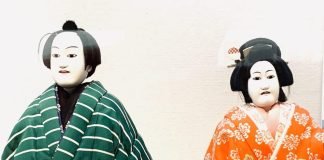
Love will tear us apart: Bunraku puppets representing Tokubei and Ohatsu, protagonists of The Love Suicides at Sonezaki (1703), the hit play based on a true and (then) very current story. Thanks to the National Bunraku Theater Exhibition Room (admission free), where this and other puppet photos were taken.
Sensational stuff. Imagine that less than a month later, a feature film based on the incident opened in theaters, becoming the blockbuster of the year and popularizing a whole new genre. Today, it usually takes a few years for a true-crime tale to get a cinematic treatment, and the resulting movies aren’t often Star Wars-level sensations. It seems things were different in 1703, when Chikamatsu Monzaemon’s bunraku play The Love Suicides at Sonezaki was staged before rapt audiences just four weeks after the events that inspired it.
Masters of Puppets
We are the hollow men: A male bunraku puppet, sans costume. Female puppets generally lack legs, being covered by a kimono all the way down.
So, what is bunraku? It’s “traditional Japanese puppet theater,” which sounds fun and lighthearted, and there are indeed comic moments, but classics of the genre are mostly tragedies or (tragic) historical plays. It was originally called ningyo joruri, combining the words for “doll [puppet]” and “recitation with musical accompaniment.” The recitation is part spoken and part sung or chanted, with voices and emotional timbres rapidly changing as a single reciter (tayu) plays multiple roles, for example switching back and forth between a girlish falsetto and a baritone growl. In 1684 the Osakan reciter known as Takemoto Gidayu founded the Takemoto-za theater in Dotonbori, where a fusion of joruri recitations and plays staged with puppets caught on with the public, and those penned by Chikamatsu made it a pop-culture phenomenon. The term bunraku was later derived from Bunraku-za, a popular theater in 19th-century Osaka, in much the same way that house music is said to have taken its name from the Chicago club the Warehouse. While we’re talking etymology, joruri [lit. “pure lapis lazuli”] derived its name from one especially popular 15th-century tale, Joruri-hime Monogatari [The Tale of Princess Joruri], which was – you guessed it – a tragic love story.
From blockhead to hero: Steps in fabricating a puppet head, in this case a warrior from a historical drama.
Joruri consists of one man with a voice and another with a plucked string instrument, originally a lute-like biwa, later a twangy three-stringed shamisen, which remains the standard today. The ningyo joruri revolution came when puppeteers began silently acting out epic tales with articulated dolls on elaborate sets. The puppets were initially small and handled by one person, but today they are about a meter high and important characters are manipulated by three puppeteers, one for the feet, one for the left hand (or right hand, as seen by the audience), and one for the head. Originally all puppeteers were dressed in black and shrouded in featureless black hoods, minimizing their presence even as they remained clearly in view, but today at important venues like the National Bunraku Theater[CS1] near Nipponbashi station in Osaka, the head-handling honchos have their faces exposed, perhaps because of public demand to see the stars. This only adds to the central magic of the genre, which is that despite all its machinery being in plain sight, from the men behind the puppets to the reciter and accompanist on a platform to the side of the stage, after a few minutes you forget the artifice, ignore the flesh-and-blood humans, and are completely sucked into the world of moving dolls.
The National Bunraku Theater on Sennichimae-dori in Nipponbashi, Chuo Ward.
This is thanks in large part to the incredibly fluid, lifelike and emotive movements of the puppets. Traditional arts and crafts in Japan often take decades of training, and here too it’s said that it takes ten years to become a leg operator (hunching down unseen by the audience and literally the low man on the totem pole), ten more to manipulate an arm, another ten to do the head, and yet another decade to be the head-master for a principal character. This means the big-name puppeteers tend to be guys of a certain age, as do the star reciters, many of them venerable Living National Treasures. This makes it all the more amazing when they join forces to bring a character like the young courtesan Ohatsu (one of the two main characters in The Love Suicides at Sonezaki) to life.
From then to now: Ikutama Shrine, probably looking much the same as it did in 1703.
Ikutama Shrine today. The surrounding neighborhood is a fairly even mix of Buddhist temples and love hotels.
Love Suicides Sites: Sketchy Sennichimae, Northern (Red) Lights
The National Bunraku Theater stands on the north side of Sennichimae-dori, east of Namba between Sakai-suji and Matsuyamachi-suji. It’s a colorful and slightly seedy area today, and was so historically, with red-light districts, cemeteries, and a public execution ground giving the Sennichimae area a less than wholesome character. Not far to the northwest is Dotonbori, where the aforementioned Takemoto-za and countless other theaters once drew crowds, and a block and a half down Sennichimae-dori to the east is Ikutama Shrine, where the story opens in The Love Suicides at Sonezaki.
Ikutama Shrine, near the Tanimachi 9-chome subway station, is a large Shinto shrine with misty origins before recorded history. It’s the site of the Ikutama Festival, every July 11 and 12, which kicks off Osaka’s summer festival season. The shrine is surrounded by a kitschy love hotel district, one of the city’s largest (there’s a smaller and shabbier one behind the National Bunraku Theater), interspersed with many Buddhist temples. This odd mix of virtue and vice may stem from temples’ connection to death and the afterlife, as they sometimes make ends meet by offloading land formerly home to cemeteries––which not many reputable buyers or renters would want, but love hotels are happy to occupy. Love and death, side by side, bring us back to The Love Suicides at Sonezaki and its doomed couple.
The Sonezaki-Shinchi red light district in olden times. Today Sonezaki is the name of a district in Kita Ward and a major east-west street.
Kitashinchi, as the present-day entertainment district is known, comes alive at night.
The true events that Chikamatsu so swiftly turned into a hit play occurred in the wee hours of April 7, 1703. Ohatsu (a pseudonym, with the honorific prefix o- added as was the custom for women in pre-modern times), a 21-year-old female sex worker employed at Tenma-ya in the Sonezaki-Shinchi red-light district, more or less overlapping with today’s Kitashinchi, lit. “north new land” (shinchi was often applied to red-light or entertainment districts, frequently built on reclaimed land or former wilderness), and 25-year-old Tokubei, a sales clerk apprenticed to a soy sauce merchant in Uchihonmachi, were found dead in a double suicide in the woods around Tsuyu-no-ten Shrine. We’ll return later to the shrine, known today as Ohatsu-Tenjin after the heroine, as that’s where the story comes to its tragic end. For now let’s return to the other shrine, Ikutama, where the action begins in the bunraku play. Leaving aside the question of how closely it’s based on real events, in the fictionalized version the two erstwhile lovers meet by chance at the shrine after not seeing each other for quite a while, just as Ohatsu is wrapping up a circuit of 33 Kannon (Buddhist goddess of mercy) temples and shrines in Osaka. The pilgrimage is portrayed in the play and foreshadows the “reborn together in the next life” theme of the climax, but that part is usually omitted from performances so as to get to the good stuff sooner. Bunraku, kabuki, noh… all traditional Japanese theater performances tended to be extremely long by present-day standards, like “bring your lunch to the theater, spend all day, take a nap during the slow parts” long, since life was more leisurely in old Japan and people lacked the vast range of entertainment options we enjoy today. If you go to see any of these today, you’ll usually see an abridged version… which may still seem long, but will be worth your while.
For a Few Dollars More…
Back to the story. When Ohatsu sees Tokubei, she’s none too pleased that he’s been out of touch for some time. He explains that his boss, who’s also his uncle, was impressed with his hard work and was trying to marry him off to his (the uncle’s) wife’s niece and have him take over the shop. Tokubei refused because of his devotion to Ohatsu, but the uncle went behind his back and gave betrothal money to Tokubei’s stepmother. When Tokubei put his foot down, the enraged uncle fired him, telling him to get the hell out of Osaka, that he’d never work in this town again, and what’s more he wanted his money back. Tokubei went to his stepmother’s village and managed to pry the betrothal money out of her, but then he ran into his friend the oil merchant Kuheiji, who begged him for a loan and promised to pay it back in three days, before the deadline for repaying Tokubei’s uncle. Tokubei agreed.
Together forever: A statue of Ohatsu and Tokubei at the shrine commonly known as Ohatsu-Tenjin.
Parentally arranged marriages, with varying degrees of willingness on the part of the children, still occur in Japan. Betrothal money (paid by the groom’s family to the bride’s) still exists too, the going rate being about 1 million to 1.5 million yen according to a major wedding-industry company, as do dowries (paid by the bride’s side). It all seems pretty antiquated, and it’s far from the universal practice it was, even among working-class folks, in 1703. But whether then or now, loaning your money to a friend when you’re in dire straits yourself seems like sheer foolishness. It’s a horror-movie “don’t open that cellar door” moment for the audience, who can guess that Tokubei is never going to see the money again and it’ll all be downhill from there. Apologies to my friends, but I can’t think of a friend to whom I’d fork over the cash in that situation… but either it was a different time, when loaning money to a friend in need was a no-brainer, or Tokubei was particularly pure-hearted, or both.
Some of the many kitschy murals memorializing the tragic couple at Ohatsu-Tenjin. The red band of fabric bound them together during the double suicide (a “red thread” is a common Japanese metaphor for lovers’ entwined fates).
Heart-shaped votive tablets inscribed with love-related prayers at Ohatsu-Tenjin.
Unlike the aristocratic Romeo and Juliet, these star-crossed lovers are a working-class guy and a working girl. Fittingly for a story set in mercantile Osaka, their troubles revolve around a few pieces of silver. While they’re at Ikutama Shrine, who shows up but his “friend” Kuheiji… who denies having borrowed the money, denounces the IOU that Tokubei produces as a forgery and Tokubei’s request as extortion, and to add insult to injury (or injury to insult), has his cronies beat him up. End of scene one.
Entrances to the Ohatsu-Tenjin-dori shopping arcade, which also comes alive at night, and the shrine.
There’s a Place for Us
Things get no better in scene two at Tenma-ya, where Ohatsu is the most popular of the young ladies on staff. Tokubei is outside the place and she has slipped out to speak with him when the dastardly Kuheiji appears and starts conversing with her co-workers. Tokubei hides beneath her kimono (one advantage of garments of that time that we don’t have today) as she goes inside to join the conversation. Kuheiji talks up the “extortion attempt” and predicts that Tokubei will be executed for it. Under the kimono, the two lovers communicate with their hands and feet, and he conveys his will to die by drawing her ankle across his throat. Quite a “feat” of communication… [Sorry!!] Scene two ends with the two slipping out to meet their doom.
The climax takes place in the Wood of Tenjin near Tsuyu-no-ten Shrine. The shrine still has that official name today, though everyone calls it Ohatsu-Tenjin (also the name of the neighboring shopping arcade, a main artery on the east side of Umeda), and it’s now a “power spot” for couples and home to some artworks of questionable taste (see photos). It’s close to Tenma-ya, which was a real place, near what is today Hanshin Fukushima Station. The couple finds a pine tree with entwined branches that looks like just the spot to depart for the afterworld, and after hesitation on his part and encouragement on hers, he kills her and then turns his dagger on himself. Oh, the humanity! You could indeed get the death penalty for a fairly petty crime in those days, but surely they could have fled Osaka and gotten a fresh start elsewhere, or something… Here, the genuine belief that they would be reborn together in a better place is essential. It may have been something similar that spurred well over a dozen couples to their own double deaths in the wake of the bunraku and kabuki adaptations of the incident, a phenomenon similar to the copycat suicides in Europe following publication of Goethe’s The Sorrows of Young Werther some decades later. What was it about the 18th century? In various parts of Europe, authorities banned the book and/or outfits resembling its protagonist’s, and in Japan, the Tokugawa shogunate first banned shinju-mono (plays, etc. about love suicides) in 1722, then outlawed love suicides themselves the following year, and even forbade use of the word for them, shinju (written with the kanji for “heart” and “center”), for beautifying the act. How could they penalize the dead? For one thing, their corpses were refused burial and left to rot, and if one or both should happen to survive, the consequences were not pretty.
The grave of playwright Chikamatsu Monzaemon, sandwiched between modern structures on Tanimachi-suji in Chuo Ward.
Suicide Solution
This cramped the style of Chikamatsu Monzaemon, whose plays in the genre turbocharged his career and put bunraku on the map. The Love Suicides at Sonezaki was Chikamatsu’s breakthrough work and remains a well-loved classic, thanks in part to its connections with well-known local sites. His The Love Suicides at Amijima (1720), based on the true story of the double suicide in Amijima, near Kyobashi in present-day Miyakojima Ward, of a paper merchant and a Sonezaki-Shinchi courtesan (do we detect a pattern here?) is actually considered a much superior masterpiece. In his time he was better known for historical plays, and his dramatization of the famous tale of the 47 ronin (masterless samurai), who avenged their lord after he was forced to commit seppuku, then committed seppuku themselves, was the basis for the bunraku play The Treasury of Loyal Retainers, a favorite to this day. Everyone loves a suicide story! After the ban on shinju, Chikamatsu turned elsewhere for dramatic material, but he was 70 at the time and died a few years later. His grave is down a narrow alley between an apartment building and a gas station on Tanimachi-suji, between Tanimachi 6-chome and Tanimachi 9-chome not far from Ikutama Shrine, the temple housing his family plot having been relocated.
Bunraku script used by a tayu (reciter). The red marks appear to be tips for pacing and intonation.
When Westerners think of puppets, they tend to think of children’s television, old-fashioned street entertainment, and manic comedy vibes. But in various Asian countries there are more serious and sophisticated dramatic puppetry traditions, as UNESCO recognized in 2003 when it designated both bunraku and wayang (Indonesian shadow puppetry) as World Intangible Cultural Heritage. Among traditional Japanese performing arts, bunraku is as complex, entertaining, and entrancing as kabuki or noh. The place to see bunraku in Osaka is the National Bunraku Theater, where condensed versions of famous plays are regularly staged. The condensed digests are still around three hours, so be ready to watch something as long as one of the lengthier Hollywood movies so common these days. Be sure to rent an audio guide no matter how proficient your Japanese might be (I think this goes for native speakers as well), since the language is antique and stylized. And be prepared to cast aside preconceptions and be astounded at puppets that come to life in stories all the more tragic when they’re (at least partly) true.
On the 10th of September, 2022, I visited one of my regular places for interesting experimental live shows as the line up seemed to catch my attention, partially because I was able to see couple of my friends perform live after some while, and also because the headliner of the event had a Finnish name, which stands out anywhere even on a global scale in its intriguing unusualness. Environment 0g, more familiarly zero gauge, is a basement space located in Sakuragawa, near the exit number 2 of Sakuragawa station, just across the bridge and to your right on the first building there is to be seen. Direct address for those interested is 3-chōme-6-1 Minamihorie, Nishi ku. Maybe hard to find at first if one does not now what they are looking for, one soon finds themselves regularly heading into the same place for interesting music and art performances. Especially home to electronic music, 0g also provides a large variety of events ranging from all kinds of experimental performances and noise shows to occasional hardcore punk and black metal events. So I would very much recommend checking it out if you get a chance. Kamikata Experimental is a monthly event curated by the owner Junya Hirano, who also runs the label Remodel.
What I really like about the space is that one can easily combine live sound from acoustic instruments to electronic sound provided by the huge PA system that is quite impressing to look at. The decoration and space design are minimalistic but interesting and fit the space and usually the music quite well. The events are usually kicked off by Junya Hirano, whose DJ sets are always interesting and you can usually find something to listen to long after the evening. Ranging from aggressive techno beats to minimalist and avantgarde fringes of the musical space, sometimes mixing different things together to come up with something completely new. Some of his sets can be listened to through mixcloud, highly recommended! This time I wasn’t able to catch his set as I was delayed by other things.
消えたとて浮かぶもの
I arrived when the first performer 消えたとて浮かぶもの Kietatoteukabumono was almost finishing up his gig, it was an interesting combination of modular synthesizer and voice, which together created an eerie landscape. Somehow the artist’s appearance was also fitting with the music, somewhat expressionless and distant, but moving to the rhythm, the sound of the voice melting into the textures, it was something I want to look into in more detail later on.
消えたとて浮かぶもの
Castanopsis
Next up was Castanopsis, whom I have seen a couple of times before. He too uses modular synthesizer, but creates soundscapes completely different, beat oriented, at times with something almost like a simple triphop feel to them. At other points he made me think of the tradition of Japanese ambient, although usually not so heavily reliant on the beat, the sound is somewhat similar. But the presence of a clear beat is something refreshing especially in the context of the modular synthesizers, which often appear to be left to their own devices, beeping and booping on aimlessly towards the predestined end of the show. But Castanopsis’ use of the instruments stands out, as it seemed to be painting imagery of beams of sun breaking through the clouds, lighting up the world after the rain or a long cloudy afternoon. Somehow too, although this connection might exist only in my head, it brought to mind some more mellow but beat oriented parts of Justin Broadrick’s Jesu, which I really like. Maybe there was a certain strain of sadness or melancholy running through the beauty of it all, and that might be what gets my mind wandering in its usual paths like this. But definitely this feels like music highly connected with light and transformation of it, slowly changing from one thing into another, moving in between different shades of same color during the half an hour set. It was somehow a really natural approach to sound, although everything was produced by synthesizers, but somehow filtering or some other effect gave it a warm tape-like quality which is always a great thing in my opinion.
Castanopsis
Zenmei
After Castanopsis, the stage was cleared for Zenmei, whose noise was accompanied by the visuals consisting of various movies like Altered States, and mostly by the footage from a steel factory, to which the harsh noise fitted quite perfectly. Somehow the contrast between Castanopsis’ nature-envoking sounds and Zenmei’s industrial, certainly more human made concept was also great in it’s harshness. The artist himself was wearing some sort of a cape and a mask, but the focus of the visual aspect was highly on the video projected on the wall. It was somewhat refreshing to hear such a straight forward burst of noise, epecially as the interesting looking instrument with huge springs laid aside on the floor gave a promise of intense junk action to come. I am not sure, but I think there was some sort of light sensitive effect used, alongside with some more often used and common noise sources. What really stood out was how well the visuals fitted the noise, there were heavier beats when the huge machines were pounding the steel beams, and some high pitched saw-like noises when there were circular saws, and other such elements that really fitted well within the context of audiovisual experience. And finally, towards the end, the spring instrument was played with a small axe, but before that the artist banged it on the high metal stands that are often used at 0g, which gave some probably improvised but welcome metal percussion aspects to the whole thing. Actually I would have like to see that implemented even more into the performance, as metal percussion would fit perfectly something like that, especially considering the visuals used. Maybe in the future he will find a collaborative companion from one of the Osaka’s metal percussionists!
Zenmei
Discrete Deity
Discrete Deity was quite minimalistic but meditative experience, consisting only of taisho koto played at first with almost only the acoustic sound of the instrument, then through slowly accumulating distortion, on top of which the voice created another layer. It was great to see the traditional instrument, as name suggests from the Taisho era, an attempt to make the traditional koto more accessible by slightly westernizing it to resemble a guitar in many aspects, used in such a different context. Although one might think the repetition of maybe two, three discordant chords might get tiring, it was quite the opposite. Maybe the tuning was also changing during the gig slightly, but mind kept listening to the sound even more intently, hearing new things among the sounds one already thought to know inside out, therefore diving deeper into it with each new discovery. The voice was drenched in echo which made it sound like some abandoned god screaming from the forgotten halls of time, along with the discords of koto it became really impactful experience in its own right. I also liked the fact that there was no loopers or even too many effects used, but the sound was just as it was. Eventually, the show ended with slowly disappearing plucking of the strings, which left the mic picking up feedback from the huge speakers, drowning everything in the high pitched, screeching sound, overtones of which rang beautifully in the concrete space. I think it was a great way to end the gig, as it left you feeling the sense of space, actually sensing it through your ears and listening to it ring. What I really like after a noise like that is how huge the silence following it sounds. The contrasts are important part of music, and the weight of silence can be heavier than any noise, no matter how huge the amplifier is.
Discrete Deity
Nobuhiro Okahashi
Nobuhiro Okahashi played his first live show in a while and I was excited to see him play. I also want to highly recommend his album Shine In, which can be found on Spotify and all the streaming services I think. Okahashi’s spacy drones are just immensely beautiful, they invoke images of the vastness of the oceans and skies, something that just spreads out into eternity as far as the ear can hear, and it does it so beautifully. Always a pleasure. Time just melts away completely. This time he also used quite a lot of field recordings which was new, I really liked that as they appeared to bring real life and world closer within the electronic sound. I talked to him after the show and he said he had lately gotten into recording field recording stuff with his phone, and that especially the last part with the garbage truck sound of Kansai is something that Osaka people will instantly recognize. I was surprised because having only lived here, I just assumed that all the Japanese garbage trucks will play the same songs, but apparently that is not the case. Live and learn!
Nobuhiro Okahashi with visuals by Kenji Tsuda
Nevertheless, the soundscapes of field recordings open up the space for new kinds of silence. When they are applied, one does not necessarily need regularly expected elements like rhythm or melody; if a short sample of sound is looped, human consciousness will build those both out of that material, and that to me is often more impressive experience than most of the well-honed music I have witnessed in my life. To listen to a simple sound happen again and again, to hear the musicality of it, and simultaneously realize that it is your own consciousness building that music out of the mundane source, that is where the magic of art and music happens in my opinion. This sort of observant way of listening opens up new pathways in music, and I hope Okahashi will explore them further in his future works, as they fit well with his ambient, slowly evolving landscapes, adding somehow another reality on among it and transforming everyday reality into music.
Johanna Elina Sulkunen with visuals by Tapani Toivanen
Lastly, it was time for Johanna Elina Sulkunen to take the stage. The music was accompanied by the visuals by Tapani Toivanen, and they both worked together immensely well. At first the sound, being more abstractly voice focused, the visuals started from nothing and slowly became evolving into grainy light like shapes, like cells still uncertain of what sort of lifeform they will eventually create, then, little by little the voice and synthesizer landscapes came together, the visuals became more distinct, clear. There was material of plants, deserts, different sorts of life and environments, that were getting some sort of glitch and modulation by artificial intelligence, and I must say this material was by far probably the most interesting AI use in visual art I have seen to date. And even thematically, they fitted well together with the sound; there were almost spoken word piece like parts about nature, and somehow the interaction of human voice and synthesizer made me contantly think of the symbiosis between human beings and machines in this modern era we are living right now. It was interesting and thought provoking, like mechanical birds flying out, the images of nature being glitched and transfigured by machine thinking, but human mind being the curator who chooses what the machine has to think, setting up the limitations of those thoughts. Therefore arose another question in my mind, who or what has set the perimeters for our thinking capacity, and are there limitations we can not exceed within the context of our understanding, because we are unable to see beyond the system within which we are operating? Art that makes you think thoughts like this is definitely worth the time spent with it.
Johanna Elina Sulkunen with visuals by Tapani Toivanen
Somehow, the set seemed like a constant on going conversation between organic human and the thinking machine. Sometimes the other was louder than the other, they grew on each other and affected each other, and the visuals followed. I don’t want to use the word “battle” or “struggle”, simply because it did not feel like one. It was not a competetive effort, but a co-existence, it was not positive or negative force, it was just something… natural, something that flowed through consciousness. And I mean this as a high praise. It is not an easy thing to do, something like that. Something that just “is” instead of declaring something huge and usually making the exclamation seem slightly cartoonish or blatant. This sort of expression seemed somehow more honest to truth, the experience of existence itself, more expressing how it is, than wanting to know why or what it is, trying to pidgeonhole it into something certain, which I think is often a doomed attempt to begin with.
At this point I realized that somehow, probably unintentionally but nevertheless there arose a running theme of natural versus industrial, organic versus mechanic in much of the nights music. Actually, the unintentionality of it made it even better, because that way it happened more organically, the separate, completely different entities coming together into interaction. With different performers the underlying theme might have felt different, but in this context everything seemed to be having this one going conversation of natural sound and synthesized sound. And in the music of the headliner, this too seemed to come into some sort of conclusion in a great way. I could definitely hear something very familiarly Finnish in it too, probably everything heavily leaning on the vocals has some strain of Lau Nau’s legacy in it, but Johanna Elina Sulkunen stood firmly on her own feet on this instance too. Besides, having lived in Denmark for over a decade, she might not be too attached to the Finnish music scene as such anyhow, but from a personal experience I know, that no matter where in the world one of us ventures, they always take some small mental corner of moss and pine trees with them.
After Osaka her tour took her to Kasai and Kyoto for three more shows, although without the visual aid of Tapani Toivanen, which I think was kind of a shame, because they worked really seemlessly together and the visual aspect also gave a lot of food for the thought, as it appeared to be evolving with the sound, searching new life forms and pathways of existence, lifeless images having some amoeba like movement and faces transforming into others, clouds coming and going out of existence, it was all really interesting I thought.
Everyone in the audience seemed to enjoy the experience a lot as well, and when one viewer said after the show, that “Finnish people… are not really human, but pure nature!” I couldn’t help but feeling somewhat proud of my countrymen, who are often overlooked as they are few and live far apart, in a country mostly uninhabited. But that connection to the nature is exactly a thing that connects Finnish and Japanese culture in a way that not too many other nations appear to understand so profoundly and naturally in their bones.
A while back in late May, I visited an exhibition at the Osaka Historical Museum. The exhibition was Naniwa hyakkei, hundred views of Osaka, consisting of historical woodblock style prints of the famous places and sites of Osaka, depicted in different times in history, mostly during the last 200 years to the beginning of 1900’s. As I am also a woodblock printmaker, it struck me as an interesting exhibition showing Osaka through ukiyo-e, traditional and well-respected local tradition of printmaking. It was very nice to walk around and see the old maps and prints of places I see every day, and how they were built around 100 years ago. It also became a sort of a game to try to spot out my dear neighborhood of Kujo from the maps, but mostly it didn’t appear to exist until fairly recently. Nevertheless, seeing the places and famous sights seemed to give some interesting context for this city that has felt more like home than probably any place I have lived before. Still, in that exhibition I also stumbled upon something unexpected, something that delighted me enormously, and that is the strange, wonderfully aho (”stupid”) world of Utagawa Yoshiume!
Utagawa Yoshiume, Nakajima by his own name, was born in 1819, in Osaka, and died here in 1879. He was the disciple of the world renown Utagawa Kuniyoshi, who is known for his surreal and imaginative imagery, sometimes scary ghost images, sometimes cats or sparrows going on with the everyday doings of human beings. It appears that some of his master’s imagination also seeped into the work of his disciple, who, among the many other sorts of works of course, made the series depicting ”Comical views of famous places in Osaka”, kokkei Naniwa meisho. He was one of the leading Osaka based ukiyo-e artists of his time and most of his work consists of portraits of kabuki actors, illustrations for books and other more common works, that are pretty much found through out every woodblock printmakers career, as they were what brought the bread to the table.
Usually ukiyo-e, the pictures of the floating world, paint the fleeting moments of human interactions, kabuki plays, nights out, themes taken from the nature and people admiring the beautiful natural view. Probably the first image to pop up to a Western mind is one of the most famous image of this type, the Great Wave from the series of 36 views from Mt. Fuji, by Katsuhiko Hokusai. They can work as a good introduction to ukiyo-e for newcomers, as they convey most of the key elements of the work; skillfully made, elegant, at best astonishing, beautiful and serious works of art. Of course these pictures come in all shapes, sizes and themes, let it be horror stories or gory displays of suicide, or townspeople fighting with farts, or some beautiful lady making love with an octopus, but the majority of the works one sees in the museums are usually of the sort that makes you gasp and admire the seriousness and dedication of the artist, carver and printer, all of whom come together to bring these beautiful works of art into the world. Most of the time one looks at the works in awe, trying to figure out how could somebody draw and cut lines so thin, when at least I appear to have the problem to get the nth cup of coffee from the table all the way to the mouth without spilling it all over. These intricate works of art somehow speak of the noble pride of the craftsmen and the artist, continuing their lineage and carrying onwards the name of their masters for the future generations to come.
The Inari shrine at Akatenugui. Source: https://fi.frwiki.wiki/wiki/
Having this sort of background of knowledge of the art presented, Yoshiume’s work seemed fresh and wild and they caught me by surprise. They are humorous and probably to some viewers vulgar, depicting for example a person of high stature on a beautiful horse, that just appears to be pissing like a waterfall all over the courtyard. In another image, an old lady is squatting in the rice field on a hot summer day, and the way the by-passers pinch their noses make you just almost able to smell the image. There is a depiction of bewildered foxes beating up an Inari shrine by-passer with sticks. There are also quite a few of pictures where drunk people are returning home at night, either dropping their precious sake and spilling it all over the ground, or being frightened by some ghosts that turn out to be either a kite stuck in the branches, or just the tree itself. But the expressions on the faces of these people, the insanely animate movement of the characters, all seems so humane and relatable that you somehow innately know how these people feel the kites and the branches are the ghosts from their childhood folktales. I think that is somehow a big part of it. As someone who grew up on the Finnish countryside, ghost stories and folk tales were a big part of teaching children what to do and what not to do. I mean, even as an adult I still might have some hesitations about looking under a lake pier in the unnatural fear of actually finding a Näkki, a Finnish water-yōkai lurking underneath it, so I can definitely understand how even grown up men can be scared to death of things and visions conjured by intoxication. Also there is something really revealing about depicting drunk people slouching back home. It tells you that it is normal, something you see quite often in real life, so I think there is a great deal of honesty in bringing that to art too. Art has sometimes a tendency to be a very carefully handpicked and selected view of reality, pretty and nice things instead of what it actually is, and for that reason it is sometimes refreshing to see something you see in your everyday life depicted in the art of the past too. It makes you have a sort of comforting feeling, that people have not changed too much, the past and the present are not too disconnected although many people build images based on these curated views on some era, and deduct that the life must have been utterly different back then. In the end, aren’t we all the same sort of beings with the same sort of fears and hopes and dreams? It is kind of hard to think that much of that would have changed in the last couple of thousand years at least, although our utilities and means of manifesting our hopes and fears in this reality have changed quite a bit even in my relatively short life time. But this is why depicting everyday things is important, it gives us a more well-rounded, honest view of an era and the wonderfully strange human beings that inhabit this Earth.
Zakoba fish market. Source: https://fi.frwiki.wiki/wiki/
Among the works there were also visions of lively marketplaces, but of course there was always something absurd about them. A hawk stealing the just sold fish and everybody trying to desperately grasp it somehow, although the bird of course is flying further and further away with its delicious catch. Merchant reaching the top of the bridge with a big load of fruits, only to have them all toppled over and roll back down to the bottom. One of my favorites was the image where the fish marketplace was serving octopus so fresh, that they were in fact still choking the merchants and spraying ink all over the customers. It was interesting to think of the amount of work all of these prints needed in order to make them exist. All the sketching, carving the blocks, test printing the colors and doing it again and again until the image is perfect, only to produce an image of a pissing horse. I think there is some wonderful poetry in that. The ink jet of the octopus was done with a beautiful, technically flawless printing, which captured the eye for a long while as I was trying to figure out how much of it was printing and how was it carved. Especially because part of the ink is behind people, some of it is on top of them, which gives the image a totally new sort of 3 dimensional depth. Sometimes it would be interesting to see the blocks of some the works like this alongside with the print, but I understand that might be kind of a niche market. Although I think maybe if more people saw them, they might find more interest in diving into the traditional Japanese arts in the role of actual practitioner too, and that would secure the preservation of the arts in the long-term future too.
A view to the Aji River. Source: http://japankonst.blogspot.com/2017/06/
The color palette is also interesting, as the images are colorful and sometimes brightly so, actually so colorful that you might not at first even understand what you are looking at. It tricks you into believing the familiarity of visual context, your expectations for works of art deceives you. I am thinking now, that this might be somewhat an outcome of the modern visual culture we live in, as we are constantly blasted with all kinds of images and visual content. That, I think, is essentially the beauty of these prints. As your consciousness gets through the image and the sometimes strange composition of the it, little by little you start to build the image in your mind and you realize the oddity of it gradually. Your expectation guides your perception, and as your perception is deceived, the moment of realizing that you are being deceived seems like a small enlightenment of joy. It opens up like a flower inside your consciousness. I think quite a few modern artists would make all these works in earthly tones and try to depict the grimness and bleakness of the world of piss and squalor and filth and try to put some political message or twist to it, but that sort of blunt, boneheaded approach gets old quite fast. It is exactly this delicate balance and contrast of the color and subject matter, the absurd stupidness and the beautifully produced work of art that makes these prints so remarkable. It also makes one think that someone should probably produce something like this of our age for the future generations, just to let them know that we weren’t all just bleak doomers all the time, we also fell down clumsily and walked into a street light pole while looking at our phone, or something like that. Actually that reminded me of how in Osaka Hankyu trains there was a public service announcement commercial running on screens a few years back that showed noble samurai and other Edo period people trying to walk and look at their phones at the same time, falling into ditches and bumping into things. I thought that was genius piece of information sharing, but only managed to see it a couple of times.
What was delightful about these prints was that they showed how the Osaka spirit has not changed in at least for the last two hundred years. As the city is largely known as a lively and welcoming business city of merchant origin, I think this somehow only half explains some of it. It is not only business or food that defines Osaka, there is something more real, more wild always hiding right beneath the surface. Real life in a way you don’t feel in a lot of larger cities. The fact is, Osaka doesn’t really feel as big as it is, and the different areas have a somewhat strong identities that make it feel strangely familiar to me at least. Basically, there is somehow a really countryside-like hands on approach to everything. A former teacher of mine used to laugh about the fact, that the rest of Japanese people are sightly scared of Osaka-folks, because whereas most Japanese do as they are told, Osakans do what they want, and it might be unexpected and strange. From my personal experience I would say that at least artists and musicians in Osaka are largely guided by hara, the gut feeling or intuition, and if that is how you happen to be build in this largely randomized lottery of genetics and environmental influence, you’ll probably fit right in. Of course a city this big has all kinds of people in it and I don’t know even a small percentage of them, but this has been how I have experienced it. For example when it comes to music, many of the Tokyo-based groups I have seen have a very well-rehearsed, tightly wound performances where you get the sense of professional approach, but also the lack of surprise, whereas Osaka and Kansai overall has probably more free spirited, open ended approach, where accidents and coincidences lead up to new discoveries and every performance becomes unique in that sense that it is happening right here and now, only this once, before it changes into something else for the next time.
In Yoshiume’s prints one can sense the sort of absurdity that appears to be all around Osaka, written into the genetics of the city itself. It is exactly that random strangeness that keeps the city exciting and new each day even after years of living in here. The people, the places, hidden art galleries and cafes that most people won’t realize exist even when they are standing at the front door of it, Osaka is full of small, hidden secrets. The people can laugh at the strangeness of this life and then talk about the dreams they had with the sort of introspective insight that would make Jung feel like a high school student. In a way, because of the subtle balances like this, it feels like Osaka is always drifting somewhere between wake and dreams, although this may sound too esoteric or unnecessarily romantic expression to most readers. But the prints made me feel a strong connection to the city itself, the people, the way of living that is not probably only unique to Osaka itself, but to a certain wild and experimental spirit of cities that are ”not-capital”, but always slightly shadowed by it. It is a sort of liberating approach to existence itself, as the whole of the city is free from being the focal point for the rest of the world, and they can just pretty much do whatever they want. It allows more wild experiments, more free spirited searching of the new paths that other people don’t dare to tread on. That kind of spirit definitely allowed movements like Gutai art emerge in Osaka, which is something I will cover in the near future.
I hope that Yoshiume’s prints will be displayed in Osaka or anywhere else again in the near future in some larger extent, as I really think they truly capture the essence of Osaka in many ways words can ever tell.
Blue is a solo contemporary dance performance by Mayu Shirai and Riku Otoyono. Mayu Shirai is an Osaka-born dancer and dance teacher who encountered street dance at an early age, moved to New York for a few years during university and deepened her connection with dancing during that time, participating in various workshops and collaborating with various dancers. Currently she lives in Osaka, where she has her dance school and collaborates with various artists. This was her first solo performance piece, an event that was held at Studio Port Mina, three performances during two days 29th and 30th of April, 2022. I went to see the first of these performances, which were based on improvisation upon the theme and overall thought out structure. Riku Otoyono is a solo musician who works under the title 夕方の豊野. In this performance he was set up in a corner with keyboard, guitar and laptop in a setting, that seemed enviably comfortable and fun for anyone who likes exploring sounds.
Photo by U Mizukawa
The setting is simple, yet brilliantly thought out. A small, one room dance-studio with white walls, a chair against the back wall, and on the chair a blue dress, colored by the artist herself, the knowledge of which somehow adds up to the experience of watching it as a work of art in its own right. The impression is strengthened by the bright light aimed at it, the music on the background, which contains sounds of harbor and percussive elements, low key, in a way ritualistic in this context. The room has three sources of light, the forementioned brighter, still dim light, blue light on the floor halfway through the stage, and on the floor in front of the stage a ribbon of small lights, under another blue cloth, which makes the whole scenario look like a wave frozen in time. The cloth on the chair, compared to these other elements, appears to be distant, sublime, out of this world, far from the audiences reach.
Photo by U Mizukawa
Soon the performance begins. The dancer stops right next to me before stepping over the frozen wave-like cloth and into the stage. What is instantly noticeable is how well the music and the movement go together in this moment. Lingering, slow, but somehow tense and anticipating. Both have the sensation of a wave, the ebb and flow, breathing in and out, and this also goes for the composition of the whole 50 minute performance. At first, the impression of the dress being out of reach seems to be somewhat valid. The dancer approaches, is caught up and pushed back to the beginning, but resiliently tries again.And again, and again. Eventually on the third or fourth try she reaches the blue cloth and the movements become more fluid, evoking elation and happiness, childlike joy over a rare finding, it is like first love, something pure and beautiful. The dress covers her face, she dances with it, but not in it, it is still an external thing, unknown, exciting. It invokes happiness and joy in beautifully natural way. Slowly, little by little, the dancer slips into the dress, wears it, becomes one with it.
This marks a dramatic change. Movements become sharper, panicking even, as if a painful transformation from one being into another. The music underlines this perfectly, it becomes noisier and more eruptive, the transofrming figure writhes and aches in front of the audience and in the climax everything goes suddenly dark and silent. The impact of this silence is an immence experience. The space is very well thought out in it’s intimacy. Little by little the movements begin again. The music begins again, this time from simple sounds that build up into a percussive loop. The blue light comes on. Mayu’s shadow becomes an important element from this point on. It seems like she is dancing with her shadow, that obediently follows her movements on the wall, she approaches it and distances from it, moves back and forth and seems to find some sort of acceptance and resolution within herself. The movements,little by little, become peaceful and more serene again. The music follows this, the marine soundscapes are soothing and blissful.
Riku Otoyono was in charge of the music of the production. Photo by U Mizukawa.
Then, as one has already forgotten they even existed, the small lights right at the edge of the stage come on and the blue light goes out. The impact of this is also intense, it seems like the simple lighting design of the whole performance goes from brighter and wider to darker and more intimate, like dwelwing deeper and deeper down into ones mind, into the most intimate and hidden parts of consciousness. Somehow this is also conveyed in the dance, as the movement and dancing is transformed into just being. Standing on the small lights, touching the blue cloth covering them, like being on the seashore by oneself, listening to the waves and thoughts, the intensity of this experience was such that I at times forgot to breathe. Then, another form of light is revealed, in it’s simplicity a smartphone flashlight, against which she shows two small paper ships, the shadows of which grow huge on the wall. She puts the light on the floor and moves the ships across the floor, so that the shadows sails on the wall. Then, became the small moment which I thought was the opening moment, 開くの瞬間。In every good performance, there is the small moment, sometimes intentional, sometimes coincidental, that is quite irrelevant, where the performance itself opens up, lik a flower to a full bloom. As the ship was left on the floor and Shirai reached for her phone, the ship’s shadow sailed through the wall without the effort of a helping hand, and that somehow seemed like a genious invention within the composition of the whole performance. Then, she placed the ship on the background, the other one slightly closer, and the shadows instantly became a landscape in their own right. The ships are left as they are, and as she stands next to them, her shadows strething huge over them on the wall, but not the least bit threatening, calm, protecting. She appeared as a goddess of the Sea, minimal movement giving this beautiful scene enough time to sink in.. What was overwhelmingly astonishing in the performance overall was how someone can express such tranquility although the excitement of the performance itself must be pulling body to a wholly different direction. Especially the facial expression transmitted nothing but peace and calmness. It was intense and beautiful experience. Somehow, the image of the shadows on the wall and the music has been etched deep into my consciousness and I notice myself still returning to them in some mundane and apparently unconnected moments.
Photo by U Mizukawa
Then the final part, immensely impactful in it’s fragile beauty, how she returned to the shore and to the small lights, slowly took off the dress and left it at the shore. The piano with it’s Japanese scale based music seemed to underline this moment perfectly, I think every person in the audience felt it, this is humanity, existence, imminent, melancholic but beautiful goodbye that we signed up for with our first breath, that is something we all share and therefore innately understand, and this small moment with it’s every detail, how the dress slowly joined the other blue cloths, becoming one with it, inseparable, unrecognizable, the small, sad smile at the moment it floated down, all of that was pure poetry in dance and motion. How little is required for such an immense emotional impact. The lack of noise, the lack of big motions, just a simple act of letting go, subtle and beautiful little moment at the end of something intense. It made me think of many important aesthetic experiences in my life and I think I might be returning to this inside my head for years to come. This small moment probably sent the biggest shivers all over me, as it was somehow really huge in it’s uneventfulness. Maybe exactly because it followed dance, movement, it felt cathartic, beautiful, the end. The lights went back on after a short while, and it seemed like everyone needed a short while in order to return from where ever we were, in some commonly shared state of consciousness. I think, at least for a person like me, this is exactly the key element to transcendent artistic experience, to be transmitted from the ordinary state of consciousness into something shared, with the audience, with the performer, something we all explore and discover together. That is usually more apparent and imminent in performances based on improvisation and exploration, which is probably why I am driven towards that sort of approach to art.
As the performance came to an end I felt happy for Mayu. It was the first one of three scheduled performances taking place in two days. And I thought it was a brilliant start, not only for the performances, but for her future projects too. What I thought was particularly well thought out in the first place was the space and lighting, the composition of the whole experience. If it would have been a big budget production in a huge stage far from the audience, I think the impact would not have been quite the same. In a larger space, you need larger, more over the top action to fill the whole of the stage and space, unless your wanted effect is in fact the opposite, the sensation of smallness. But in place like this, every movement, every breath seems to count in a different way, everything matters. This way, the intimacy and especially the lights and shadows became elements that served the performance well in their own right. It was a triumph of innovation and creative thinking, instead of buying your way out of most problems there could be. Studio Port Mina was a great location for this piece, the audience was limited to few handfuls of people and it seemed to bring every person close together in the sold out performance.
Photo by U Mizukawa
What I was thinking after the performance was how this was in many ways a triumph of creativity and innovation. The simple lighting composition especially was brilliantly thought out. The simplicity and minimalist approach worked perfectly in the context of the performance itself. The direction, forementioned order of use, the way lighting moved from brighter and more general to something darker and more intimate, everything seemed to work in the favor of the performance itself. The lighting was executed by Tomoya Ogishiba, who runs an art bar Maga-Yura in Noda, right across the JR loop line station. The practice performances for this performance were also held in Maga-Yura, and Mayu Shirai does also perform morning dances there on Monday mornings, 8-10 am, on the rooftop so it can be seen from the station platform. I also highly recommend visiting Maga-Yura, as it is one of the most soothing things possible to listen to ambient performances while watching the trains and the passengers go back and forth. But I am sure there will be another article about Maga-Yura later on.
In the absence of huge budget and huge stages the performance achieved interesting and thoroughly touching quality of intimacy that could not have been achieved any other way I think. If it had been a huge production on big stage, the movements might have been bigger, but maybe the impact had been different, somehow smaller. This way, on a small, confined space, the movements overall composition was much bigger in relation to the space available, and such was also the emotional impact of the movements. Every pause, every breath counts, when it is right in your face. The bigger the space, the more you need to do in order to fulfill it, unless one’s purpose is to underline the lack of something or the smallness of the performer. But I instantly thought, that Studio Port Mina was the perfect space for this performance. The studio is also available for dance classes and for rent for performances such as this.
Somehow, before the performance, with the cloth laid on the chair in mellow light, the tension seemed to start building up towards the back wall, towards the cloth, unachievable for the audience, first out of reach even for the performer, who eventually heroed her way towards it, redeeming us all from the tension of the unattainable. It seemed like an installation in its own right.
After the performance the atmosphere seemed relieved and relaxed, a local brewery had produced two special beers and a mikan juice that were sold on the occasion. Everybody seemed to have thoroughly enjoyed the performance and I as I left, I felt happy for going to see it, as it felt like Mayu’s journey as a dancer and performance artist had taken an important and interesting step towards something new, and this is just the beginning. I hope in the future she’ll be provided with the resources to make the productions exactly as she sees them, as it might become even globally interesting, but I was also glad for the smallness of this production, because it bred some really interesting and creative solutions to some practical problems that other’s would have tried to solve just by showing money into the problem until it disappears. I really prefer this sort of approach.
Luckily enough these performances were documented well enough, and a shorter, edited version of it is uploaded to Youtube, so I highly recommend you’ll take the time to watch it. There is also an extensive photo gallery of the performance uploaded to a separate instagram account. I am glad to provide this text as part of this sort of documentation, for I think contemporary dance is something that people might think of particularly difficult to approach if they come from the world outside of it. I can not say I would understand much of it, but especially in recent years I have maybe come to understood dancing in a much larger context than just “moving with the music”. We all have a body and it moves in a completely unique way, that is something we all share, so I think at best dance performances can help one to somehow understand their body and its movements and its effect on everyday consciousness in a pretty profound and sometimes emotionally touching way. For me personally this performance was really interesting, maybe even healing in some level, and it inspired me to think of things slightly differently, so I am honored I got to see it.
If you have any wishes of what sort of underground and marginal events or phenomenons you might be interested in reading about, I will take suggestions, but Osaka as a whole is always swarming nest of various different things, interesting people making some of the most interesting art on this planet and definitely funniest people to be around I have ever met, so I have quite a few ideas for the future. Still, as I am sometimes in the middle of the action, it might be difficult to distance myself from it, so I am asking whether the readers might also excuse a more “hands on” approach to for example event reports. You can contact me through this site or zenfilth@gmail.com .