






The movie, though shot and released in 1955, plays out in the early years of the Showa era, in circa 1932. Featuring Osaka before World War II with large parts of the inner city still consisting of narrow lanes lined with traditional wooden buildings.

Toho, the studio producing the film, spent lavishly on the reconstruction of old Osaka on its studio sets and that shows. They didn’t just rebuild one street like smaller film studios would do – they recreated a part of the old Hozenji Yokocho neighborhood in Namba, just south of Dotonbori in great detail, along with parts of old Dotonbori itself.

The special effects master overseeing all that construction was none other than Eiji Tsubaraya, who had also build the sets for all the early Godzilla movies, he later recreated historic Osaka for the 1961 Osaka movie Daredevil in the Castle.
Just that this time, Tsubaraya didn’t get the chance to grandly blow up his constructions as he did in so many other Toho productions. Meoto Zenzai is a rather quiet film after all, strictly aiming for down-to-earth realism.
Table of Contents
Meoto Zenzai (Japan, 1955) 夫婦善哉
Ryukichi Koreyasu, the son of a wealthy wholesale cosmetics merchant, is introduced by a dialogue between a trader arriving for business and a Koreyasu company employee: “The young master? He’s been disinherited and he disappeared. Maybe he’s with that girl in Shinmachi…” Shinmachi being the traditional red-light district of Osaka.
Indeed, Ryukichi (Hisaya Morishige), the young master of the Koreyasu cosmetics trading house, a married man and father of a teenage daughter named Mitsuko had fallen in love with the popular Shinmachi geisha Choko (Chikage Awashima) and had decided to run away with her.

Ryukichi and Choko make it as far as Atami, the famous hot spring town in Shizuoka Prefecture, south of Tokyo. Ryukichi hates Atami for being a run-down town, to top it off, a strong earthquake hits while the two fugitives discuss their options. Clearly a reference to the Great Kanto Earthquake of 1923 which destroyed much of Tokyo and Yokohama.
Ryukichi and Choko hurry back to Osaka where they shack up with Choko’s parents who run a humble tempura shop.
Choko re-enters the geisha business. She still has the old connections and she knows how to make money there – money she strictly saves for her future with Ryukichi.

Ryukichi on the other hand has no skills at all. All he can think about is getting his position as the heir of the Koreyasu business back. He squanders the money Choko makes on nights out drinking, he even steals her savings to that end.
His father won’t budge – he disinherited Ryukichi and that’s it. For him, Ryukichi betrayed the family and has thus rightly thrown out of the house.
Ryukichi’s sister Fudeko marries and her husband – university-educated no less – is made the new young master of the Koreyasu trading company. He doesn’t know much about the business and focusses all his attention on cleanliness… even the slightest bit of dust can get him into a bizarre furor.
Choko gets serious about starting a business together with Ryukichi. They opt for an eel restaurant, Ryukichi being a gourmet after all. The business fails because Ryukichi soon loses interest; then he gets seriously ill.
Choko finances his surgery, including his convalescence stay at the Arima Hot Springs in Hyogo Prefecture, in the mountains north of Kobe.
Ryukichi’s wife dies along the way (we never get to see her), there is a subplot involving daughter Mitsuko’s difficult relation to her father.
Choko opens her own bar / sukiyaki restaurant and it immediately becomes a favorite of the Osaka press. That press consists of rowdy reporters and sneaky photographers, some of them like to throw new-fangled English terms around, like “Darling” and Lady”.

Choko is no stranger to wild parties herself and with those newspaper men, she lives it up as only a geisha would do at the time.
Things between Ryukichi and Choko keep getting up and down. In a desperate moment, that gas hose leading up to the sukiyaki tables on the second floor of the restaurant is used for quite dramatic scenes…
Whatever happens, Choko struggles on and she always succeeds in one way or another while Ryukichi comes off as the charming loser who always wrecks Choko’s best efforts.
She loves him nonetheless…
The Novel
The film was based on the 1940 book Meoto Zenzai by Sakunosuke Oda (1913 – 1947), an Osaka writer who focused his novels on characters on the margins of Japanese sociey. Along with Osamu Dazai and Ango Sakaguchi, he was considered to belong to the buraiha school of decadent writing. He was despised by conversative critics and some of his books were banned.
Oda was born in Osaka and he wrote about the Osaka he knew – the common people, their lives and neighborhoods.
Oda lived near or frequently visited the Hozenji Yokocho area just south of Dotonbori – that’s where he placed the central locations of his novel Meoto Zenzai.
Jiyuken Curry Rice
By many accounts, Oda was a regular customer at the original Jiyuken restaurant a bit south of Hozenji Yokocho. Founded in 1910, the Jiyuken was the first restaurant in Osaka to serve yoshoku (Western food adapted to Japanese palates) and especially famous for its curry rice.
The restaurant still exists today and is still very popular. Comments on google maps praise the great curry and complain about rude waitresses. Still a true Osaka joint after all those years.
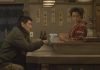
Anyway, in Sakunosuke Oda’s novel (and the subsequent movie) Meoto Zenzai, the Jiyuken is Choko’s favorite eatery. At one point in the movie, after a fight with Ryukichi, she sits down at a table and orders two plates of curry rice – even though she is alone.
She immediately calls herself stupid after doing so but that order sets the scene for the real Meoto Zenzai later on.
Meoto Zenzai – the Azuki Bean Dish
Meoto Zenzai was originally the name of a sweet azuki bean dish first served at a restaurant named Ofuku on the grounds of Hozenji Temple in Namba in about Meiji 16, the year 1883 in the Western calendar.

Zenzai is traditionally a sweet azuki bean paste mixed with crushed azuki beans and a piece of mochi rice cake inside.
The founder of the restaurant, bunraku (puppet play) narrator Takemoto Koto-dayu had a genius idea… not serving a large portion of the sweet dish in one big bowl but dividing that one serving into two smaller bowls. That way, the serving felt larger.
Takemoto named his way of serving zenzai the meoto zenzai (translating to good couple), eventually drawing a lot of young lovers to his spot.

The restaurant, later renamed after its most famous dish, Meoto Zenzai, still exists today and can be found right there in Hozenji Yokocho.
Sakunosuke Oda titled his novel after the dish, which then also became the title of the movie adaptation.
International Movie Title
Toho Studio knew of course that Meoto Zenzai carried absolutely no meaning for international audiences. So, they first went on to promote the film internationally with the title Love Is Shared Like Sweets.
When that didn’t work out as intended, the studio went for the bland English-language title Marital Relations.
Despite the fact that the movie is not about any marital relation at all… rather the opposite. It’s about a decidedly non-marital relationship.
The Director: Shiro Toyoda
Director Shiro Toyoda (1906 – 1977) was a Kyoto native who went right after his high school graduation to Tokyo to study script writing, intending to become a theater playwright. His teacher was the pioneering early Japanese film director Eizo Tanaka.
Tanaka quickly got Toyoda interested in movie work. In 1925, Toyoda joined Shochiku Studio as an assistant director. The Shochiku bosses apparently didn’t see much potential in him and kept him in charge assisting in the production of low-quality output.
Dissatisfied, Toyoda took the chance and joined an up-and-coming new studio which quickly grew to become the absolute powerhouse Toho, soon to be Japan’s by far largest film studio.
Toho offered Toyoda directorial positions rather quickly, he made his debut there in 1937 with the successful novel-adaptation Young People.
Adapting novels for the screen became Toyoda’s focus point for his following career. He directed more than 60 movies, almost all of them based on more or less famous literary works.
Toyoda worked with a small trusted group of screenwriters and technical staff, especially his chosen cameramen, he developed close working relationships with his favored actors. Backed up by the large resources of Toho Studio, his approach proved to be the perfect recipe for at times challenging but highly profitable works for Toho.
His Meoto Zenzai for example scooped up all the Japanese film prizes of the year, including the Blue Ribbon Award for Best Director, Best Actor (Hisaya Morishige) and Best Actress (Chikage Awashima).
The Actors

The character of Ryukichi was played by Hisaya Morishige. Morishige (1913 – 2009), was born in Hirakata City, Osaka. He studied at Waseda University in Tokyo, started out as stage actor and, during World War II, worked as NHK radio announcer in Manchuria.
After the war, he entered the movies. He got his first role in the 1947 movie Joyu, directed by Teinosuke Kinugasa, a classic movie master who had started out in the era of silent cinema.
The Internet Movie Database (IMDb) lists 288 films in which Morishige appeared during his long career. Though the term “films” might not be quite correct to describe all of his screen appearances, especially in the later days of his career. From the 1970s on, he worked primarily in TV, acting in many TV productions which may not actually qualify as real movies.
Morishige did act in quite a few classic Japanese movies, though. Worth mentioning are Snow Country (1957), another film directed by Shiro Toyoda and based on the famous novel by Yasunari Kawabata, The End of Summer (1961), directed by Yasujiro Ozu and 47 Ronin (1994) by Kon Ichikawa. Morishige also worked as voice actor on Hayao Miyazaki’s anime film Princess Mononoke (1997).

Chikage Awashima played the role of Choko in Meoto Zenzai. Awashima (1924 – 2012) originated from Tokyo. However, her relation to Kansai dates back to her earliest days. At age 15, she joined the legendary all-girl Takarazuka Revue in Takarazuka, Hyogo where she received rigorous acting training, then went on constantly performing with the musical revue theater until she switched to the movies in about 1950.
Awashima worked frequently with director Shiro Toyoda in her early screen career, they made more than ten films together, Meoto Zenzai being one of them.
At the same time, she also worked with Yasujiro Ozu, one of the absolute classical masters of Japanese cinema, appearing in Ozu’s Early Summer (1951), The Flavor of Green Tea over Rice (1952) and Early Spring (1956).
IMDb lists more than 170 acting roles for Awashima. As so many other actors and actresses of the classical period of Japanese cinema, in her later years, she was primarily active on television.
By the way, among those hard-partying Osaka newspaper men in Meoto Zenzai were both Haruo Nakajima and Katsumi Tezuka. The two men acting inside the Godzilla monster suit in Toho’s first Godzilla movie (1954).
Osaka Locations
Since the film was shot after World War II but told a story taking place before the war, the Osaka street scenes had to be recreated on the Toho Studio sets. Special effects master Eiji Tsubaraya did a great job there recreating old Osaka.

For the most part, the story plays out in Hozenji Yokocho, the area around Hozenji Temple just south of Dotonbori. Tsubaraya showed the area from elevated positions, featuring the general lay-out of the temple and its surroundings but he also went on convincingly detailing how the narrow lanes of the area looked like on the ground level.

The only true outdoor shots in the movie feature footage of the Arima Hot Spring area in Hyogo Prefecture, a popular weekend destination for Osaka folks.