






Wakana (Chizuru Ikewaki) is 14 years old, a student in middle school and her parents are a Manzai comedy couple, regularly working the stage in a Shin Sekai comedy club.
Manzai is a style of comedy today most associated with Osaka. The comedy acts generally consist of the interactions between two performers, one a foolish funny man, the other a straight character.

Harumi and Ryusuke is the name of the comedy act by Wakana’s parents; they use their real first names as stage names and they play a quarreling married couple. They are popular with their live audiences and that’s enough to provide for a frugal but happy life with Wakana and her younger brother Ichiro in a small old house on the Osaka periphery.
Harumi (Yuko Tanaka) and Ryusuke (Kenji Sawada) use their daily squabbles as fodder for their comedy act, often invoking Ryusuke’s frequent infidelity for comical effect. In real life, Harumi doesn’t mind Ryusuke’s nights out with other girls that much.
Wakana and her brother Ichiro re-enact the skits of their parents in fronts of their friends though they don’t really understand the deeper meaning of any of that adult stuff.

Things take a turn when Taeko (Asako Kobayashi) shows up, a heavily pregnant girl, pregnant by Ryusuke. Now Harumi demands a divorce. Ryusuke agrees.
They both know, though, that their livelihood depends on their comedy act. They agree to continue it, spurned on by the theater manager who assures them that “divorcee comedy acts make for the best couple comedy acts.”
Ryusuke and Taeko move to a house nearby Harumi’s. Harumi and Ryusuke open a snack bar together they name Couples.
The bar is a success, their comedy act gets more popular than ever. Now, they even appear on TV, something they never achieved while being married. Wakana likes to take care of Chisato, her baby half-sister born to Taeko and Ryusuke. Happy times, all around.
But Ryusuke just can’t get his pants zipped up. Soon, another baby is on the way, this time from the magician’s assistant.
Taeko doesn’t have Harumi’s sense of humor. She just bolts when hearing the news, leaving her baby daughter Chisato in the care of Harumi’s family.

Ryusuke despairs over Taeko’s disappearance and takes up heavy drinking. One day, he suddenly disappears.
By now, we are about an hour into the movie and a second act starts, closely related to the first act, of course, but still, it suddenly feels like watching a different movie.
Table of Contents
Osaka Story (Japan, 1999) 大阪物語
From the beginning, the film centered on Wakana and tells the events from her point of view. But now, the film fully concentrates on Wakana.
Wakana decides to go looking for her father Ryusuke. She teams up with Toru (Kosuke Nanno), the most notorious rebel student of her class, a student with a history of truancy and violence. She grabs the pack of New Year’s cards Ryusuke had received and leaves home without telling anyone.
Sending New Year’s cards (nengajou) was the most popular way to stay in contact with old friends in Japan until very recently. Hundreds of millions of them were sent within Japan; the Japan Post Office still operates a lottery system based on numbers printed on their officially issued cards. In the early 2000s, a prime winning lottery number could win you a trip to Hawaii. Today, in the digital age, much less of those cards are sent but the system is still intact… the winning prizes are much humbler than before, though.
In any case, those New Year’s cards all have return addresses written or printed on and those are the addresses of Ryusuke’s true old friends, Wakana reckons.
So, with Toru serving as her protector, Wakana sets out on a journey across Osaka, looking up the old friends of her father, hoping to find him hiding in somebody’s kitchen.

Her travels take her all over the city. From Juso in the north to Dotonbori in the south, to Umeda, to the Hankyu Department Store in front of Osaka Station and many points inbetween.
It feels like a road movie though all the travel is done by inner-city trains. Wakana meets and talks to a lot of Ryusuke’s all friends. They all agree that he is a very funny, very free spirit. He never caved in to the political demands of the student revolutionaries back in the day, he just made fun of them, one of them says. He always had easy times with the girls, another one adds.
At the same time, Wakana and Toru move through perilous areas in the rougher areas of Osaka. They need to defend themselves against youth gangs, perverts and rapists lusting for young Wakana. At times, Osaka feels like the Wild West, just with modern advertising and smoking chimneys as a backdrop instead of the mountain formations of Utah.
Will Wakana find her father? Will the family reconcile after all? Well, you need to watch the film by yourself to find out.
Manzai Performers
Though the film is clearly fiction, the line between fiction and reality blurs when it comes to presenting the world of Osaka comedy.

We see Harumi & Ryusuke on stage more than once. Their comedy lines were written by the movie script writers. Along with them, however, we also get brief glimpses of plenty of other Osaka comedy acts and magicians, performing on the same stage as the Harumi & Ryusuke duo. Those are real Osaka comedy theater acts, some of them are famous to TV audiences nation-wide.
The old friends of Ryusuke Wakana talks to on her journey through Osaka aren’t just any casted characters either. They are real Osaka comedians even though their memories of Ryusuke are scripted, of course.

Miyako Chocho
Take Miyako Chocho (1920 – 2000) for example. Wakana walks into her bar and inquires about her father.
Miyako Chocho is not identified by name in the movie. Veteran watchers of Manzai comedy however will recognize her immediately and of course, her name shows up in the credits.
Miyako Chocho was one of the most famous female Osaka Manzai performers of all time. Miyako Chocho was born in Tokyo, she moved to Kobe as a child and made all her career in Osaka.
And yes, the most successful part of her long career she spent as a divorced woman continuing a stage act with her ex-husband for more than 10 years. Just that at the time, nobody knew the details of their marital status. The acerbic skits she traded with her ex became national TV favorites throughout the 1960s. The always nosy weekly magazines eventually made their divorced status public but those news didn’t do any damage to Miyako Chocho’s popularity at all. They rather enhanced it.
Interestingly, for a time Miyako Chocho used the stage name Wakana. Actually, she became Wakana the Second after the first comedienne with that stage name passed away.
By now, several succeeding performers have worked under the name Wakana. That Ryusuke chose the name Wakana for his daughter was thus no coincidence.
When Wakana asks Miyako Chocho what she thinks on whether her father might still be in Osaka or not, Chocho replies with these memorable lines…
“He’s definitely still in Osaka. Osaka has always been a strange place. Once you are born here, you never want to leave. No matter what happens, you end up staying because you grow to love it…” She continues on and her declaration of love to the city may be one of the most profound Osaka ever got in any movie.
The Actors
Harumi is played by Osaka-born actress Yuko Tanaka, Ryusuke is played by Kenji Sawada. In fact, Yuko Tanaka and Kenji Sawada are married to each other since 1989. So, they were already married for 10 years at the time the film was made.

Tanaka, born in 1955 in Ikeda, a small town on the outskirts of Osaka. She started her career in the early 1980s with a supporting role in master director Shohei Imamura’s Eijanaika (1981), then went on to play the daughter of Edo-era ukyo-e woodprint master Katsushika Hokusai in Kaneto Shindo’s Edo Porn (1981). Tanaka appeared in the famous Tora-san movie series, she was the lead of the long-running NHK TV drama Oshin which got very large airplay internationally and made Tanaka a star in China, Saudi Arabia and plenty of other countries.
Most recently, Tanaka won several international prizes for her appearance in Hirokazu Koreeda’s drama Monster (2023). Tanaka remains one of the most popular Japanese actresses active today.
Tanaka also had a leading role in the Osaka yakuza movie Yasha (1985), acting alongside Ken Takakura and Takeshi Kitano. She can also be seen as the woman saving the starving homeless middle schooler in the Osaka movie The Homeless Student (2008).

Kenji Sawada, born in 1948, was a pop / rock star before he became an actor. In the late 1960s, Sawada was the lead singer of Group Sound band The Tigers, most famous for their song Smile for Me (1969), written and composed by Barry and Maurice Gibb of the Bee Gees. In 1969, The Tigers made the cover of American music magazine Rolling Stone, with the cover story being about rock music in Japan.
The Tigers broke up in 1971 and Sawada’s music career eventually petered out. Thus, he went for the movies.
The Internet Movie Data base (IMDb) lists 40 entries for Sawada as actor so far. Among his most famous movies were roles in the classic crime thriller The Man Who Stole the Sun (1979), in Paul Schrader’s Mishima (1985) and in Takashi Miike’s over-the-top horror comedy The Happiness of the Katakuris (2001).

The daughter of Ryusuke and Harumi, Wakana, is played by Chizuru Ikewaki, born in Kagoshima in 1981.
Her part in Osaka Story was Ikewaki’s first major movie role. She has since become one of Japan’s most notable actresses. Internationally, she may be most widely known for her role in the Oscar-nominated Hirokazu Koreeda film Shoplifters (2018).
In the 2008 Osaka movie The Homeless Student, Ikewaki played the elder sister of the main character, the titular homeless middle school student.
The Director: Jun Ichikawa
Director Jun Ichikawa (1948 – 2008) started out with TV commercials before he got to tackle actual movies. The film that brought him to international attention was his award-winning Tony Takitani (2004), based on a short story by Haruki Murakami.
Jun Ichikawa, a Tokyo native, shows an incredibly deep perception of all things Osaka when filming Osaka Story. He really gives the film the feeling of being a true Osaka film.
Osaka Locations
The comedy club where Harumi & Ryusuke regularly perform seems to be located in Sakai in southern Osaka. The location of the house they live in with their children is much harder to pin-point. A bus heading for Umeda stops close to the house, though.

Once Wakana starts her journey through Osaka in search of her father, a lot of Osaka landmarks appear on screen.

They include Osaka Castle, the Umeda Sky Building, Tsutenkaku Tower as well as the Kuromon Market in Chuo Ward and the Sakaemachi Shopping Street in Juso in the north of Osaka.

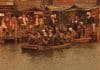
Wakana and Toru also witness the grand boat parade at the Tenjin Matsuri festival at Tenjin Shrine in Kita Ward.
The movie takes you all over Osaka, from dirty backstreets to some of the most famous sites. At the same time, it illuminates the back stages of Osaka’s Manzai comedy, providing some real insights in very entertaining form.